
Radio Control: Sport Aerobatics
Ron Van Putte
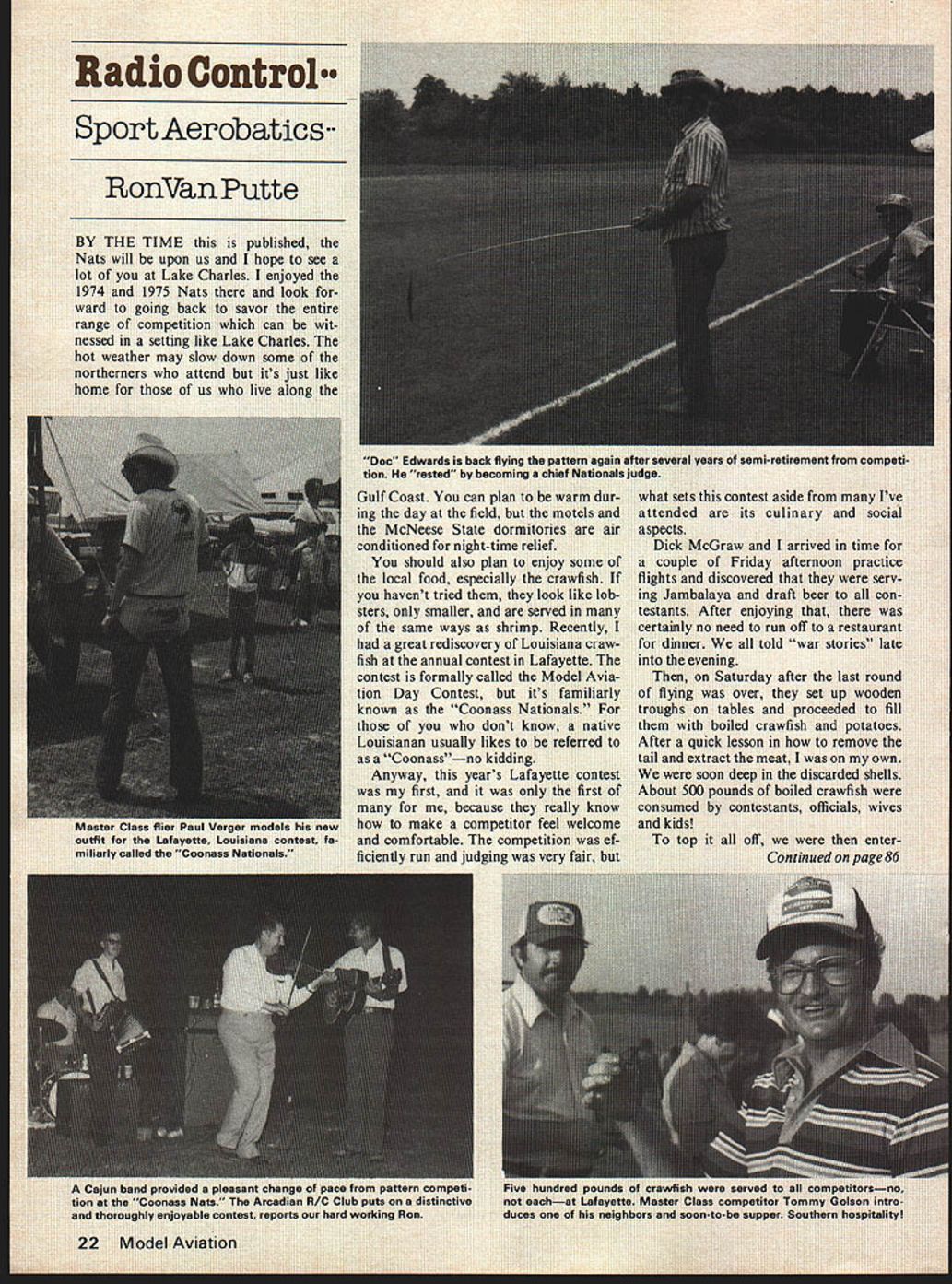
BY THE TIME this is published, the Nats will be upon us and I hope to see a lot of you at Lake Charles. I enjoyed the 1974 and 1975 Nats there and look forward to going back to savor the entire range of competition which can be witnessed in a setting like Lake Charles. The hot weather may slow down some of the northerners who attend but it's just like home for those of us who live along the Gulf Coast. You can plan to be warm during the day at the field, but the motels and the McNeese State dormitories are air conditioned for night-time relief.
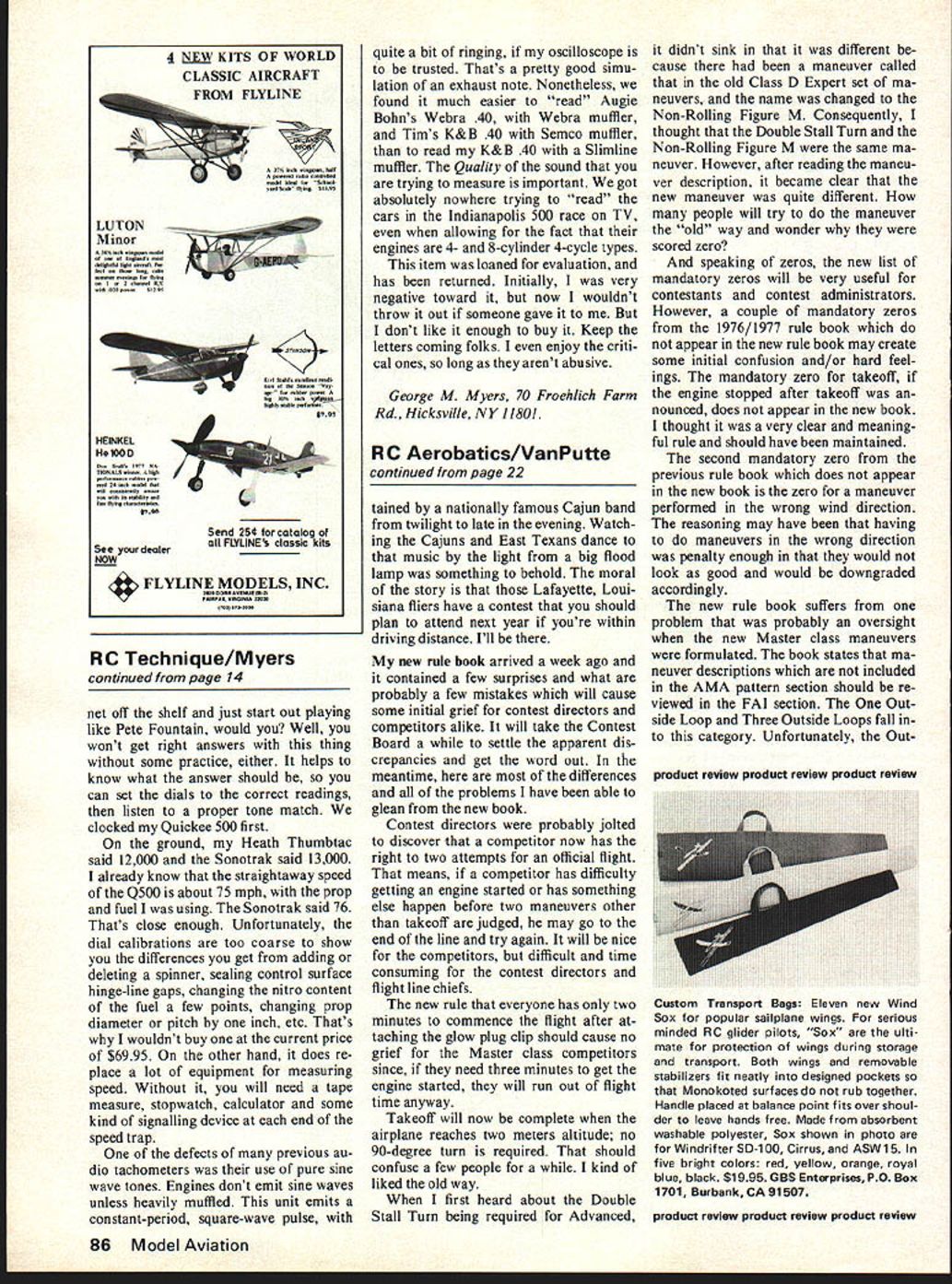
You should also plan to enjoy some of the local food, especially the crawfish. If you haven't tried them, they look like lobsters, only smaller, and are served in many of the same ways as shrimp. Recently, I had a great rediscovery of Louisiana crawfish at the annual contest in Lafayette. The contest is formally called the Model Aviation Day Contest, but it's familiarly known as the "Coonass Nationals." For those of you who don't know, a native Louisianan usually likes to be referred to as a "Coonass"—no kidding.
Anyway, this year's Lafayette contest was my first, and it was only the first of many for me, because they really know how to make a competitor feel welcome and comfortable. The competition was efficiently run and judging was very fair, but what sets this contest aside from many I've attended are its culinary and social aspects.
Dick McGraw and I arrived in time for a couple of Friday afternoon practice flights and discovered that they were serving Jambalaya and draft beer to all contestants. After enjoying that, there was certainly no need to run off to a restaurant for dinner. We all told "war stories" late into the evening.
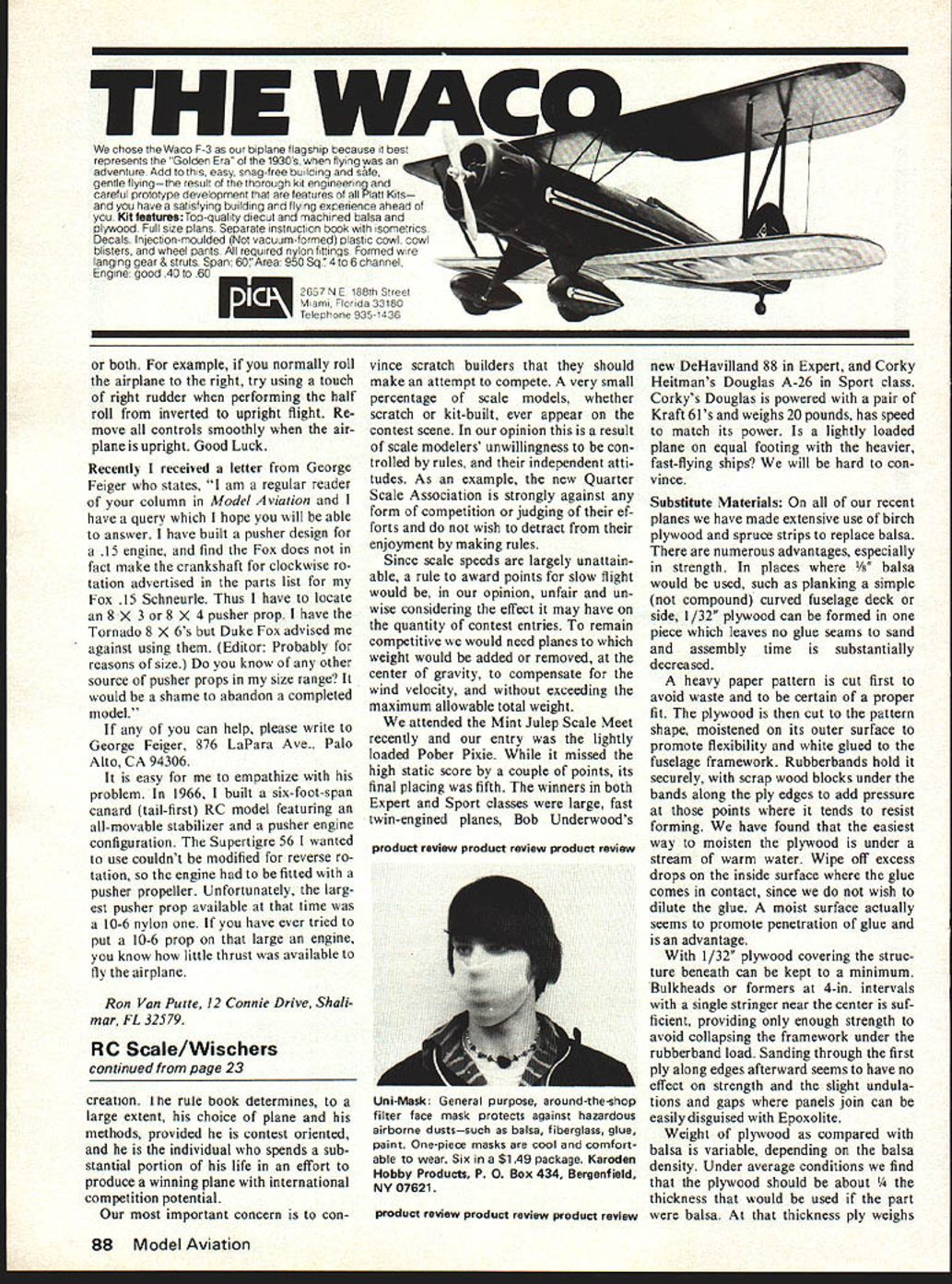
Then, on Saturday after the last round of flying was over, they set up wooden troughs on tables and proceeded to fill them with boiled crawfish and potatoes. After a quick lesson in how to remove the tail and extract the meat, I was on my own. We were soon deep in the discarded shells. About 500 pounds of boiled crawfish were consumed by contestants, officials, wives and kids!
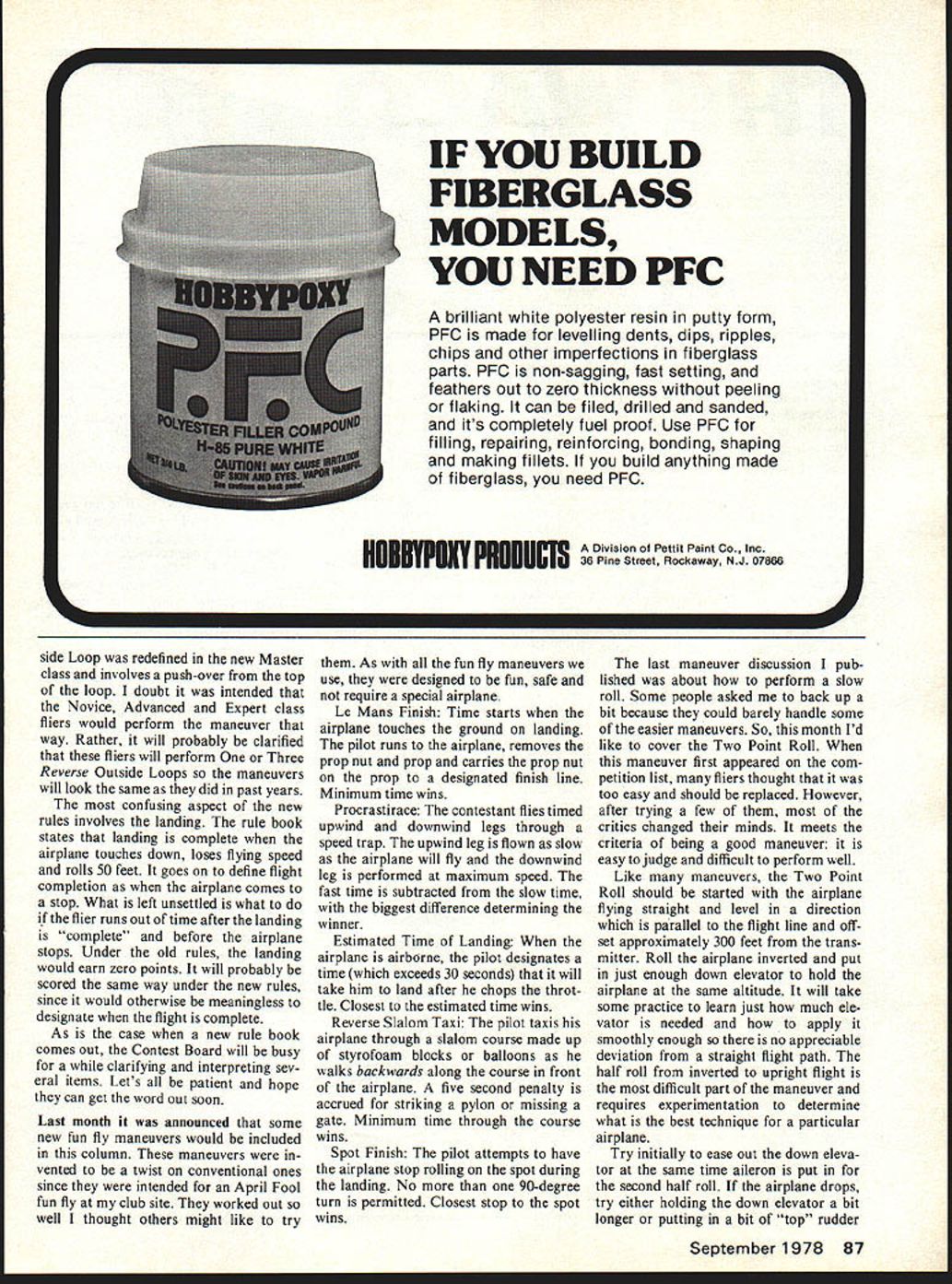
To top it all off, we were then entertained by a nationally famous Cajun band from twilight to late in the evening. Watching the Cajuns and East Texans dance to that music by the light from a big flood lamp was something to behold. The moral of the story is that those Lafayette, Louisiana fliers have a contest that you should plan to attend next year if you're within driving distance. I'll be there.
My new rule book arrived a week ago and it contained a few surprises and what are probably a few mistakes which will cause some initial grief for contest directors and competitors alike. It will take the Contest Board a while to settle the apparent discrepancies and get the word out. In the meantime, here are most of the differences and all of the problems I have been able to glean from the new book.
Contest directors were probably jolted to discover that a competitor now has the right to two attempts for an official flight. That means, if a competitor has difficulty getting an engine started or has something else happen before two maneuvers other than takeoff are judged, he may go to the end of the line and try again. It will be nice for the competitors, but difficult and time consuming for the contest directors and flight line chiefs.
The new rule that everyone has only two minutes to commence the flight after attaching the glow plug clip should cause no grief for the Master class competitors since, if they need three minutes to get the engine started, they will run out of flight time anyway.
Takeoff will now be complete when the airplane reaches two meters altitude; no 90-degree turn is required. That should confuse a few people for a while. I kind of liked the old way.
When I first heard about the Double Stall Turn being required for Advanced, it didn't sink in that it was different because there had been a maneuver called that in the old Class D Expert set of maneuvers, and the name was changed to the Non-Rolling Figure M. Consequently, I thought that the Double Stall Turn and the Non-Rolling Figure M were the same maneuver. However, after reading the maneuver description, it became clear that the new maneuver was quite different. How many people will try to do the maneuver the "old" way and wonder why they were scored zero?
And speaking of zeros, the new list of mandatory zeros will be very useful for contestants and contest administrators. However, a couple of mandatory zeros from the 1976/1977 rule book which do not appear in the new rule book may create some initial confusion and/or hard feelings. The mandatory zero for takeoff, if the engine stopped after takeoff was announced, does not appear in the new book. I thought it was a very clear and meaningful rule and should have been maintained.
The second mandatory zero from the previous rule book which does not appear in the new book is the zero for a maneuver performed in the wrong direction. The reasoning may have been that having to do maneuvers in the wrong direction was penalty enough in that they would not look as good and would be downgraded accordingly.
The new rule book suffers from one problem that was probably an oversight when the new Master class maneuvers were formulated. The book states that maneuvers which are not included in the AMA pattern section should be reviewed in the FAI section. The One Outside Loop and Three Outside Loops fall into this category. Unfortunately, the Out- side Loop was redefined in the new Master class and involves a push-over from the top of the loop. I doubt it was intended that the Novice, Advanced and Expert class fliers would perform the maneuver that way. Rather, it will probably be clarified that these fliers will perform One or Three Reverse Outside Loops so the maneuvers will look the same as they did in past years.
The most confusing aspect of the new rules involves the landing. The rule book states that landing is complete when the airplane touches down, loses flying speed and rolls 50 feet. It goes on to define flight completion as when the airplane comes to a stop. What is left unsettled is what to do if the flier runs out of time after the landing is "complete" and before the airplane stops. Under the old rules, the landing would earn zero points. It will probably be scored the same way under the new rules, since it would otherwise be meaningless to designate when the flight is complete.
As is the case when a new rule book comes out, the Contest Board will be busy for a while clarifying and interpreting several items. Let's all be patient and hope they can get the word out soon.
Last month it was announced that some new fun fly maneuvers would be included in this column. These maneuvers were invented to be a twist on conventional ones since they were intended for an April Fool fun fly at my club site. They worked out so well I thought others might like to try them. As with all the fun fly maneuvers we use, they were designed to be fun, safe and not require a special airplane.
Le Mans Finish: Time starts when the airplane touches the ground on landing. The pilot runs to the airplane, removes the prop nut and prop and carries the prop nut on the prop to a designated finish line. Minimum time wins.
Procrastinate: The contestant flies timed upwind and downwind legs through a speed trap. The upwind leg is flown as slow as the airplane will fly and the downwind leg is performed at maximum speed. The fast time is subtracted from the slow time, with the biggest difference determining the winner.
Estimated Time of Landing: When the airplane is airborne, the pilot designates a time (which exceeds 30 seconds) that it will take him to land after he chops the throttle. Closest to the estimated time wins.
Reverse Slalom Taxi: The pilot taxis his airplane through a slalom course made up of styrofoam blocks or balloons as he walks backwards along the course in front of the airplane. A five second penalty is accrued for striking a pylon or missing a gate. Minimum time through the course wins.
Spot Finish: The pilot attempts to have the airplane stop rolling on the spot during the landing. No more than one 90-degree turn is permitted. Closest stop to the spot wins.
The last maneuver discussion I published was about how to perform a slow roll. Some people asked me to back up a bit because they could barely handle some of the easier maneuvers. So, this month I'd like to cover the Two Point Roll. When this maneuver first appeared on the competition list, many fliers thought that it was too easy and should be replaced. However, after trying a few of them, most of the critics changed their minds. It meets the criteria of being a good maneuver: it is easy to judge and difficult to perform well.
Like many maneuvers, the Two Point Roll should be started with the airplane flying straight and level in a direction which is parallel to the flight line and offset approximately 300 feet from the transmitter. Roll the airplane inverted and put in just enough down elevator to hold the airplane at the same altitude. It will take some practice to learn just how much elevator is needed and how to apply it smoothly enough so there is no appreciable deviation from a straight flight path. The half roll from inverted to upright flight is the most difficult part of the maneuver and requires experimentation to determine what is the best technique for a particular airplane.
Try initially to ease out the down elevator at the same time aileron is put in for the second half roll. If the airplane drops, try either holding the down elevator a bit longer or putting in a bit of "top" rudder or both. For example, if you normally roll the airplane to the right, try using a touch of right rudder when performing the half roll from inverted to upright flight. Remove all controls smoothly when the airplane is upright. Good Luck.
Transcribed from original scans by AI. Minor OCR errors may remain.

