
Radio Control: Sport Aerobatics
Ron Van Putte
RECENTLY I began a class for fellow club members on how to fly aerobatic pattern maneuvers. The class started with a discussion of the proper airplane setup for the Novice pattern. It soon became apparent that many fliers have difficulty with flying in general, and pattern flying in particular, because of poor airplane setup.
Typically, airplanes have control deflections far in excess of what is required for performing most maneuvers. I don't know if they are set up this way to ensure that adequate control power will be available for emergency situations, or if the builder copied the local "hot dog" flier who has an airplane which can perform snap rolls immediately after takeoff. Nevertheless, what follows are my opinions on how an airplane should be rigged for the Novice pattern.
Landing gear / wheel combination
For a tricycle gear installation, adjust the landing gear and wheel combination so the airplane will sit on the ground in a level attitude. If the nose of the airplane is tipped down, the airplane will not take off smoothly. As the airplane accelerates on takeoff, wing lift will be directed downward, causing a nose-down pitching moment about the main gear which increases with airspeed. The excessive up-elevator required to "un-stick" the nose will cause the airplane to pitch up rapidly when it finally begins to rotate, and the airplane will leap into the air at too high a climb angle.
Conversely, if the gear is rigged so the nose sits up too high, the airplane will probably take off prematurely and may perform the classic "snap roll and crash" maneuver.
Many fliers use excessive nose-gear steering. Pattern airplanes are not meant to turn on the ground; nose-gear steering should only be enough to make the airplane go in a straight line on takeoff and landing. In a pattern contest the caller carries the airplane to the takeoff position and picks it up after the landing, but outside of contests we tend to give a bit more steering for convenience when taxiing. Generally, use the longest steering arm and the least amount of rudder output practical. If you can see more than barely detectable nose-gear movement, it's probably too much.
Rudder
Rudder control deflections in excess of about 35 degrees do little more than increase drag. For the Novice pattern, set the maximum rudder deflection to about 35 degrees and leave it there. Most well-known pattern airplanes have sufficiently large rudders; if your airplane lacks directional control with 35 degrees of rudder, the airplane needs a bigger rudder.
Aileron
Adjust aileron deflection so the airplane performs three axial rolls in five seconds when the stick is held to the stops. Have a friend time the maneuver while you call "start" and "stop." After setting the maximum aileron deflection to obtain three rolls in five seconds, the airplane will have adequate rolling power for all but the "snap" maneuvers. Pilots who want extra aileron for snaps will usually have a dual-rate aileron switch anyway.
Elevator
Elevator deflection is the most difficult to adjust. For most Novice-pattern airplanes, the maximum elevator deflection required is the amount necessary to flare for landing. Adjust the elevator so it provides enough deflection, plus a small reserve, to rotate to the landing attitude. Have a friend watch your elevator-stick position as you land and adjust so you have about a 25 percent reserve. More elevator is needed for spins, but since the Novice pattern doesn't include spins there's no reason to compromise the other maneuvers to retain spin capability.
If you adjust the control deflections as indicated, your flying will smooth out and the maneuvers will look much better. Increased smoothness will improve your confidence, and confidence is one of the most important factors in flying aerobatics.
Recent loss and rebuilding
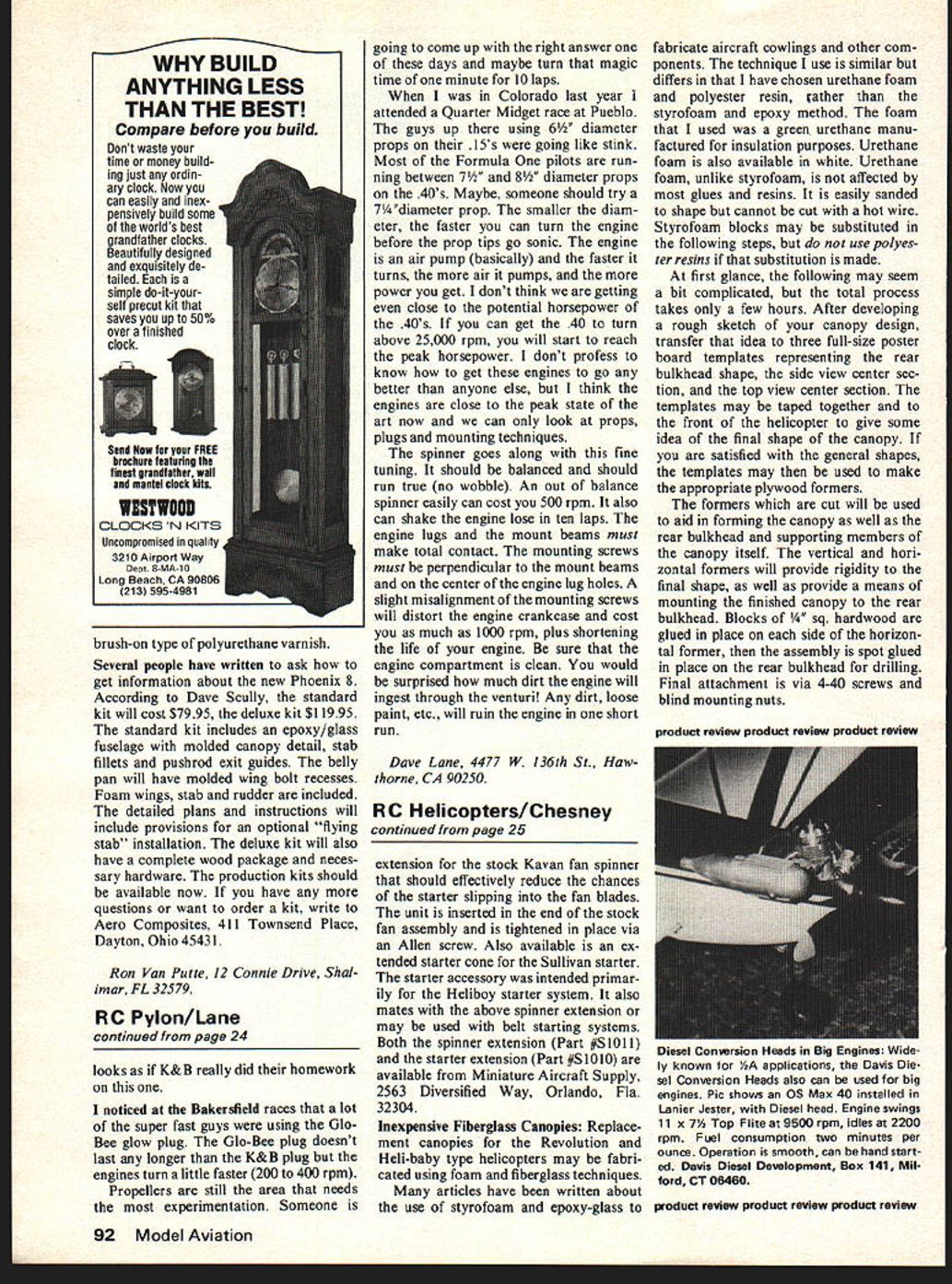
Friends mourn the death of a fine old lady. She was born during the first week of October 1974 and died the second week of June 1978. My venerable Phoenix VI will not rise from the ashes after a crash caused by a mid-air collision at the Huntsville, Alabama contest on June 11. Jim Ray, from Decatur, Alabama, who flew the other airplane, became an Ace that day. It was the fifth mid-air collision in which Jim had been involved where the other airplane was destroyed and he was able to land his.
Every cloud is supposed to have a silver lining, but I'm hard pressed to discover one just now since I'm madly building a new airplane to use at the Nats. I'm hoping my new Phoenix is at least as good as the old one. It will definitely be mechanically better, since there will be some new techniques involved that should make it a sounder airplane.
Bonding lightweight fiberglass cloth to wing skins
I tried something new that had been rattling around in my "ought to try sometime" file. After the wing skin had been prepared for covering a complete wing panel (both sides), I bonded lightweight fiberglass cloth to the outside of the skin using Southern R/C Products Epoxy Kit. The cloth was smoothed on the wing skin and mixed epoxy (thinned slightly with isopropyl alcohol) was brushed through it, taking care to keep out wrinkles. The entire skin was then rolled with toilet tissue (a broomstick handle through the center of the tube). As tissue became soaked with epoxy it was removed and discarded.
The glass cloth bonded perfectly to the balsa wing skin and is virtually impossible to see from more than a foot or so away. The wing skin was much easier to bond to the core because there was no tendency for the skin to crack when it was rolled around the leading edge. You can imagine how much stronger the wing panel is, especially in the area around the retractable landing gear. Although I haven't painted the wing yet, it should be much easier to fill, resulting in very little weight buildup due to the glass cloth.
Shulman System of Contest Management
There are some good ideas about pattern contests that have been around for a long time. Many years ago Leon Shulman developed techniques to speed up and improve pattern contests and calls them the Shulman System of Contest Management. He offers a reprint of the article of the same title that appeared in the April 1971 issue of Radio Control Modeler magazine to anyone who sends him a self-addressed, stamped envelope. Write to: Leon Shulman, 173 Essex Avenue, Metuchen, New Jersey 08840.
Polyurethane varnish and styrofoam cores
Here's an update on the use of polyurethane varnish to coat wing skins and styrofoam cores prior to using contact cement. I received a letter from Louie Higgins of Adelphi, Maryland, who wrote: "Like you, I've applied the brush-on type of polyurethane varnish to just about every type of foam there is with nary a problem. However, I have heard of people using the spray type and having it melt the foam. I guess it must be the propellant that does the damage."
That could be the case, because most spray contact-cement products warn against covering the wing too soon after spraying, due to damage that the propellant can cause to styrofoam. To be on the safe side, I plan to stick with the brush-on type.
Transcribed from original scans by AI. Minor OCR errors may remain.

