

Radio Control: Sport Aerobatics
Ron Van Putte
Product evaluations and editorial philosophy
Product evaluations are a sticky subject with magazines. The magazine staff is reluctant to print a critical review of one of their advertisers' products. At the same time, columnists shouldn't be expected to "rubber stamp" a rave review written by an advertiser.
Several years ago all magazines had the philosophy that they would only publish favorable product evaluations. Then along came the critical reviews in Radio Control Modeler magazine. Several manufacturers improved their products after a poor rating was published. Other magazines subsequently published negative but fair product reports and caused product improvement. On the other hand, some manufacturers did stop advertising in magazines critical to their products.
Several Model Aviation columnists, including myself, perform product evaluations and report on them. I am proud to say that the magazine prints both favorable and unfavorable product reviews as long as the evaluations are honestly performed and the review will benefit the readers.
My personal philosophy is that a product received from a manufacturer deserves a fair, complete evaluation and review, reporting both the favorable and unfavorable aspects. I think it benefits both readers and manufacturers to handle product reviews that way so that a strongly favorable review really means something.
Royal Pro Tach — kit evaluation
With the above in mind, I'd like to report on the Royal Pro Tach. Since assembling electronic kits is a hobby of mine and my friends know me to be frugal (my enemies call me a tightwad), I chose to purchase and assemble the kit version of the tachometer.
This is not a new product. The article on kit assembly originally appeared in the July 1975 RCM. However, recent comments from other modelers make it apparent that it is not well known to the average flier.
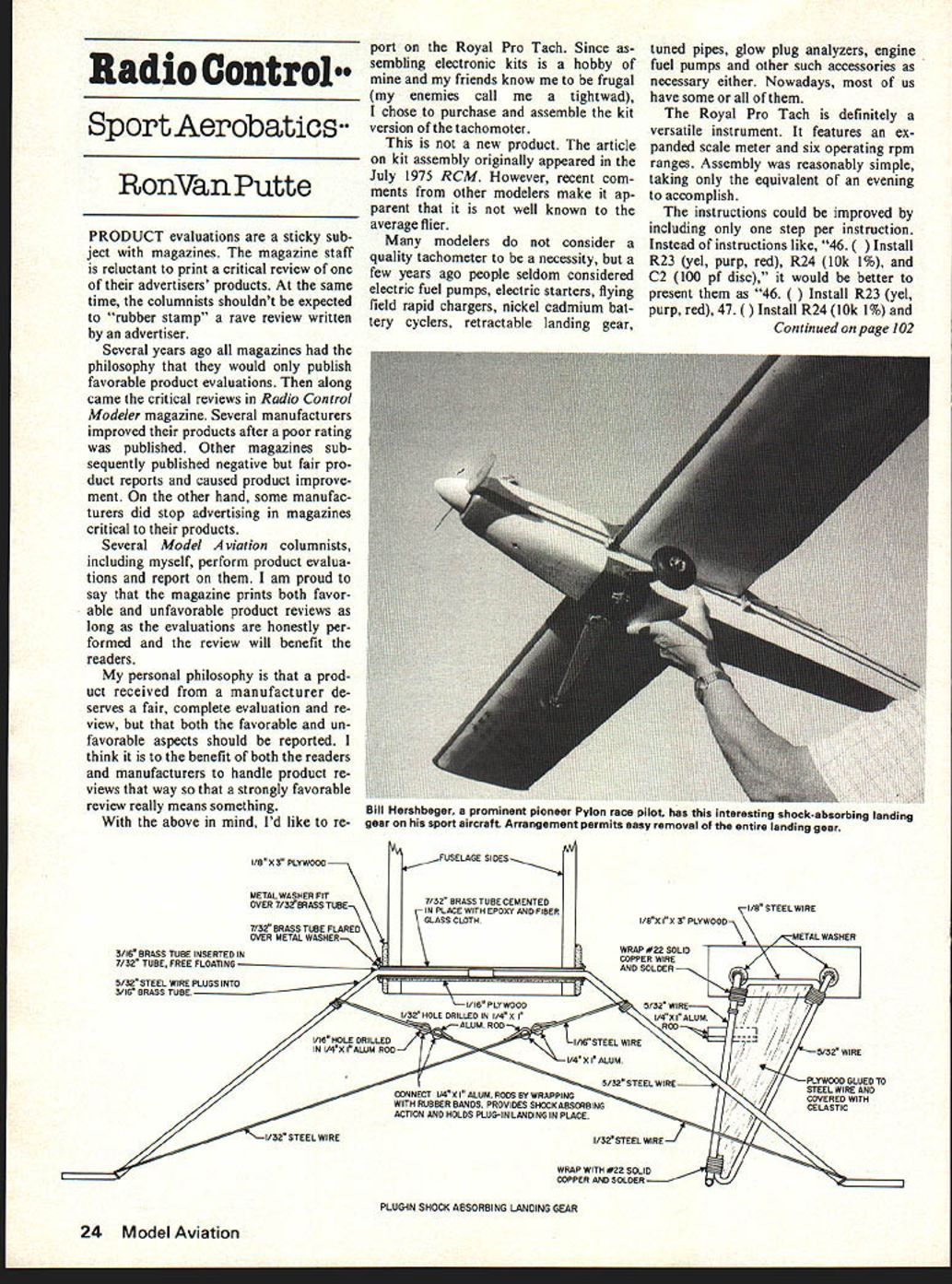
Many modelers do not consider a quality tachometer to be a necessity, but a few years ago people seldom considered electric fuel pumps, electric starters, flying field rapid chargers, nickel-cadmium battery cyclers, retractable landing gear, tuned pipes, glow plug analyzers, engine fuel pumps and other such accessories as necessary either. Nowadays, most of us have some or all of them.
The Royal Pro Tach is definitely a versatile instrument. It features an expanded-scale meter and six operating rpm ranges. Assembly was reasonably simple, taking only the equivalent of an evening to accomplish.
The instructions could be improved by including only one step per instruction. Instead of combined instructions such as: "46. ( ) Install R23 (yellow, purple, red), R24 (10k 1%), and C2 (100 pF disc)," it would be better to present them as separate steps:
- Install R23 (yellow, purple, red).
- Install R24 (10k, 1%).
- Install C2 (100 pF disc).
I occasionally lost track in the middle of multi-step instructions and neglected to do one of the steps. Consequently, care needs to be taken. I ended up marking off individual components as they were installed.
As with almost any kit I've ever assembled, there were parts missing. The absence of a transistor and two resistors was aggravating since I was anxious to try out my new toy. However, Royal quickly sent the missing parts when informed.
My Pro Tach works perfectly. To coin a phrase, "It flew right off the drawing board." Calibration was a five-minute job. In short, other than minor changes to the instructions and better quality control of parts packaging, the only improvement to the Royal Pro Tach I can think of is to reduce the $59.95 price tag so that more modelers can afford it.
Letter from Bill Kaiser (San Francisco)
Every once in a while I get a letter from a fellow modeler that makes me envious; such is the case with a letter from Bill Kaiser (San Francisco). Bill has the imagination and versatility which many of us wish we had. Here is Bill's letter:
"At the end of your article in the Sept. '78 issue of Model Aviation you mentioned a 6-foot canard. I have a 6-foot aerobatic canard using Ridge Runner wings and have been flying it for one year now. I also referred to it as having 6-foot wings until someone mentioned to me that I should name the glider 'Two Yard Canard.'
"I fly the glider only off the slope and the horizontal stabilizer in front is 24" wide with the elevator flap being 1 3/4" wide. The front of the stabilizer is rubber-banded and has never been badly damaged.
"I am always looking for something interesting and different to fly off the slope. I have a successful hang-glider Regallo wing made with aluminum tubing and Dacron that has a standard fuselage under it with rudder and elevator. A control bar was attached to the top of the fuselage at regular wing position and the keel at the rear of the Regallo wing was fastened to the top of the strengthened vertical fin. I have a radio-controlled blimp which is 9 feet long and has an electric motor (Radio Shop special) at the rear on a 6-foot fuselage that hangs under the blimp. The electric motor swivels up and down and left and right and the blimp will turn practically around on itself. It goes at a walking speed and the electric motor runs about 45 minutes on a 550 mAh battery pack. Receiver and two servos run off a 450 mAh battery. The electric motor only operates when the transmitter stick is moved up or down. I also have a three-wheeled land sailer with winch, jib, and many sails."
I wrote to Bill requesting additional details and pictures of his fascinating variety of models. I hope you share my anticipation of reading and seeing more from him.
NSRCA and the 1978 Nats
Several people pointed out that the mandatory zero for engine failure after takeoff was announced and had not really been deleted from the published list of mandatory zeros as I alleged in the September issue. The mandatory zero for "Engine not running throughout all maneuvers except Spin, Approach, and Landing" covers the situation of engine failure during takeoff.
Apparently, many people do not know that the 1978 Nats radio control aerobatics events were planned and run by the National Society of Radio Controlled Aerobatics (NSRCA). NSRCA people can take the credit for the best-run RC aerobatics Nats in history. That's not just my opinion either; seasoned Nats competitors were delighted with the improved flight line efficiency and especially with the rapid tabulation and posting of results, which permitted a competitor to see results on the scoreboard within minutes of completion of a flight.
The NSRCA has come a long way in improving aerobatic competition, but we have a long way to go. It is to the advantage of all pattern competitors to be NSRCA members, so I hope that all non-members will send their membership dues to hardworking Mrs. Sally Brown, the NSRCA Secretary/Treasurer, at 8534 Huddleston Dr., Cincinnati, OH 45236. Be sure to list your address and AMA number. Also enclose a check for $6 for 1978. Dues in 1979 will be $10.
If you live in Alabama, Arkansas, Florida, Georgia, Louisiana, Mississippi, or Tennessee and are an NSRCA member, you may be interested to hear that I was just appointed NSRCA Vice President for District 3, which includes those states. Dick McGraw, the former VP, was forced to give up the job for business and health reasons. Please let me hear from you.
Hobby-poxy Formula 3
How does that commercial go? Something like, "With a name like Frizzers, it's got to be good!" Well, with a name like Hobby-poxy, thixotropic epoxy glue, it's got to be good—and it is. Hobby-poxy's new Formula 3 glue is thick and resists running on vertical surfaces. That made it perfect for installing the firewall in my new Phoenix 8 fuselage. The Aero Composites Phoenix 8 fuselage is epoxy/glass construction, and epoxy is recommended rather than polyester glues. Since I have never been happy with mixing different powders with glues to make a paste thick enough to form decent fillets around bulkheads, this new Pettit product was welcome. It works.
Ron Van Putte 12 Connie Drive Shalimar, FL 32579
Transcribed from original scans by AI. Minor OCR errors may remain.

