
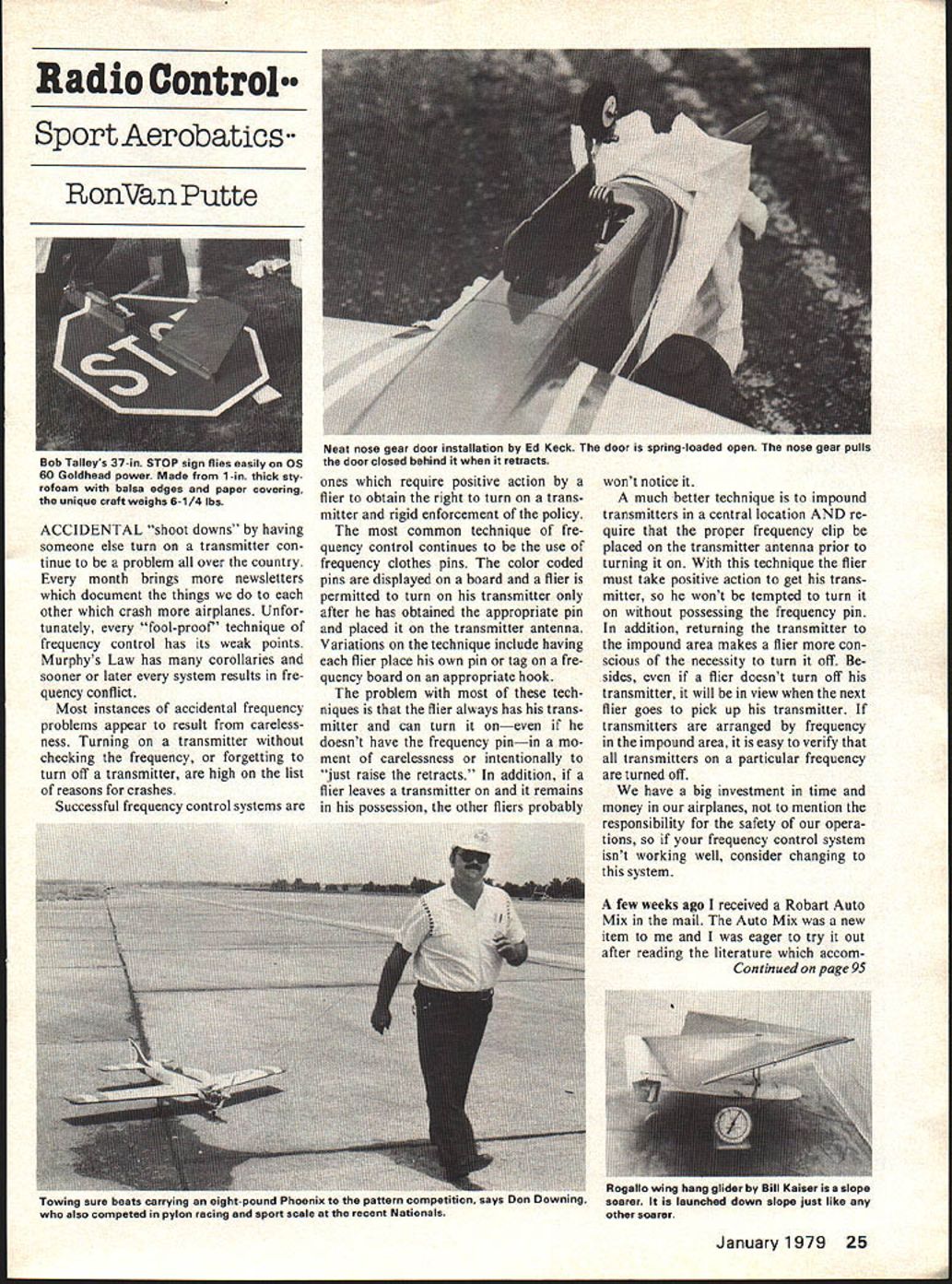
Radio Control: Sport Aerobatics
Ron Van Putte
Frequency Control
Accidental "shoot downs" caused by someone else turning on a transmitter continue to be a problem across the country. Every month brings more newsletters documenting the things we do to each other that crash more airplanes. Unfortunately, every "fool-proof" technique of frequency control has its weak points. Murphy's Law has many corollaries and sooner or later every system results in frequency conflict.
Most instances of accidental frequency problems result from carelessness. Turning on a transmitter without checking the frequency, or forgetting to turn off a transmitter, are high on the list of reasons for crashes.
Successful frequency control systems require positive action by a flier to obtain the right to turn on a transmitter and rigid enforcement of the policy.
The most common technique of frequency control continues to be the use of frequency clothes pins. The color-coded pins are displayed on a board and a flier is permitted to turn on his transmitter only after he has obtained the appropriate pin and placed it on the transmitter antenna. Variations include having each flier place his own pin or tag on a frequency board on an appropriate hook.
The problem with most of these techniques is that the flier always has his transmitter and can turn it on—even if he doesn't have the frequency pin—in a moment of carelessness or intentionally to "just raise the retracts." In addition, if a flier leaves a transmitter on and it remains in his possession, the other fliers probably won't notice it.
A much better technique is to impound transmitters in a central location and require that the proper frequency clip be placed on the transmitter antenna prior to turning it on. With this technique the flier must take positive action to get his transmitter, so he won't be tempted to turn it on without possessing the frequency pin. Returning the transmitter to the impound area also makes a flier more conscious of the necessity to turn it off. Besides, even if a flier doesn't turn off his transmitter, it will be in view when the next flier goes to pick up his transmitter. If transmitters are arranged by frequency in the impound area, it is easy to verify that all transmitters on a particular frequency are turned off.
We have a big investment in time and money in our airplanes, not to mention the responsibility for the safety of our operations. If your frequency control system isn't working well, consider changing to this impound-and-clip system.
Robart Auto Mix
A few weeks ago I received a Robart Auto Mix in the mail. The Auto Mix was new to me and I was eager to try it after reading the literature that accompanied it. The Auto Mix is intended for situations in which excessive fuel is supplied to the engine. This could be the result of too much muffler pressure applied to the fuel tank, a fuel pump set at a pressure that is too high, the use of a fuel pump with a standard carburetor, or other similar situations. The Auto Mix returns excess fuel to the fuel tank. The net result is that the engine "thinks" the tank is located at the Auto Mix.
I use fuel pumps with standard carburetor-equipped engines in my Phoenix 6 airplanes. The Phoenix tank/engine combination, with the high tank and side-mounted engine, results in a tremendous height difference between the centerlines of the tank and the carburetor. Consequently, if an engine is set for good upright operation, it usually leans out severely when the airplane is flown through the inverted parts of maneuvers. The use of a pump with the engine solves that problem. However, it is difficult to adjust fuel pump pressure so that it is high enough to guarantee fuel delivery for all conditions, yet low enough so the needle valve settings are not sensitive. Up to now I have settled for having a little too much pressure and a sensitive needle valve in order to guarantee a reliable supply of fuel.
The Robart Auto Mix has permitted me to enjoy the reliable fuel supply that a pump provides without a correspondingly sensitive needle valve. Contrary to the instructions, I use a three-line system in the tank. The vent/overflow line attaches to the muffler pressure tap. The fill line attaches to the excess fuel return tap of the Auto Mix. The fuel pickup line attaches to a Perry pump inlet tap and subsequently to the Auto Mix. Of course, the Auto Mix outlet attaches to the carburetor. When I called Robart to tell them what I had done, Maynard Shade suggested that the reason the three-line system worked for me is that I used a Perry pump. Presumably, use of the Robart pump would require having a two-line system or plugging the third line.
Filling the tank is a little different from what was done previously. I used to fill the tank through the fill line (surprise!) and cap the line when the tank was full. Now I simply remove the line from the carburetor and fill through it.
In case you hadn't guessed, I am completely satisfied with the Robart Auto Mix and recommend it to anyone with problems similar to those I described.
The Plane Lodged in the Tree Club (Valley Forge)
The pine trees that line the runway my club flies from have claimed their share of hapless airplanes. Since they are technically called slash pines, we have all sorts of local stories about the airplane eater called Slash and his grizzled uncle named Graymoss. This was in the back of my mind as I read a recent Hear Ye newsletter of the Valley Forge Signal Seekers (Pennsylvania), edited by Ray Cummings. Ray described a harrowing experience involving one of the northern variety of airplane eaters. A somewhat edited version follows:
"Did you ever notice that lovely stand of timber that serves so well to mark the line of separation between the Pa. Turnpike and the start of the Park? I'm sure that at one time or another you must have heard their serene message, that quiet resting sound at your back, when you are on the flight line doing your thing. They are silent witnesses to your performance... quietly waiting... patiently waiting... always waiting!
"As long as the prevailing winds do their thing, the tall trees seem preoccupied with other activities and rarely call attention to their enduring community. However, let the winds shift to blowing in your face, as they sometimes do, and then the stage is set for them to adopt a new personality—somewhat like a 'Dr. Jekyll and Mr. Hyde.' A more sinister partnership could hardly be contrived; the two, acting in collusion, pose a real threat to the unwary. As the Great White is to Amity, our set of Jaws comes disguised under a cover of green.
"If you gather from this prologue that I am the latest member of the Plane Lodged in the Tree Club, score yourself an 'A' for observation and move to the head of the class. It's nice to know, however, that I am in such distinguished company. Discussing this lamentable situation with club veterans, it seems to be a problem that most of them have experienced in their pursuit of this unpredictable hobby of ours.
"At the very least, it is a challenge to the imagination and seems to provoke an outpouring of interesting solutions. To wit: consider these 'gems' which were offered by various members.
- Call the Valley Forge Fire Company—for a $50.00 donation or so they will come and retrieve the stranded bird.
- Get a bow and arrow and shoot a line to bring it down that way.
- Rent some climbing equipment and climb the tree yourself (100' plus, mind you).
"Having witnessed the fire company retrieve an Aeromaster with ladders, poles and hooks, I decided against this method.
"The bow-and-arrow school sounds like Rube Goldberg to me. At best what was left of the plane would display the scars of the fall of 100' plus all the tugging of lines, etc., assuming that one could even make contact in the first place. Finally, the rental approach merely implies that it is little or nothing to don climbing equipment and pop up a 100' tree and safely bring yourself and the plane down in one piece without incident. Forget it, brother! I may have been dumb enough to have put the plane in the tree to begin with, but I'm not going to compound the felony by getting myself up there to show the world what a complete ass I am! Even if I lost plane, radio, and engine, it would not make a dent in the eventual cost in doctor and hospital bills that could be anticipated by trying to get it down by doing it myself.
"Of course, add to all this the fact that it is now 9 p.m. on Friday evening of the July 4th holiday weekend, just to round out the picture. When I got home, I started calling tree surgeons and discovered a lot of them to be phantoms with disconnected phone lines or prerecorded messages to imply that they were no longer in business. What few I could make contact with, considering the hour, were not able to round up their men until four or five days later. Try telling a bored female voice (answering service) that the emergency in question is not on a tree located on your property but in the woods somewhere in Valley Forge National Park! The stony silence that results from that one can almost be measured over the phone cable. I gave up on Friday evening at 11 p.m. and heard AccuWeather state that the weekend was going to be wet and stormy beginning on Sunday and continuing. All of this meant that I had to get it down on Saturday or write it all off as a goner.
"Faced with the necessity of having to act the next morning, I got up early and started calling names out of the Yellow Pages. As luck would have it, I struck pay dirt on my first call. My story has a happy ending, thanks to the president of a large landscaping firm who was sympathetic to the needs of fliers, having acquired a private pilot's license himself.
"I called him at 8 a.m. Saturday and described the situation. He agreed to come out immediately and look it over. I promptly drove to the field and found him waiting for me when I arrived. He brought along his spikes and line and said he would give it a try, although his technique was a bit rusty due to the fact that he does not climb that much anymore. Well, one would hardly know it, for he popped right up the tree, attached the line to the plane, lowered it to me, slung a harness for himself with the line, and descended safely to the ground, all in about fifteen minutes from start to finish. I was amazed that this difficult job could be made to look so easy and brought off so fast. If you have a tough job, get a pro. The results are worth it in the end."
I'm sure you will agree that Ray's article was worth reading, too.
Ron Van Putte 12 Connie Drive Shalimar, FL 32579
Transcribed from original scans by AI. Minor OCR errors may remain.

