
Radio Control
Sport Aerobatics
Ron Van Putte
LATELY there has been a lot of discussion about providing more incentive to the beginning pattern flier. There are several obstacles to new pattern competitors and many are unwilling to overcome all of them. The recent reduction in attendance at pattern contests testifies to the need to consider changes which can be made to encourage new pattern fliers.
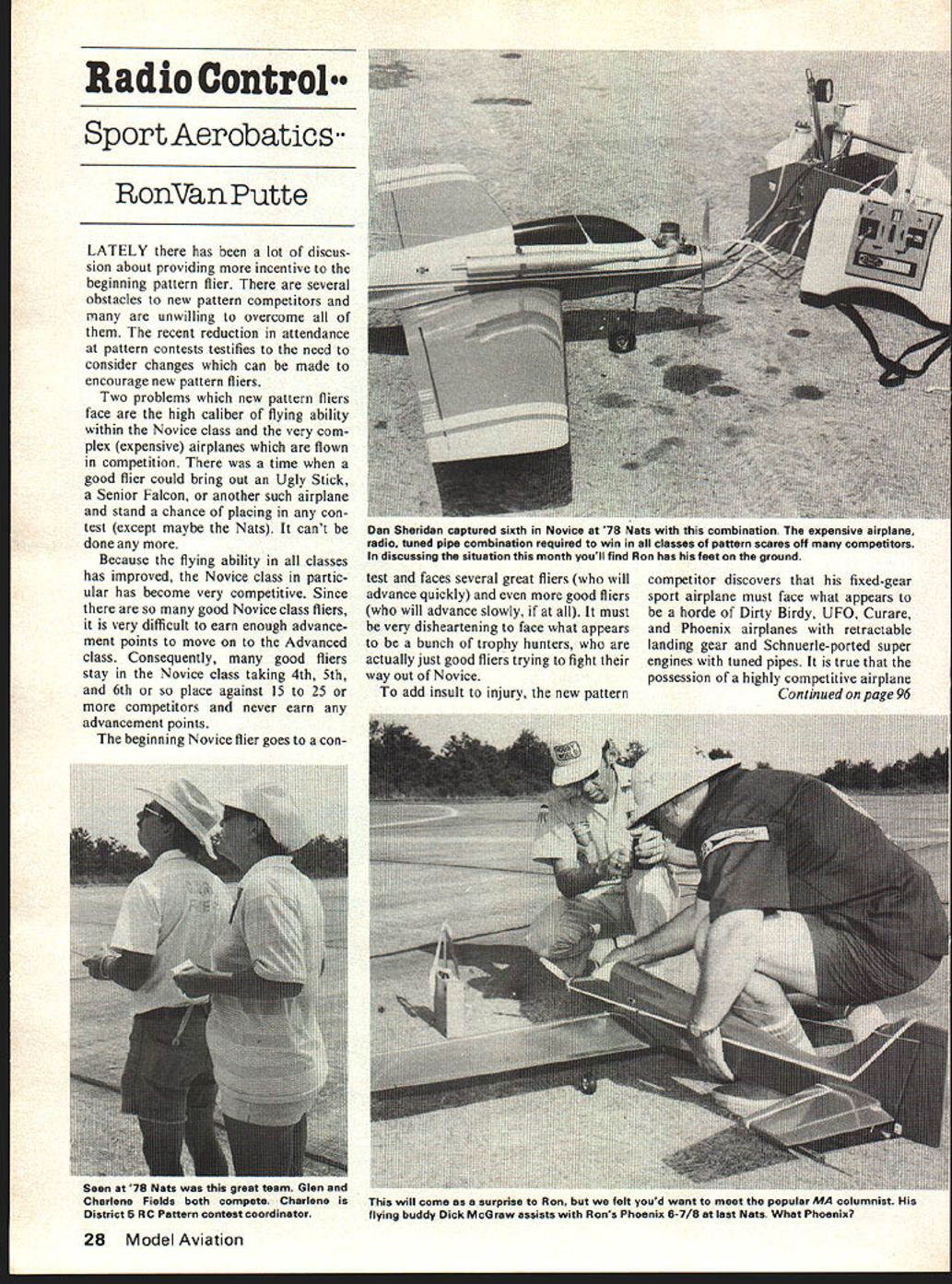
Two problems which new pattern fliers face are the high caliber of flying ability within the Novice class and the very complex (expensive) airplanes which are flown in competition. There was a time when a good flier could bring out an Ugly Stick, a Senior Falcon, or another such airplane and stand a chance of placing in any contest (except maybe the Nats). It can't be done any more.
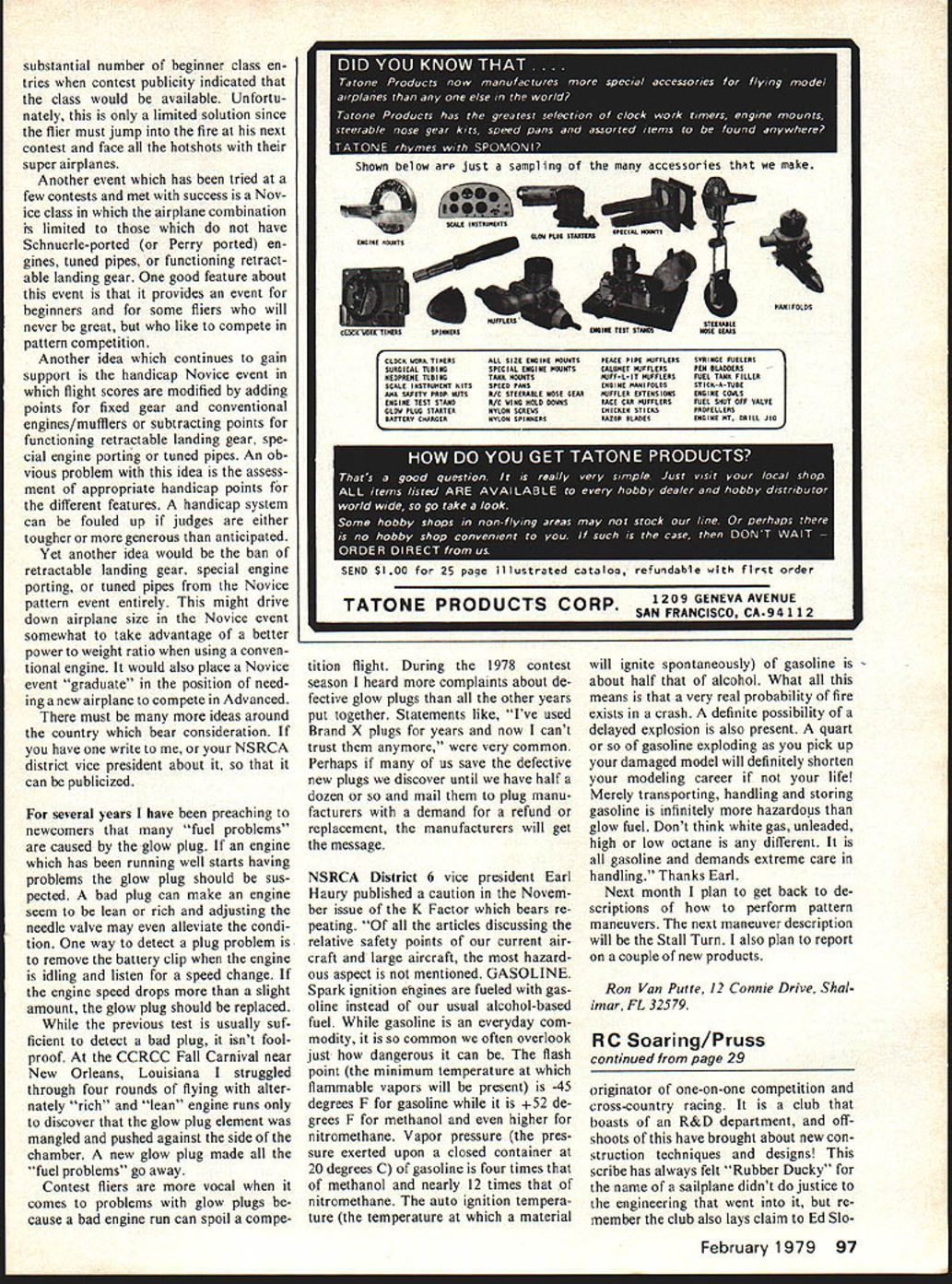
Because the flying ability in all classes has improved, the Novice class in particular has become very competitive. Since there are so many good Novice class fliers, it is very difficult to earn enough advancement points to move on to the Advanced class. Consequently, many good fliers stay in the Novice class taking 4th, 5th, 6th or so place against 15 to 25 or more competitors and never earn any advancement points.
The beginning Novice flier goes to a contest and faces several great fliers (who will advance quickly) and even more good fliers (who will advance slowly, if at all). It must be very disheartening to face what appears to be a bunch of trophy hunters, who are actually just good fliers trying to fight their way out of Novice.
To add insult to injury, the new pattern competitor discovers that his fixed-gear sport airplane must face what appears to be a horde of Dirty Birdy, UFO, Curare, and Phoenix airplanes with retractable landing gear and Schnuerle-ported super engines with tuned pipes. It is true that the possession of a highly competitive airplane does not guarantee a Novice pattern trophy, but there are enough good fliers around who do have them to make it very difficult for even a great flier to win with a sport airplane.
Possible approaches to alleviate the situation
There are several ways to proceed in alleviating the situation and all of them have their pitfalls. It will probably take a grass-roots movement to have much of an effect on pattern flying since major changes in the rules are very infrequent unless there is a widespread demonstration of the need and desire to change them. Contest Directors will have to make decisions to offer competition in line with proposed rule changes and see how they work out. The National Society of Radio Controlled Aerobatics (NSRCA) can be a strong factor in proposed rule changes. The NSRCA district vice presidents should be given feedback on proposed changes so that the issues can be aired in the K Factor, the monthly newsletter of the NSRCA. If you aren't already an NSRCA member, send $10 for 1979 dues to Mrs. Sally Brown, Secretary-Treasurer; 8534 Huddleston Drive, Cincinnati, OH 45236.
What has been tried:
- A special beginner Novice class. Many large contests had a substantial number of beginner class entries when contest publicity indicated the class would be available. Unfortunately, this is only a limited solution since the flier must jump into the fire at his next contest and face all the hotshots with their super airplanes.
- A Novice class limited by airplane combination: no Schnuerle-ported (or Perry-ported) engines, no tuned pipes, and no functioning retractable landing gear. One good feature about this event is that it provides an event for beginners and for some fliers who will never be great but who like to compete in pattern competition.
- A handicap Novice event in which flight scores are modified by adding points for fixed gear and conventional engines/mufflers or subtracting points for functioning retractable landing gear, special engine porting, or tuned pipes. An obvious problem with this idea is the assessment of appropriate handicap points for the different features. A handicap system can be fouled up if judges are either tougher or more generous than anticipated.
- A ban of retractable landing gear, special engine porting, or tuned pipes from the Novice pattern event entirely. This might drive down airplane size in the Novice event somewhat to take advantage of a better power-to-weight ratio when using a conventional engine. It would also place a Novice event "graduate" in the position of needing a new airplane to compete in Advanced.
There must be many more ideas around the country which bear consideration. If you have one, write to me or your NSRCA district vice president about it so that it can be publicized.
Glow plug advice
For several years I have been preaching to newcomers that many "fuel problems" are caused by the glow plug. If an engine which has been running well starts having problems the glow plug should be suspected. A bad plug can make an engine seem to be lean or rich and adjusting the needle valve may even alleviate the condition. One way to detect a plug problem is to remove the battery clip when the engine is idling and listen for a speed change. If the engine speed drops more than a slight amount, the glow plug should be replaced.
While the previous test is usually sufficient to detect a bad plug, it isn't foolproof. At the CCRCC Fall Carnival near New Orleans, Louisiana, I struggled through four rounds of flying with alternately "rich" and "lean" engine runs only to discover that the glow plug element was mangled and pushed against the side of the chamber. A new glow plug made all the "fuel problems" go away.
Contest fliers are more vocal when it comes to problems with glow plugs because a bad engine run can spoil a competition flight. During the 1978 contest season I heard more complaints about defective glow plugs than all the other years put together. Statements like, "I've used Brand X plugs for years and now I can't trust them anymore," were very common. Perhaps if many of us save the defective new plugs we discover until we have half a dozen or so and mail them to plug manufacturers with a demand for a refund or replacement, the manufacturers will get the message.
Gasoline safety
NSRCA District 6 vice president Earl Haury published a caution in the November issue of the K Factor which bears repeating:
"Of all the articles discussing the relative safety points of our current aircraft and large aircraft, the most hazardous aspect is not mentioned. GASOLINE. Spark ignition engines are fueled with gasoline instead of our usual alcohol-based fuel. While gasoline is an everyday commodity, it is so common we often overlook just how dangerous it can be. The flash point (the minimum temperature at which flammable vapors will be present) is -45 degrees F for gasoline while it is +52 degrees F for methanol and even higher for nitromethane. Vapor pressure (the pressure exerted upon a closed container at 20 degrees C) of gasoline is four times that of methanol and nearly 12 times that of nitromethane. The auto ignition temperature (the temperature at which a material will ignite spontaneously) of gasoline is about half that of alcohol. What all this means is that a very real probability of fire exists in a crash. A definite possibility of a delayed explosion is also present. A quart or so of gasoline exploding as you pick up your damaged model will definitely shorten your modeling career if not your life! Merely transporting, handling and storing gasoline is infinitely more hazardous than glow fuel. Don't think white gas, unleaded, high or low octane is any different. It is all gasoline and demands extreme care in handling."
Thanks, Earl.
Looking ahead
Next month I plan to get back to descriptions of how to perform pattern maneuvers. The next maneuver description will be the Stall Turn. I also plan to report on a couple of new products.
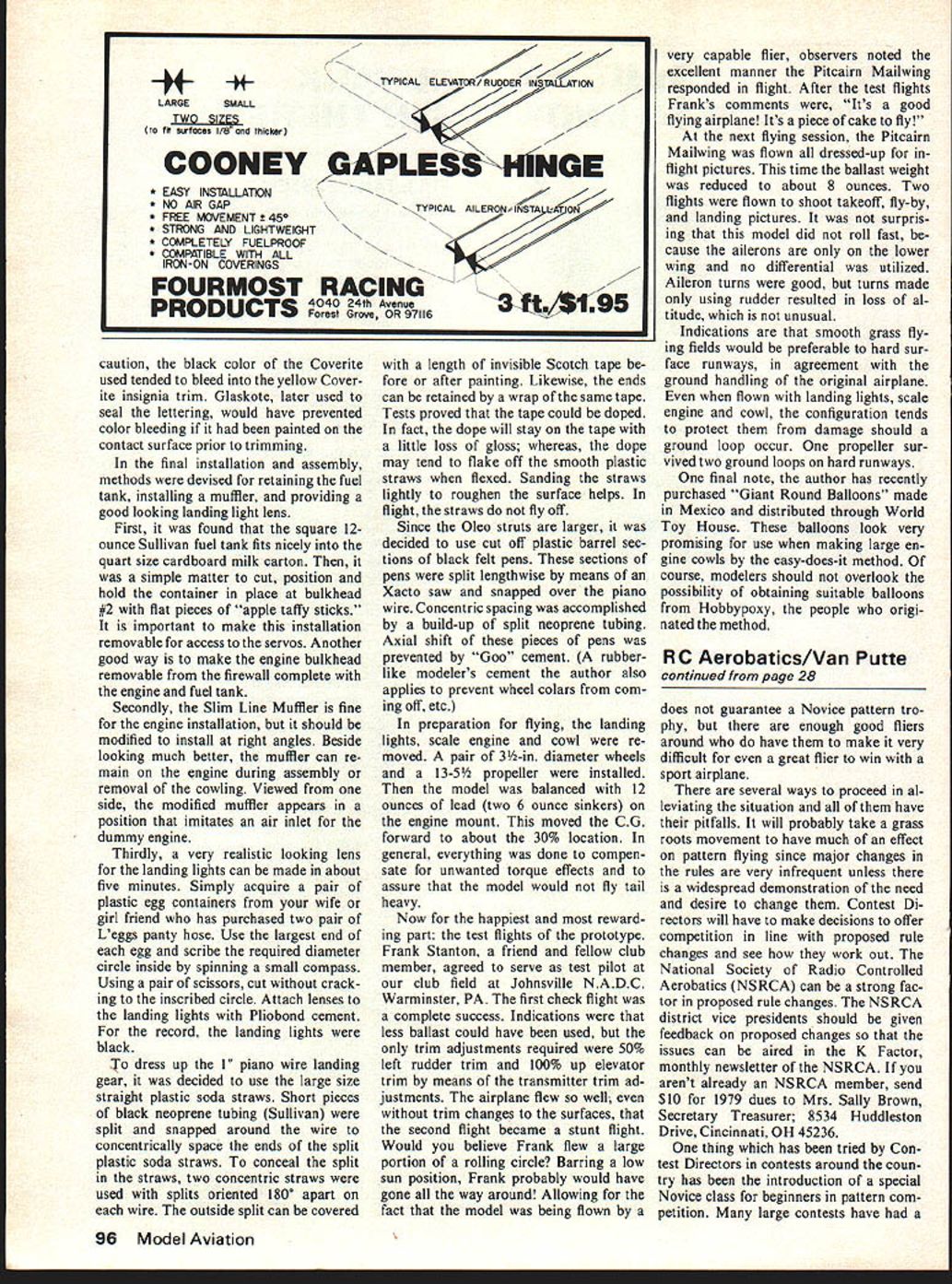
Ron Van Putte 12 Connie Drive Shalimar, FL 32579
Transcribed from original scans by AI. Minor OCR errors may remain.

