
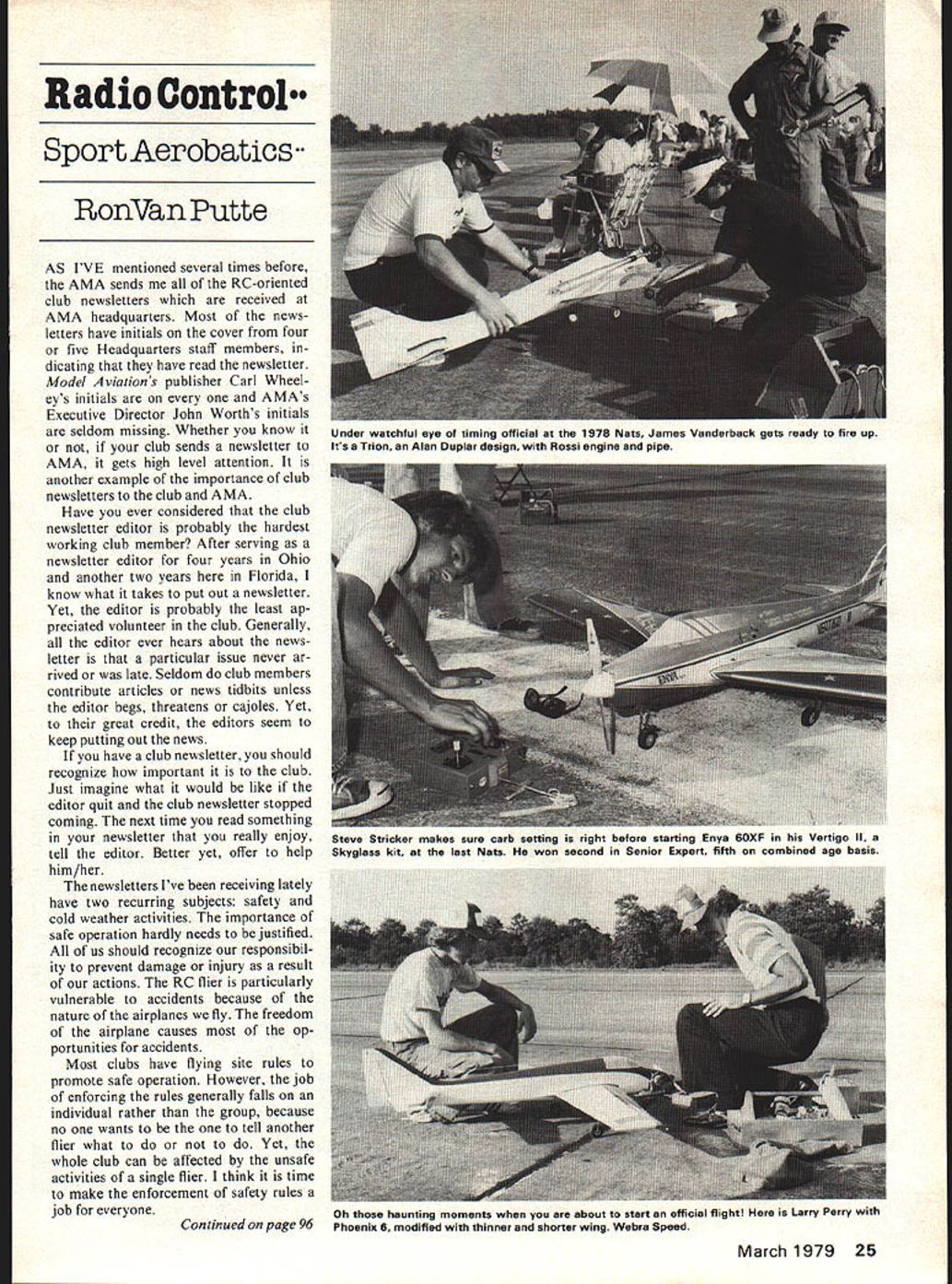
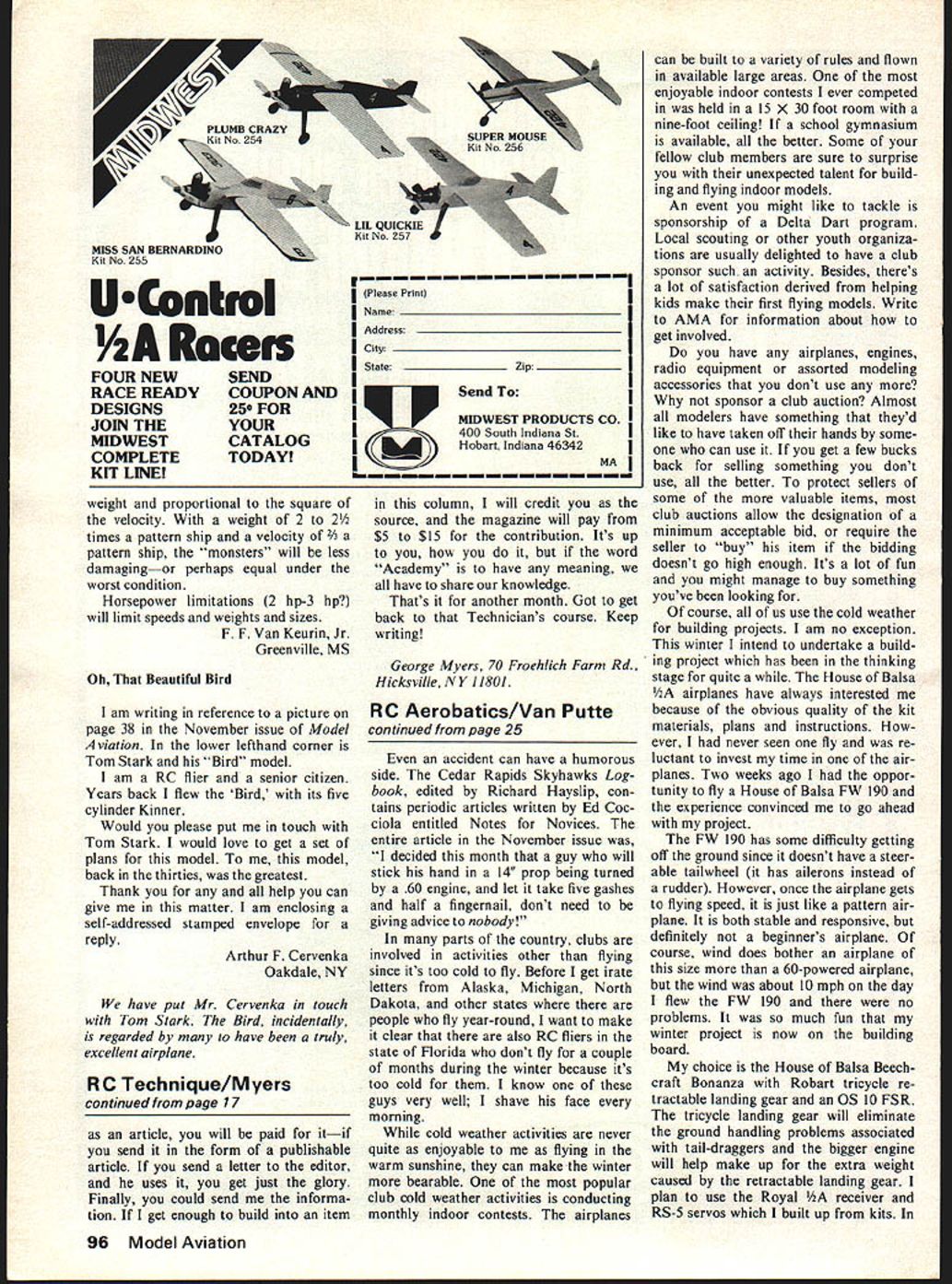
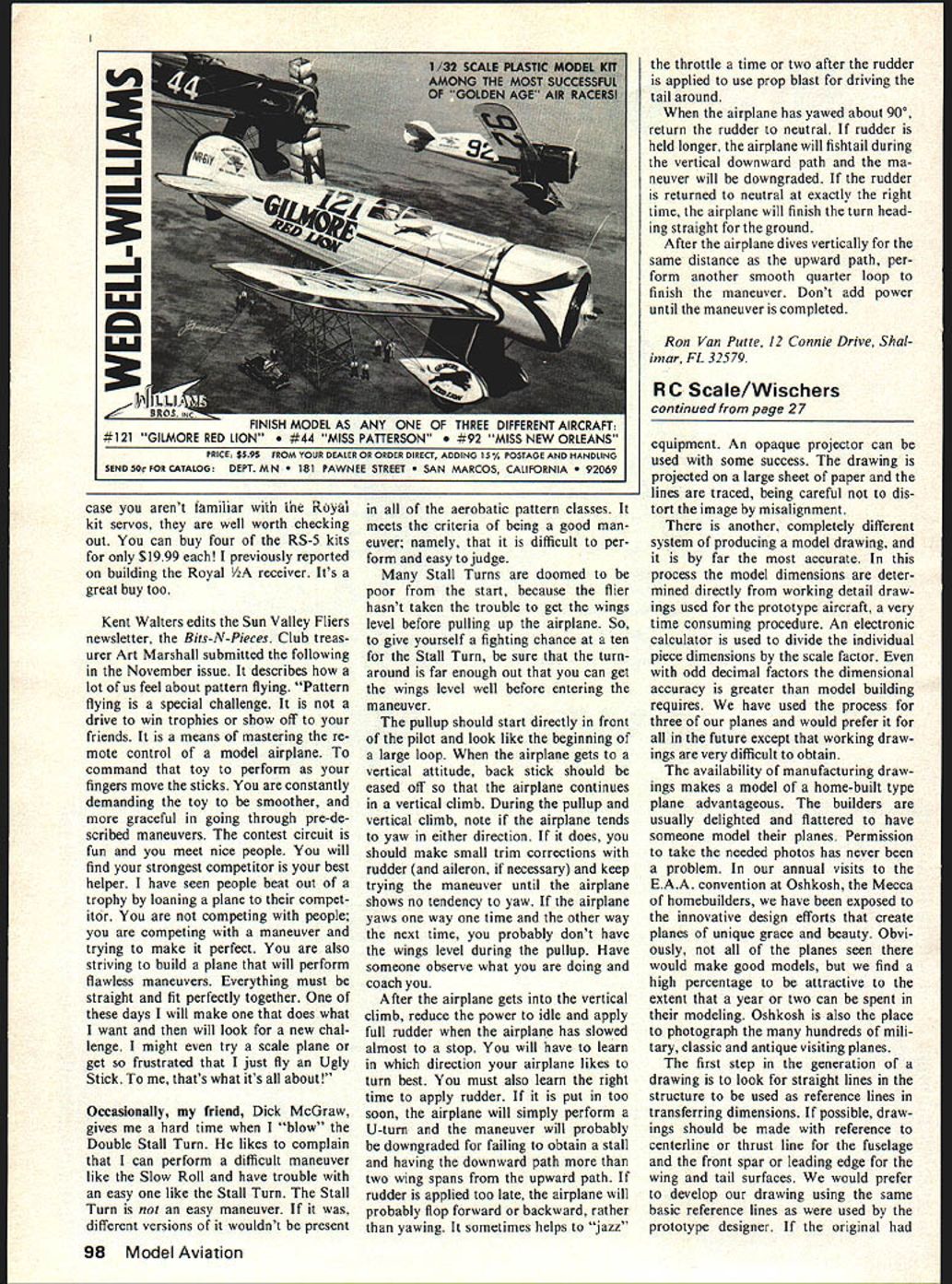
Radio Control: Sport Aerobatics
Ron Van Putte
Newsletters and editors
As I've mentioned several times before, the AMA sends me all of the RC-oriented club newsletters which are received at AMA headquarters. Most of the newsletters have initials on the cover from four or five Headquarters staff members, indicating that they have read the newsletter. Model Aviation's publisher Carl Wheeler's initials are on every one and AMA's Executive Director John Worth's initials are seldom missing. Whether you know it or not, if your club sends a newsletter to AMA, it gets high-level attention. It is another example of the importance of club newsletters to the club and AMA.
Have you ever considered that the club newsletter editor is probably the hardest-working club member? After serving as a newsletter editor for four years in Ohio and another two years here in Florida, I know what it takes to put out a newsletter. Yet, the editor is probably the least appreciated volunteer in the club. Generally, all the editor ever hears about the newsletter is that a particular issue never arrived or was late. Seldom do club members contribute articles or news tidbits unless the editor begs, threatens, or cajoles. Yet, to their great credit, the editors seem to keep putting out the news.
If you have a club newsletter, you should recognize how important it is to the club. Just imagine what it would be like if the editor quit and the club newsletter stopped coming. The next time you read something in your newsletter that you really enjoy, tell the editor. Better yet, offer to help him or her.
Safety and enforcement
The newsletters I've been receiving lately have two recurring subjects: safety and cold-weather activities. The importance of safe operation hardly needs to be justified. All of us should recognize our responsibility to prevent damage or injury as a result of our actions. The RC flier is particularly vulnerable to accidents because of the nature of the airplanes we fly. The freedom of the airplane causes most of the opportunities for accidents.
Most clubs have flying-site rules to promote safe operation. However, the job of enforcing the rules generally falls on an individual rather than the group, because no one wants to be the one to tell another flier what to do or not to do. Yet, the whole club can be affected by the unsafe activities of a single flier. I think it is time to make the enforcement of safety rules a job for everyone.
Even an accident can have a humorous side. The Cedar Rapids Skyhawks Logbook, edited by Richard Hayslip, contains periodic articles written by Ed Cocciola entitled "Notes for Novices." The entire article in the November issue was, "I decided this month that a guy who will stick his hand in a 14" prop being turned by a .60 engine, and let it take five gashes and half a fingernail, don't need to be giving advice to nobody!"
Cold-weather activities
In many parts of the country, clubs are involved in activities other than flying since it's too cold to fly. Before I get irate letters from Alaska, Michigan, North Dakota, and other states where there are people who fly year-round, I want to make it clear that there are also RC fliers in the state of Florida who don't fly for a couple of months during the winter because it's too cold for them. I know one of those guys very well; I shave his face every morning.
While cold-weather activities are never quite as enjoyable as flying in the warm sunshine, they can make the winter more bearable. One of the most popular club cold-weather activities is conducting monthly indoor contests. The airplanes can be built to a variety of rules and flown in available large areas. One of the most enjoyable indoor contests I ever competed in was held in a 15 x 30-foot room with a nine-foot ceiling! If a school gymnasium is available, all the better. Some of your fellow club members are sure to surprise you with their unexpected talent for building and flying indoor models.
Youth programs
An event you might like to tackle is sponsorship of a Delta Dart program. Local scouting or other youth organizations are usually delighted to have a club sponsor such an activity. Besides, there's a lot of satisfaction derived from helping kids make their first flying models. Write to AMA for information about how to get involved.
Club auctions
Do you have any airplanes, engines, radio equipment, or assorted modeling accessories that you don't use any more? Why not sponsor a club auction? Almost all modelers have something that they'd like to have taken off their hands by someone who can use it. If you get a few bucks back for selling something you don't use, all the better.
To protect sellers of some of the more valuable items, most club auctions allow the designation of a minimum acceptable bid, or require the seller to "buy" his item if the bidding doesn't go high enough. It's a lot of fun and you might manage to buy something you've been looking for.
Winter building project
Of course, all of us use the cold weather for building projects. I am no exception. This winter I intend to undertake a building project which has been in the thinking stage for quite a while. The House of Balsa 1/2A airplanes have always interested me because of the obvious quality of the kit materials, plans, and instructions. However, I had never seen one fly and was reluctant to invest my time in one of the airplanes. Two weeks ago I had the opportunity to fly a House of Balsa FW 190 and the experience convinced me to go ahead with my project.
The FW 190 has some difficulty getting off the ground since it doesn't have a steerable tailwheel (it has ailerons instead of a rudder). However, once the airplane gets up to flying speed, it is just like a pattern airplane. It is both stable and responsive, but definitely not a beginner's airplane. Of course, wind does bother an airplane of this size more than a .60-powered airplane, but the wind was about 10 mph on the day I flew the FW 190 and there were no problems. It was so much fun that my winter project is now on the board.
My choice is the House of Balsa Beechcraft Bonanza with Robart tricycle retractable landing gear and an OS .10 FSR. The tricycle landing gear will eliminate ground-handling problems associated with taildraggers, and the bigger engine will help make up for the extra weight caused by the retractable landing gear. I plan to use the Royal 1/4A receiver and RS-5 servos which I built up from kits. In case you aren't familiar with the Royal kit servos, they are all worth checking out. You can buy four of the RS-5 kits for only $19.99 each! I previously reported on building the Royal 1/4A receiver. It's a great buy too.
Pattern flying
Kent Walters edits the Sun Valley Fliers newsletter, Bits-N-Pieces. Club treasurer Art Marshall submitted the following in the November issue. It describes how a lot of us feel about pattern flying:
"Pattern flying is a special challenge. It is not a drive to win trophies or show off to your friends. It is a means of mastering the remote control of a model airplane. To command that toy to perform as your fingers move the sticks. You are constantly demanding the toy to be smoother, and more graceful in going through pre-described maneuvers. The contest circuit is fun and you meet nice people. You will find your strongest competitor is your best helper. I have seen people beat out of a trophy by loaning a plane to their competitor. You are not competing with people; you are competing with a maneuver and trying to make it perfect. You are also striving to build a plane that will perform flawless maneuvers. Everything must be straight and fit perfectly together. One of these days I will make one that does what I want and then will look for a new challenge. I might even try a scale plane or get so frustrated that I just fly an Ugly Stick. To me, that's what it's all about!"
Occasionally, my friend Dick McGraw gives me a hard time when I "blow" the double stall turn. He likes to complain that I can perform a difficult maneuver like the slow roll and have trouble with an easy one like the stall turn. The stall turn is not an easy maneuver. If it was, different versions of it wouldn't be present in all of the aerobatic pattern classes. It meets the criteria of being a good maneuver; namely, that it is difficult to perform and easy to judge.
Many stall turns are doomed to be poor from the start because the flier hasn't taken the trouble to get the wings level before pulling up the airplane. So, to give yourself a fighting chance at a ten for the stall turn, be sure that the turn-around is far enough out that you can get the wings level well before entering the maneuver.
The pull-up should start directly in front of the pilot and look like the beginning of a large loop. When the airplane gets to a vertical attitude, back stick should be eased off so that the airplane continues in a vertical climb. During the pull-up and vertical climb, note if the airplane tends to yaw in either direction. If it does, you should make small trim corrections with rudder (and aileron, if necessary) and keep trying the maneuver until the airplane shows no tendency to yaw. If the airplane yaws one way one time and the other way the next time, you probably don't have the wings level during the pull-up. Have someone observe what you are doing and coach you.
After the airplane gets into the vertical climb, reduce the power to idle and apply full rudder when the airplane has slowed almost to a stop. You will have to learn in which direction your airplane likes to turn best. You must also learn the right time to apply rudder. If it is put in too soon, the airplane will simply perform a U-turn and the maneuver will probably be downgraded for failing to obtain a stall and having the downward path more than two wingspans from the upward path. If rudder is applied too late, the airplane will probably flop forward or backward, rather than yawing. It sometimes helps to "jazz" the throttle a time or two after the rudder is applied to use prop blast for driving the tail around.
When the airplane has yawed about 90°, return the rudder to neutral. If rudder is held longer, the airplane will fishtail during the vertical downward path and the maneuver will be downgraded. If the rudder is returned to neutral at exactly the right time, the airplane will finish the turn heading straight for the ground.
After the airplane dives vertically for the same distance as the upward path, perform another smooth quarter loop to finish the maneuver. Don't add power until the maneuver is completed.
Ron Van Putte 12 Connie Drive Shalimar, FL 32579
Transcribed from original scans by AI. Minor OCR errors may remain.

