
Radio Control: Sport Aerobatics
Ron Van Putte
Presentation of the PRAERIE to the U.S. Air Force Armament Museum
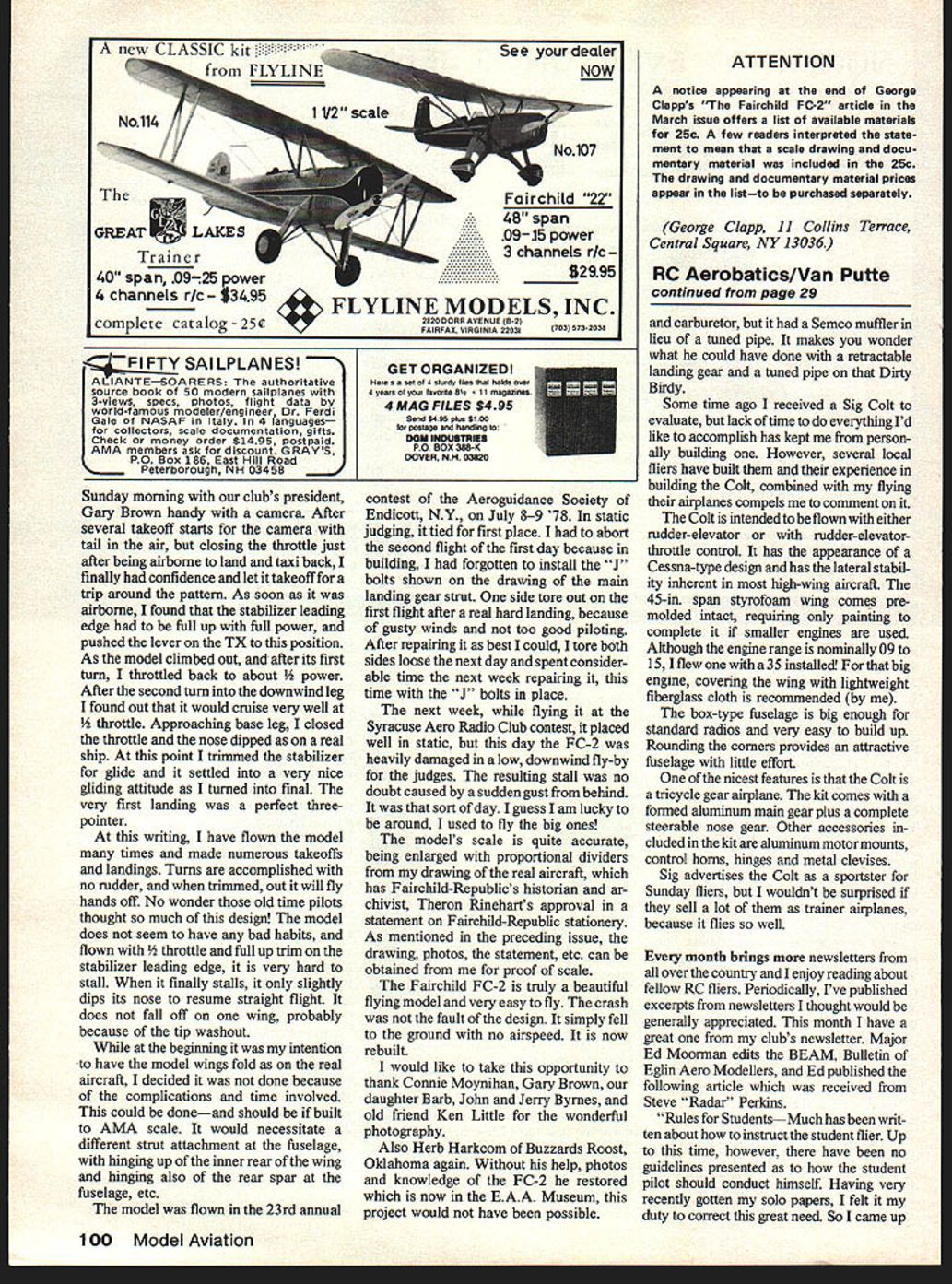
It's not often that a model airplane club can make a contribution to a major museum, but the Eglin Aero Modellers recently had an opportunity to present an airplane to the U.S. Air Force Armament Museum at Eglin Air Force Base in Florida. The airplane was one of the first remotely piloted vehicles designed to carry both a television camera and a LASER designator. A remote pilot flew the airplane by watching the television picture transmitted from an onboard camera. Crosshairs in the field of view enabled the pilot to point the LASER at a target and "paint" it with a spot of light. An Air Force fighter then dropped a bomb containing a special LASER spot-seeking guidance system that directed the bomb to the spot on the target. The system proved that it was possible for a remotely piloted system to perform target designation in a tactical scenario and paved the way for many of the current remotely piloted vehicle systems.
Called the PRAERIE, the system was integrated by the Philco Ford Corporation, which borrowed heavily on existing model technology. K&B Manufacturing Company made the two-cylinder opposed engines. Conventional Kraft radio systems with boosted transmitter output provided control. Modelers Jan Sakert and Dick Riggs built the basic airframes. The television camera and LASER designation system were about the only features you would not expect to find at almost any flying field.
The big orange PRAERIE spanned 13 feet and had a gross weight of more than 50 pounds. Although it was only a three-channel airplane (lacking ailerons), it was well suited to perform the target designation mission. It was tested at one of the target ranges at Eglin AFB during the spring and early summer of 1973. After initial tests were successfully accomplished, two missions were flown in which F-4C fighter aircraft dropped MK 84 LASER-guided bombs that destroyed two obsolete trucks that had been "painted" with a LASER spot by the PRAERIE designation system.
The Eglin Aero Modellers were contacted by Philco Ford personnel after a landing accident severely damaged one of the test aircraft. The club was offered the airframe since it was too badly damaged to be economically repaired. During the next five years the battered remains were stored in my attic awaiting an ambitious individual to put it back together.
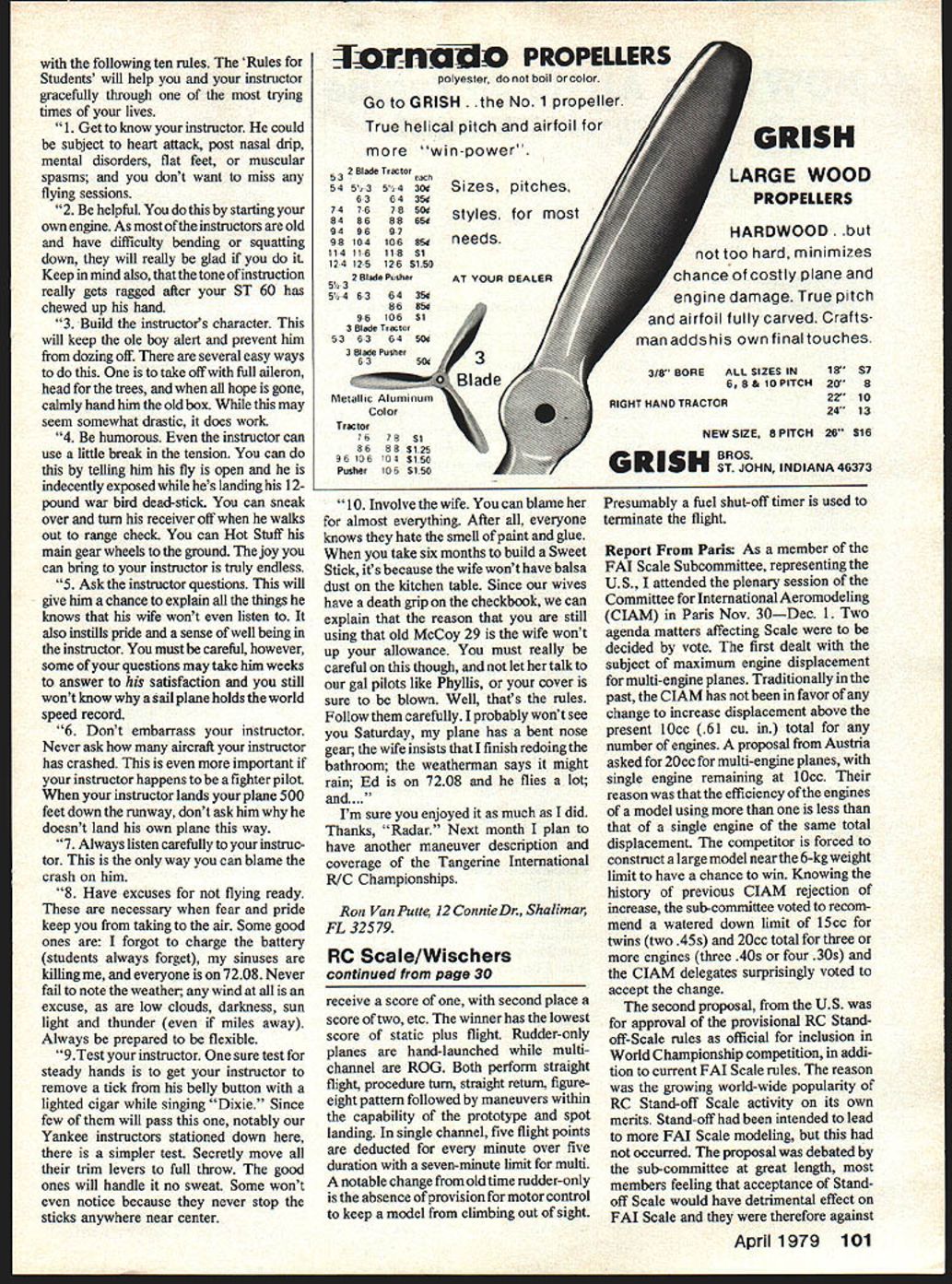
One evening, Mel Bray, a long-time club member and former president who had recently returned to the area after retiring from the Air Force, said he'd heard about the PRAERIE and would like to tackle the repair job. A month later the job was done and on December 5, 1978 the PRAERIE was presented to the U.S. Air Force Armament Museum as an addition to the armament-related memorabilia in the museum. Within the day, museum officials installed the PRAERIE in the entranceway.
Pattern competition note
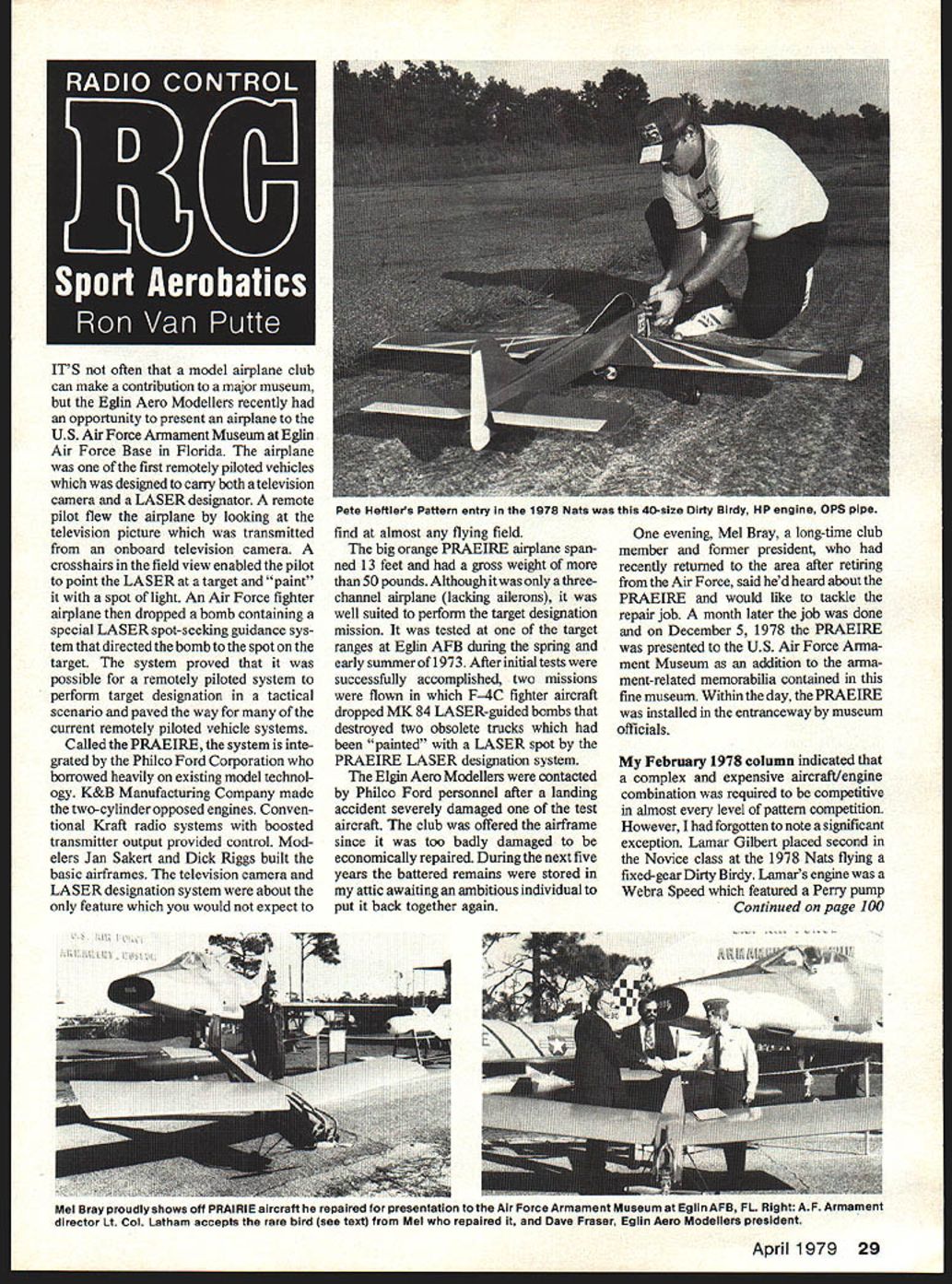
My February 1978 column indicated that a complex and expensive aircraft/engine combination was required to be competitive in almost every level of pattern competition. However, I had forgotten to note a significant exception. Lamar Gilbert placed second in the Novice class at the 1978 Nats flying a fixed-gear Dirty Birdy. Lamar's engine was a Webra Speed which featured a Perry pump.
Flying the Fairchild FC-2 model
One Sunday morning with our club's president, Gary Brown, handy with a camera, I finally had confidence to let the model take off for a trip around the pattern after several takeoff starts with the tail in the air and closing the throttle just after airborne to land and taxi back. As soon as it was airborne I found that the stabilizer leading edge had to be full up with full power, so I pushed the lever on the transmitter to this position. As the model climbed out and after its first turn, I throttled back to about half power. After the second turn into the downwind leg I found it would cruise very well at one-quarter throttle. Approaching base leg, I closed the throttle and the nose dipped as on a real ship. I trimmed the stabilizer for glide and it settled into a very nice gliding attitude as I turned into final. The very first landing was a perfect three-pointer.
Since then I have flown the model many times and made numerous takeoffs and landings. Turns are accomplished with no rudder, and when trimmed it will fly hands-off. No wonder those old-time pilots thought so much of this design! The model does not seem to have any bad habits, and flown with one-quarter throttle and full-up trim on the stabilizer leading edge, it is very hard to stall. When it finally stalls, it only slightly dips its nose to resume straight flight. It does not fall off on one wing, probably because of the tip washout.
At the beginning it was my intention to have the model wings fold as on the real aircraft, but I decided not to do this because of the complications and time involved. This could be done—and should if built to AMA scale. It would necessitate a different strut attachment at the fuselage, hinging up of the inner rear of the wing, and hinging of the rear spar at the fuselage, etc.
The model was flown in the 23rd annual contest of the Aeroguidance Society of Endicott, N.Y., on July 8–9, 1978. In static judging it tied for first place. I had to abort the second flight of the first day because, in building, I had forgotten to install the "J" bolts shown on the drawing of the main landing gear strut. One side tore out on the first flight after a real hard landing because of gusty winds and not-too-good piloting. After repairing it as best I could, I tore both sides loose the next day and spent considerable time the next week repairing it, this time with the "J" bolts in place.
The next week, while flying it at the Syracuse Aero Radio Club contest, it placed well in static, but that day the FC-2 was heavily damaged in a low, downwind fly-by for the judges. The resulting stall was no doubt caused by a sudden gust from behind. It was that sort of day. I guess I am lucky to be around. I used to fly the big ones!
The model's scale is quite accurate, being enlarged with proportional dividers from my drawing of the real aircraft, which has Fairchild-Republic's historian and archivist Theron Rinehart's approval as to scale. As mentioned in the preceding issue, the drawings, photos, and statement can be obtained from me for proof of scale.
The Fairchild FC-2 is truly a beautiful flying model and very easy to fly. The crash was not the fault of the design. It simply fell to the ground with no airspeed. It is now rebuilt.
I would like to take this opportunity to thank Connie Moynihan, Gary Brown, our daughter Barb, John and Jerry Byrnes, and our friend Ken Little for the wonderful photography. Also, Herb Harkcom of Buzzards Roost, Oklahoma, again — without his help, photos, and knowledge of the FC-2 he restored (now in the E.A.A. Museum), this project would not have been possible.
Rules for Students
The "Rules for Students" will help you and your instructor gracefully through one of the most trying times of your lives.
- Get to know your instructor. He could be subject to heart attack, post-nasal drip, mental disorders, flat feet, or muscular spasms; and you don't want to miss any flying sessions.
- Be helpful. You do this by starting your own engine. As most instructors are old and have difficulty bending or squatting, they will really be glad if you do it. Keep in mind, also, that the tone of instruction really gets ragged after your .60 has chewed up his hand.
- Build the instructor's character. This will keep the old boy alert and prevent him from dozing off. There are several easy ways to do this. One is to take off with full aileron, head for the trees, and when all hope is gone, calmly hand him the old box. While this may seem somewhat drastic, it does work.
- Be humorous. Even the instructor can use a little break in the tension. You can do this by telling him his fly is open and he is indecently exposed while he's landing his 12-pound warbird dead-stick. You can sneak over and turn his receiver off when he walks out to range-check. You can Hot-Stuff his main-gear wheels to the ground. The joy you can bring to your instructor is truly endless.
- Ask the instructor questions. This will give him a chance to explain all the things he knows that his wife won't even listen to. It also instills pride and a sense of well-being in the instructor. Be careful, however — some of your questions may take him weeks to answer to his satisfaction and you still won't know why a sailplane holds the world speed record.
- Don't embarrass your instructor. Never ask how many aircraft your instructor has crashed. This is even more important if your instructor happens to be a fighter pilot. When your instructor lands your plane 500 feet down the runway, don't ask him why he doesn't land his own plane that way.
- Always listen carefully to your instructor. This is the only way you can blame the crash on him.
- Have excuses for not flying ready. These are necessary when fear and pride keep you from taking to the air. Some good ones are: "I forgot to charge the battery" (students always forget), "my sinuses are killing me," and "everyone is on 72.08." Never fail to note the weather; any wind at all is an excuse, as are low clouds, darkness, sunlight and thunder (even if miles away). Always be prepared to be flexible.
- Test your instructor. One sure test for steady hands is to get your instructor to remove a tick from his belly button with a lighted cigar while singing "Dixie." Since few of them will pass this test, notably our Yankee instructors stationed down here, there is a simpler test. Secretly move all their trim levers to full throw. The good ones will handle it no sweat. Some won't even notice because they never stop the sticks anywhere near center.
- Involve the wife. You can blame her for almost everything. After all, everyone knows they hate the smell of paint and glue. When you take six months to build a Sweet Stick, it's because the wife won't have balsa dust on the kitchen table. Since our wives have a death grip on the checkbook, we can explain that the reason you are still using that old McCoy 29 is the wife won't up your allowance. Be careful on this, though, and not let her talk to our gal pilots like Phyllis, or your cover is sure to be blown.
I'm sure you enjoyed it as much as I did. Thanks, "Radar." Next month I plan to have another maneuver description and coverage of the Tangerine International R/C Championships.
Ron Van Putte 12 Connie Dr., Shalimar, FL 32579.
Transcribed from original scans by AI. Minor OCR errors may remain.

