
Radio Control: Sport Aerobatics
Ron Van Putte
The trek to Orlando, Florida for the Tangerine International RC Contest has become a ritual for refugees from the frozen north. The 1978 event was no exception. I would hate to calculate the average distance that contestants drove, but it must have approached 1,000 miles. That's a heck of a way to go to fly toy airplanes! Nevertheless, the Tangerine Contest has become the thing to do late in the year.
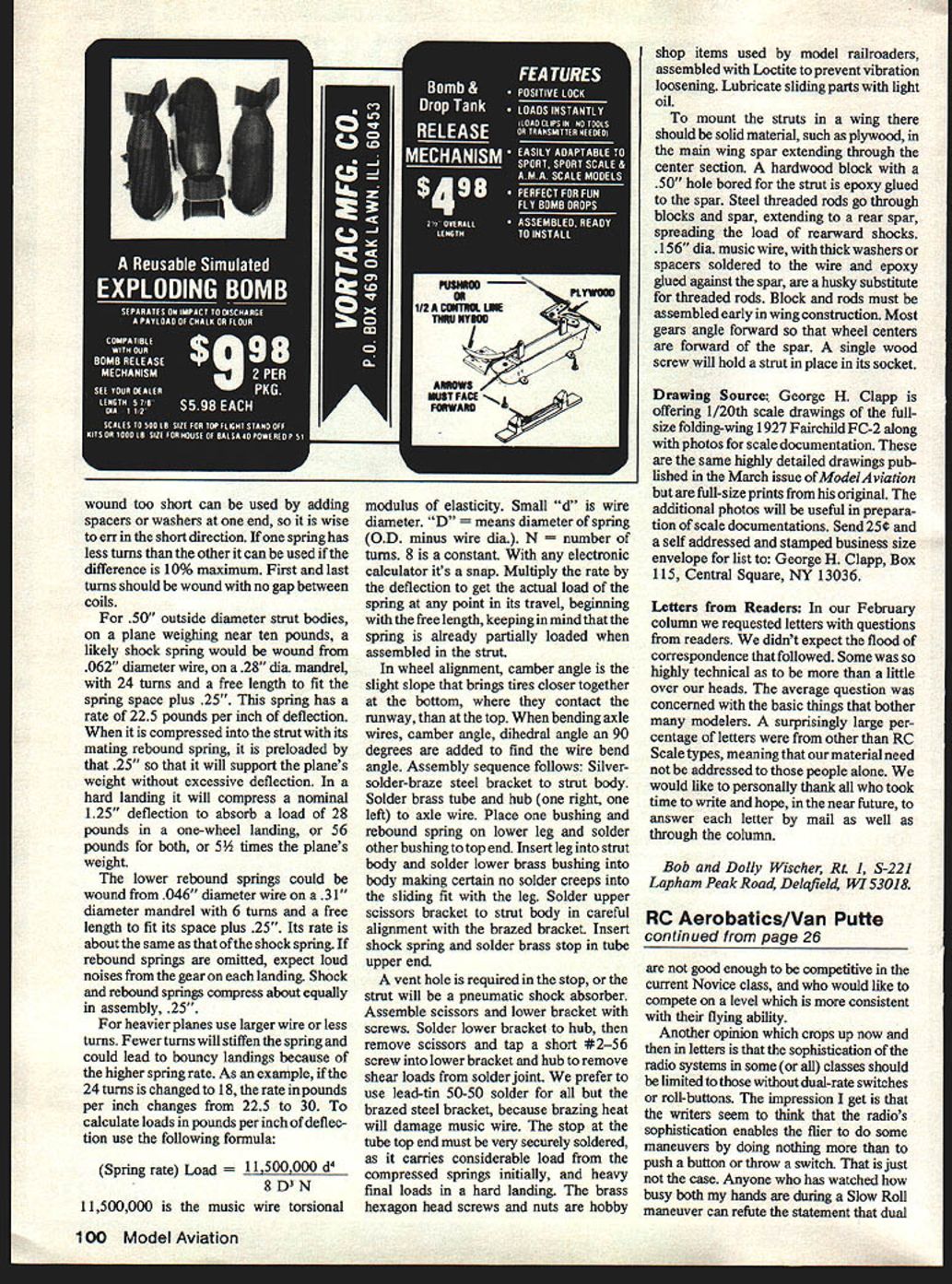
This year I returned after missing the previous two years due to Christmas trips to and by relatives, respectively. The contest still had the same comfortable flavor to it. A couple of nice touches were the bags of tangerines and special flight caps for contestants that were passed out at the welcoming party/registration at the host motel during the evening prior to pattern competition.
A form of the Shulman system was used to expedite flight line operation and it worked very well. The new rule about allowing two attempts per official flight complicated the system somewhat, but they had planned for it and things went smoothly.
In fact, everything went smoothly except the weather. The weather was a bummer. One would expect that 2½ days of flying from two flight lines by 70 contestants who were flying abbreviated patterns would yield a bundle of rounds, but that was not the case. Rain shut down most of the afternoon of the first day, virtually all of the second day, and about half of the morning of the last day of pattern flying. As a result, barely three rounds were squeezed in by the soggy contestants. It didn't help a bit to have local fliers say, "You should have been here last week, it was beautiful!"
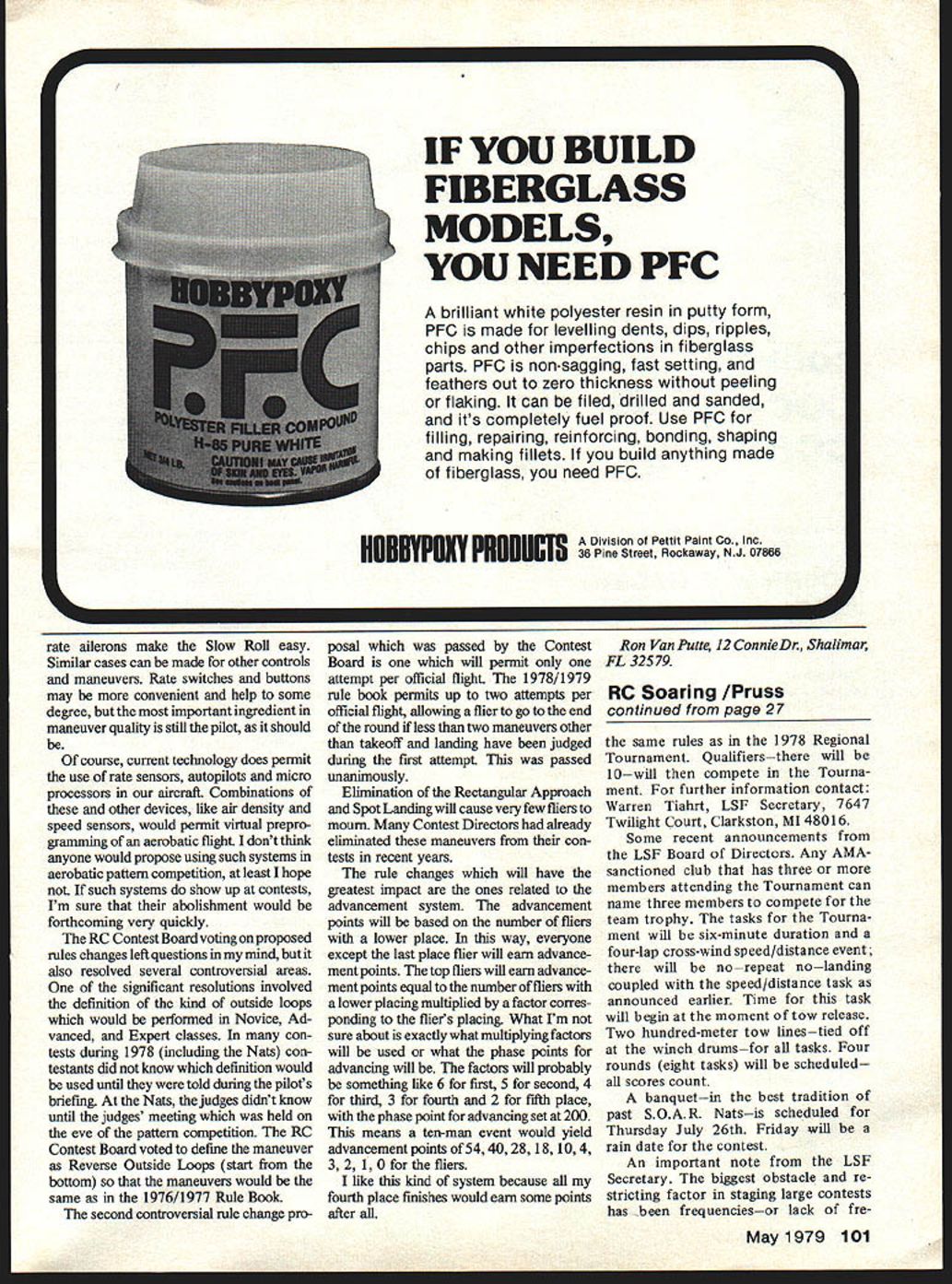
Despite the lousy conditions, very few fliers lost their sense of humor. There were some surprises in store for Nats champion Dave Brown. Both Don Weitz and Steve Helms edged him out in the Masters class. Don's flying was remarkably consistent, in spite of the rain and gusty winds. Steve had the highest single flight score, but didn't have a good enough flight to back it up and he finished in second place. The other fliers were well down the point total from the three top finishers.
The pattern event director, Wayne Potter, hadn't intended to have a Beginner class, but a mixup in the contest announcement resulted in the class being included. Wayne ended up pleased to have the Beginner event since five contestants entered it.
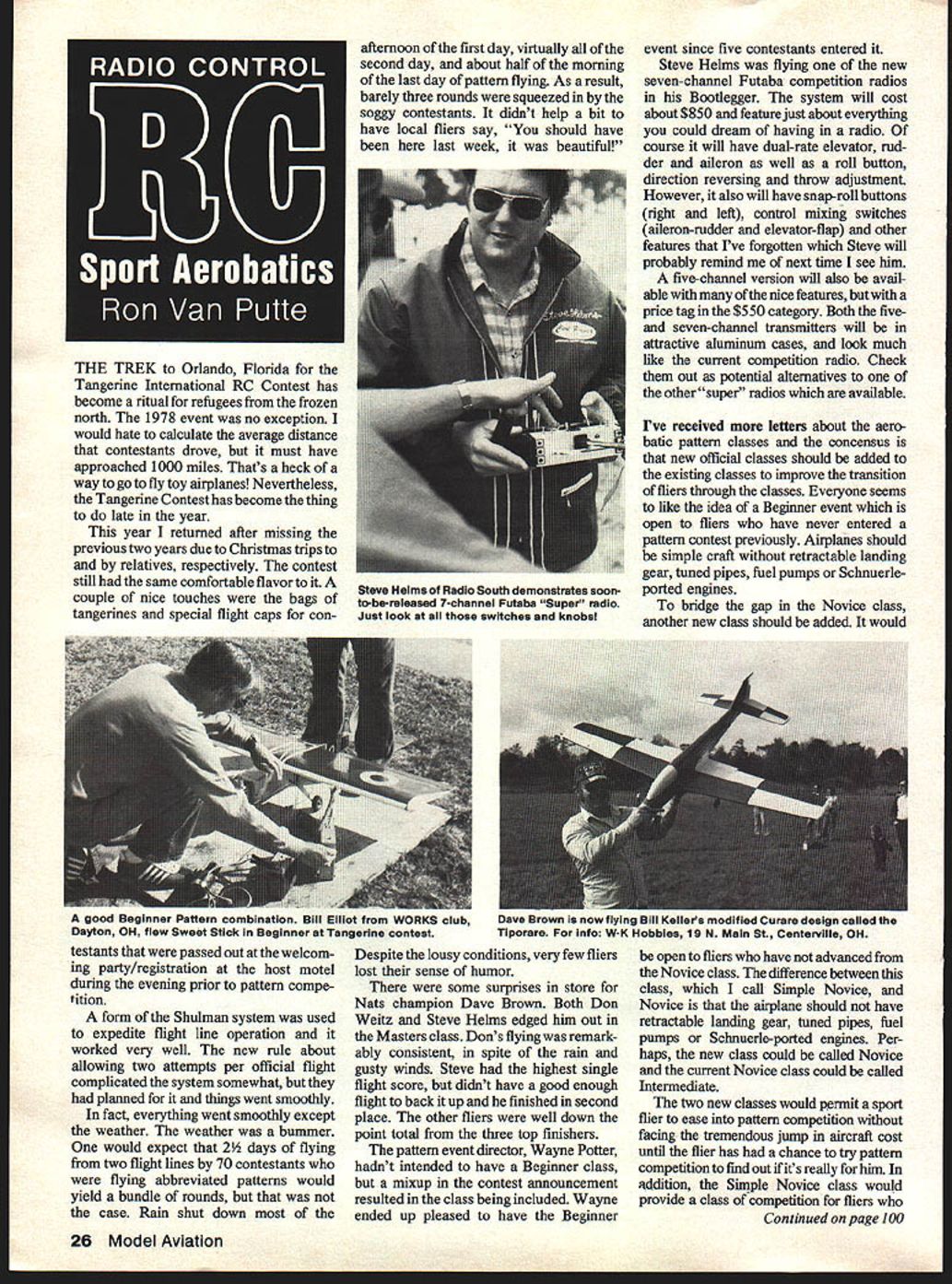
Steve Helms was flying one of the new seven-channel Futaba competition radios in his Bootlegger. The system will cost about $850 and feature just about everything you could dream of having in a radio. Of course it will have dual-rate elevator, rudder and aileron as well as a roll button, direction reversing and throw adjustment. However, it also will have snap-roll buttons (right and left), control mixing switches (aileron-rudder and elevator-flap) and other features that I've forgotten which Steve will probably remind me of next time I see him.
A five-channel version will also be available with many of the nice features, but with a price tag in the $550 category. Both the five- and seven-channel transmitters will be in attractive aluminum cases, and look much like the current competition radio. Check them out as potential alternatives to one of the other "super" radios which are available.
Beginner and Novice class proposals
I've received more letters about the aerobatic pattern classes and the consensus is that new official classes should be added to the existing classes to improve the transition of fliers through the classes. Everyone seems to like the idea of a Beginner event which is open to fliers who have never entered a pattern contest previously. Airplanes should be simple craft without retractable landing gear, tuned pipes, fuel pumps or Schnuerle-ported engines.
To bridge the gap in the Novice class, another new class should be added. It would be open to fliers who have not advanced from the Novice class. The difference between this class, which I call Simple Novice, and Novice is that the airplane should not have retractable landing gear, tuned pipes, fuel pumps or Schnuerle-ported engines. Perhaps, the new class could be called Novice and the current Novice class could be called Intermediate.
The two new classes would permit a sport flier to ease into pattern competition without facing the tremendous jump in aircraft cost until the flier has had a chance to try pattern competition to find out if it's really for him. In addition, the Simple Novice class would provide a class of competition for fliers who are not good enough to be competitive in the current Novice class, and who would like to compete on a level which is more consistent with their flying ability.
Radio sophistication and competition concerns
Another opinion which crops up now and then in letters is that the sophistication of the radio systems in some (or all) classes should be limited to those without dual-rate switches or roll-buttons. The impression I get is that the writers seem to think that the radio's sophistication enables the flier to do some maneuvers by doing nothing more than to push a button or throw a switch. That is just not the case. Anyone who has watched how busy both my hands are during a Slow Roll maneuver can refute the statement that dual-rate ailerons make the Slow Roll easy. Similar cases can be made for other controls and maneuvers. Rate switches and buttons may be more convenient and help to some degree, but the most important ingredient in maneuver quality is still the pilot, as it should be.
Of course, current technology does permit the use of rate sensors, autopilots and microprocessors in our aircraft. Combinations of these and other devices, like air density and speed sensors, would permit virtual preprogramming of an aerobatic flight. I don't think anyone would propose using such systems in aerobatic pattern competition, at least I hope not. If such systems do show up at contests, I'm sure that their abolishment would be forthcoming very quickly.
Rule changes and the RC Contest Board
The RC Contest Board voting on proposed rules changes left questions in my mind, but it also resolved several controversial areas. One of the significant resolutions involved the definition of the kind of outside loops which would be performed in Novice, Advanced, and Expert classes. In many contests during 1978 (including the Nats) contestants did not know which definition would be used until they were told during the pilot's briefing. At the Nats, the judges didn't know until the judges' meeting which was held on the eve of the pattern competition. The RC Contest Board voted to define the maneuver as Reverse Outside Loops (start from the bottom) so that the maneuvers would be the same as in the 1976/1977 Rule Book.
The second controversial rule change proposal which was passed by the Contest Board is one which will permit only one attempt per official flight. The 1978/1979 rule book permits up to two attempts per official flight, allowing a flier to go to the end of the round if less than two maneuvers other than takeoff and landing have been judged during the first attempt. This was passed unanimously.
Elimination of the Rectangular Approach and Spot Landing will cause very few fliers to mourn. Many Contest Directors had already eliminated these maneuvers from their contests in recent years.
The rule changes which will have the greatest impact are the ones related to the advancement system. The advancement points will be based on the number of fliers with a lower place. In this way, everyone except the last place flier will earn advancement points. The top fliers will earn advancement points equal to the number of fliers with a lower placing multiplied by a factor corresponding to the flier's placing. What I'm not sure about is exactly what multiplying factors will be used or what the phase points for advancing will be. The factors will probably be something like 6 for first, 5 for second, 4 for third, 3 for fourth and 2 for fifth place, with the phase point for advancing set at 200. This means a ten-man event would yield advancement points of 54, 40, 28, 18, 10, 4, 3, 2, 1, 0 for the fliers.
I like this kind of system because all my fourth place finishes would earn some points after all.
Ron Van Putte 12 Connie Dr. Shalimar, FL 32579
Transcribed from original scans by AI. Minor OCR errors may remain.

