
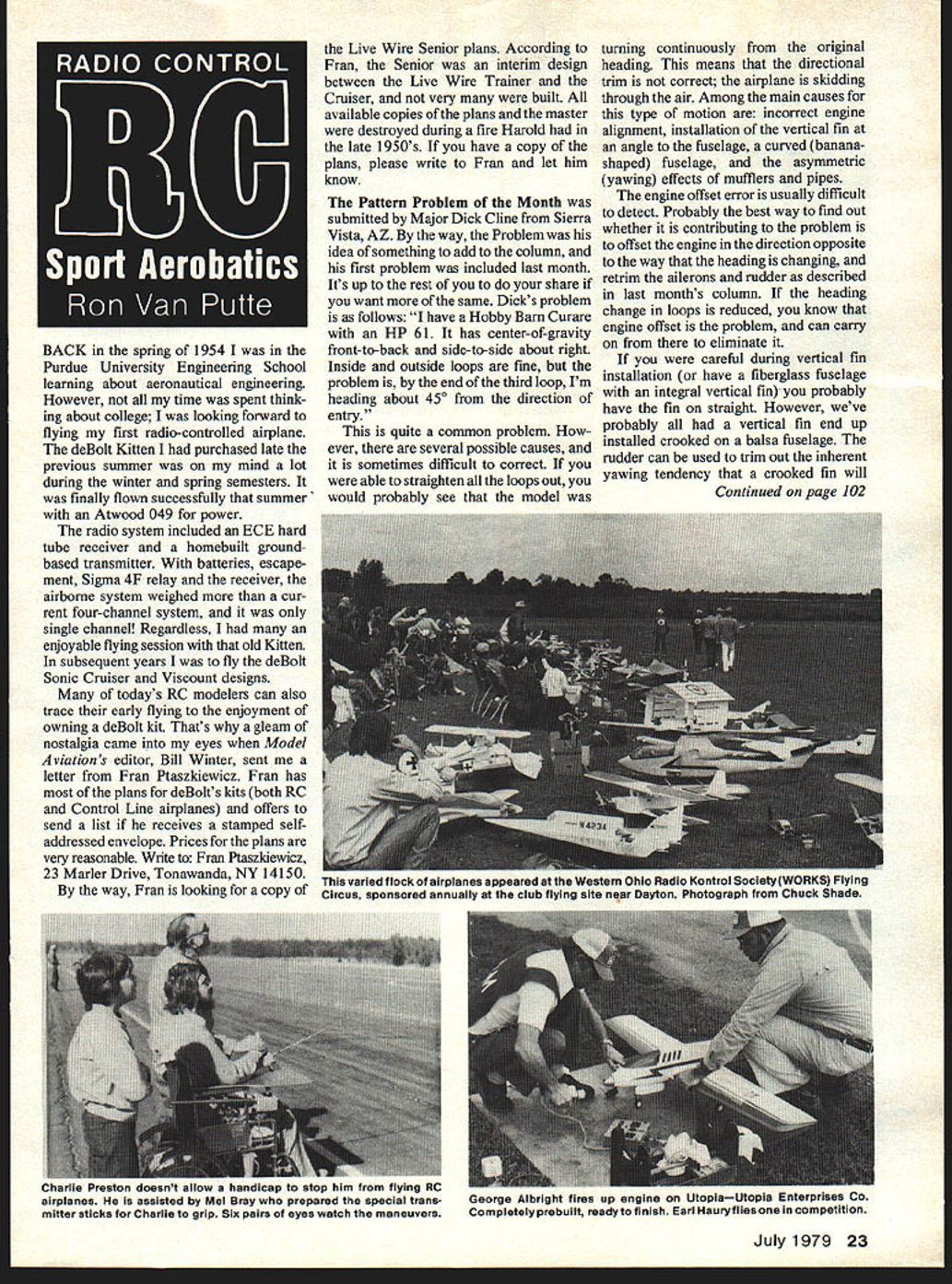
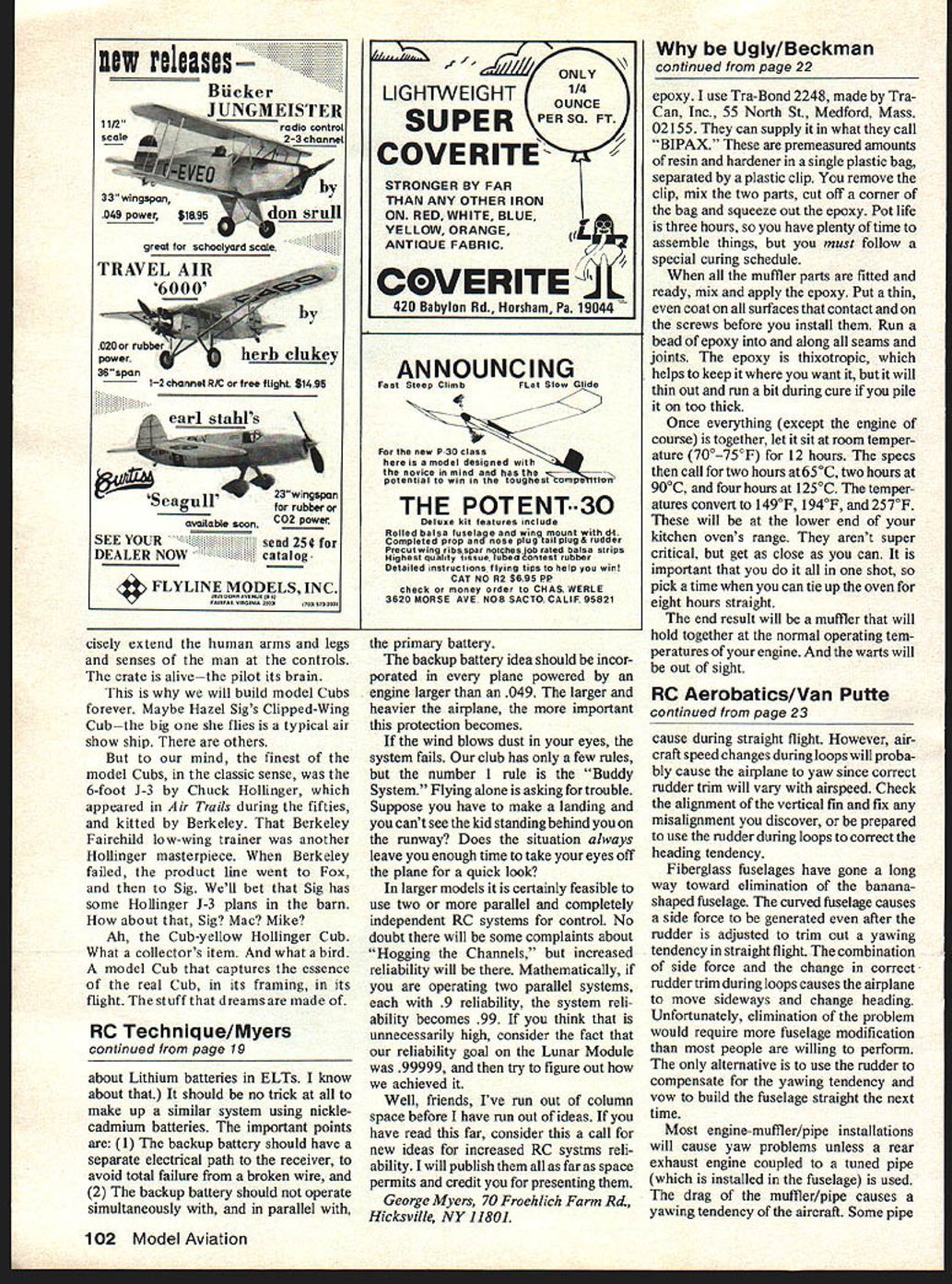
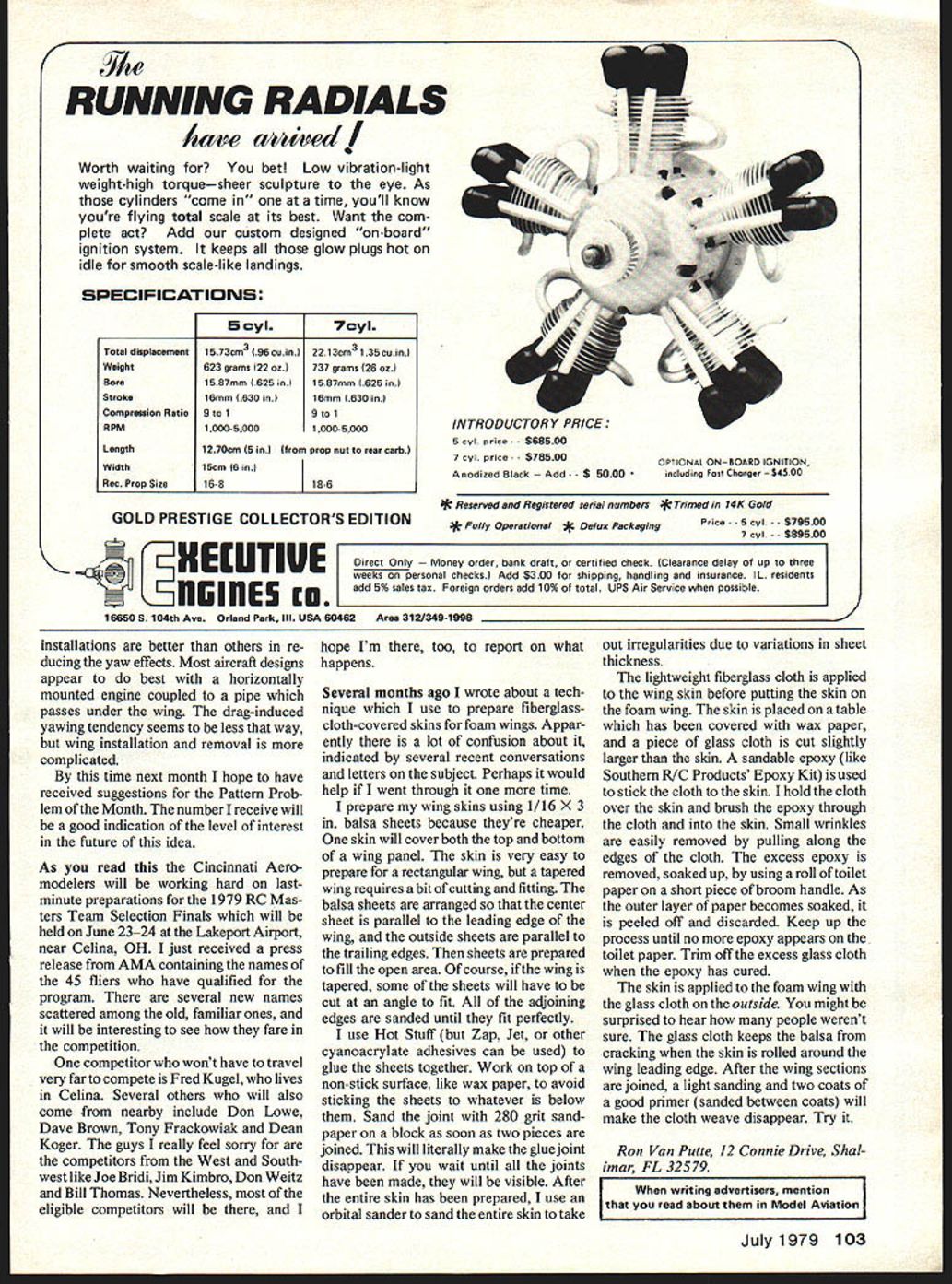
Radio Control: Sport Aerobatics
Ron Van Putte
Early years and deBolt kits
Back in the spring of 1954 I was in the Purdue University Engineering School learning about aeronautical engineering. However, not all my time was spent thinking about college; I was looking forward to flying my first radio-controlled airplane. The deBolt Kitten I had purchased late the previous summer was on my mind a lot during the winter and spring semesters. It was finally flown successfully that summer with an Atwood .049 for power.
The radio system included an ECE hard-tube receiver and a homebuilt ground-based transmitter. With batteries, escapement, Sigma 4F relay and the receiver, the airborne system weighed more than a current four-channel system, and it was only single channel! Regardless, I had many enjoyable flying sessions with that old Kitten. In subsequent years I was to fly the deBolt Sonic Cruiser and Viscount designs.
Many of today's RC modelers can also trace their early flying to the enjoyment of owning a deBolt kit. That's why a gleam of nostalgia came into my eyes when Model Aviation's editor, Bill Winter, sent me a letter from Fran Ptaszkiewicz.
Plans and contact
Fran has most of the plans for deBolt's kits (both RC and control-line airplanes) and offers to send a list if he receives a stamped, self-addressed envelope. Prices for the plans are very reasonable. Write to:
- Fran Ptaszkiewicz
- 23 Marler Drive
- Tonawanda, NY 14150
By the way, Fran is looking for a copy of the Live Wire Senior plans. According to Fran, the Senior was an interim design between the Live Wire Trainer and the Cruiser, and not very many were built. All available copies of the plans and the master were destroyed during a fire Harold had in the late 1950s. If you have a copy of the plans, please write to Fran and let him know.
Pattern Problem of the Month
The Pattern Problem of the Month was submitted by Major Dick Cline from Sierra Vista, AZ. The Problem was his idea of something to add to the column, and his first problem was included last month. It's up to the rest of you to do your share if you want more of the same. Dick's problem is as follows:
"I have a Hobby Barn Curare with an HP 61. It has center-of-gravity front-to-back and side-to-side about right. Inside and outside loops are fine, but the problem is, by the end of the third loop, I'm heading about 45° from the direction of entry."
This is a common problem, but there are several possible causes, and it is sometimes difficult to correct. If you were able to straighten all the loops out, you would probably see that the model was turning continuously from the original heading. This means the directional trim is not correct; the airplane is skidding through the air.
Among the main causes for this type of motion are:
- Incorrect engine alignment (engine offset).
- Installation of the vertical fin at an angle to the fuselage (crooked fin).
- A curved (banana-shaped) fuselage.
- Asymmetric (yawing) effects of mufflers and pipes.
Engine offset error is usually difficult to detect. Probably the best way to find out whether it is contributing to the problem is to offset the engine in the direction opposite to the way the heading is changing, and retrim the ailerons and rudder as described in last month's column. If the heading change in loops is reduced, you know that engine offset is the problem and can carry on from there to eliminate it.
If you were careful during vertical-fin installation (or have a fiberglass fuselage with an integral vertical fin) you probably have the fin on straight. However, we've all probably had a vertical fin end up installed crooked on a balsa fuselage. The rudder can be used to trim out the inherent yawing tendency that a crooked fin will cause during straight flight. However, aircraft speed changes during loops will probably cause the airplane to yaw since correct rudder trim will vary with airspeed. Check the alignment of the vertical fin and fix any misalignment you discover, or be prepared to use the rudder during loops to correct the heading tendency.
Fiberglass fuselages have gone a long way toward elimination of the banana-shaped fuselage. A curved fuselage causes a side force to be generated even after the rudder is adjusted to trim out a yawing tendency in straight flight. The combination of side force and the change in correct rudder trim during loops causes the airplane to move sideways and change heading. Unfortunately, elimination of the problem would require more fuselage modification than most people are willing to perform. The only alternative is to use the rudder to compensate for the yawing tendency and vow to build the fuselage straight the next time.
Most engine-muffler/pipe installations will cause yaw problems unless a rear-exhaust engine coupled to a tuned pipe (installed in the fuselage) is used. The drag of the muffler/pipe causes a yawing tendency of the aircraft. Some pipe installations are better than others in reducing the yaw effects. Most aircraft designs appear to do best with a horizontally mounted engine coupled to a pipe which passes under the wing. The drag-induced yawing tendency seems to be less that way, but wing installation and removal is more complicated.
By this time next month I hope to have received suggestions for the Pattern Problem of the Month. The number I receive will be a good indication of the level of interest in the future of this idea.
RC Masters Team Selection Finals
As you read this the Cincinnati Aeromodelers will be working hard on last-minute preparations for the 1979 RC Masters Team Selection Finals, which will be held on June 23–24 at the Lakeport Airport near Celina, OH. I just received a press release from AMA containing the names of the 45 fliers who have qualified for the program. There are several new names scattered among the old, familiar ones, and it will be interesting to see how they fare in the competition.
One competitor who won't have to travel very far to compete is Fred Kugel, who lives in Celina. Several others who will also come from nearby include Don Lowe, Dave Brown, Tony Frackowiak and Dean Koger. The guys I really feel sorry for are the competitors from the West and Southwest like Joe Erbil, Jim Kimbro, Don Weitz and Bill Thomas. Nevertheless, most of the eligible competitors will be there, and I hope I'm there, too, to report on what happens.
Preparing fiberglass-cloth-covered skins for foam wings
Several months ago I wrote about a technique I use to prepare fiberglass-cloth-covered skins for foam wings. Apparently there is a lot of confusion about it, indicated by several recent conversations and letters on the subject. Perhaps it would help if I went through it one more time.
I prepare my wing skins using 1/16 x 3-in. balsa sheets because they're cheap. One skin will cover both the top and bottom of a wing panel. The skin is very easy to prepare for a rectangular wing, but a tapered wing requires a bit of cutting and fitting.
The balsa sheets are arranged so that the grain of the center sheet is parallel to the leading edge of the wing, and the outside sheets are parallel to the trailing edges. Then sheets are prepared to fit the open area. Of course, if the wing is tapered, some of the sheets will have to be cut at an angle to fit. All of the adjoining edges are sanded until they fit perfectly.
I use Hot Stuff (but Zap, Jet, or other cyanoacrylate adhesives can be used) to glue the sheets together. Work on top of a non-stick surface, like wax paper, to avoid sticking the sheets to whatever is below them. Sand the joint with 280-grit sandpaper on a block as soon as two pieces are joined. This will literally make the glue joint disappear. If you wait until all the joints have been made, they will be visible. After the entire skin has been prepared, I use an orbital sander to sand the entire skin to take out irregularities due to variations in sheet thickness.
The lightweight fiberglass cloth is applied to the wing skin before putting the skin on the foam wing. The skin is placed on a table which has been covered with wax paper, and a piece of glass cloth is cut slightly larger than the skin. A sandable epoxy (like Southern R/C Products' Epoxy Kit) is used to stick the cloth to the skin. I hold the cloth over the skin and brush the epoxy through the cloth and into the skin. Small wrinkles are easily removed by pulling along the edges of the cloth.
The excess epoxy is removed (soaked up) by using a roll of toilet paper on a short piece of broom handle. As the outer layer of paper becomes soaked, it is peeled off and discarded. Keep up the process until no more epoxy appears on the toilet paper. Trim off the excess glass cloth when the epoxy has cured.
The skin is applied to the foam wing with the glass cloth on the outside. The glass cloth keeps the balsa from cracking when the skin is rolled around the wing leading edge. After the wing sections are joined, a light sanding and two coats of a good primer (sanded between coats) will make the cloth weave disappear. Try it.
Ron Van Putte 12 Connie Drive Shalimar, FL 32579
Transcribed from original scans by AI. Minor OCR errors may remain.

