
Radio Control: Sport Aerobatics
Ron Van Putte
You'll be reading this column just as the 1979 Nats begins and I hope it is successful for everyone, especially the AMA. Recent Nats have lost money, partly because of reductions in attendance, particularly in RC pattern events. The 1979 gas crunch isn't going to help the situation either, so let's keep our fingers crossed. Good luck to all of you competitors.
Even though you'll be reading this at Nats time, the contest season has just begun as it is written. I just returned from two delightful contests here in the deep South: Lafayette and Baton Rouge, Louisiana. The gas shortage scare didn't seem to affect attendance in Lafayette for their Coon-Ass Nationals. This contest is famous for the extracurricular activities. Besides putting on an administratively excellent contest, the Acadian RC Club featured a pig roast on Friday night and their Saturday night specialty, 700 pounds of crawfish for contestants and their families. How's that for Southern hospitality!
Not to be outdone, the Baton Rouge RC Club also sponsored a well-managed contest and included two free meals. Friday night's feature was giant spiced sausages for supper (so good that Dick McGraw and I bought ten pounds of them to take home). On Saturday evening we stuffed ourselves from two giant kettles filled with jambalaya (look it up in your dictionary). This transplanted upstate New Yorker just loves Southern cooking (except for grits — they don't have any taste). If you have plans for a trip south next May, look up these two fine contests.
Earlier in the month of May I was contest director of what may have been the last Jim Kirkland Memorial RC Contest. The Eglin Aero Modellers sponsored the sixth annual contest at a beautiful, but temporary, site on the Eglin AFB reservation. An Air Force Civil Engineering training squadron has taken over the previous site to teach emergency repair personnel how to make rapid runway repairs following bomb damage. The training involves blowing holes in the 200-by-4,000-foot runway that had been used as a flying site. The temporary site is another abandoned runway (200-by-8,000-foot), but it is being shared with a group performing tests on sensor systems for detection of battlefield intrusion and it may turn out that flying RC models is incompatible with their mission. If RC aircraft operation interferes with the test mission, the Eglin Aero Modellers will probably be operating from a small strip somewhere in the mammoth 720-square-mile Eglin AFB reservation. Unfortunately, a small strip will not support a contest of the caliber of the Kirkland Memorial and the club may be forced to cancel further contests.
While I was at the Baton Rouge contest I had the unique experience of flying a Balsa USA Phaeton biplane, powered by an OS 60 four-cycle engine. John Pagan, from Beaumont, Texas, let me fly his airplane for about 15 minutes. The docile but responsive airplane was a real joy to fly and I had a great time. John made a few minor modifications to the kit, mostly to reinforce the cabane struts and reshape the rudder. The unique sound of the four-cycle OS engine swinging a Top Flite 13-5½ prop cannot be described accurately — it remotely resembles the sound of a moped loafing past.
I won't claim that the airplane will perform the entire FAI Masters pattern, but I performed loops, stall turns, axial rolls, four-point rolls and other sport maneuvers and had a fine time.
Wing design and stall behavior
You are probably familiar with Reynolds number effects on small-scale wings. The reduced chord and lower Reynolds numbers at the tips can change stall behavior compared with full-size aircraft. I'm assuming this all holds true for our Reynolds number region; I can't imagine these effects reversing.
Dan wrote: "I have recently built wings that taper from 15% at the root to 12% at the tip and my Martin Baker MB-5 uses the 23015–23012 airfoil. With a 34 ounce per sq. ft. wing loading (which I consider to be moderate), and after some 75 flights, I have yet to suffer an unwanted snap roll. I've made some poor takeoffs and routinely make high G turns and do tight square loops, so I feel the tapered percentage airfoil is working. Another sport plane I just finished also has the tapered percentage airfoil and I have a difficult time getting it to snap roll on command.
"Since most full-size planes use decreasing percentage toward the tip, increasing the percent tip thickness would not only be non-scale but would look like the constant percentage wings used on many 'scale' kits look bad enough. I would be interested in your comments."
You are right, Dan, about the non-scale appearance of a wing with tips noticeably too thick. In searching through information on airfoils, we find a list of stall patterns, one of which indicates that a tapered wing without washout twist and with a reduced percentage of thickness at the tip will experience tip stalls first because of the smaller Reynolds number and the thinner airfoil. There is a loss of aileron control near the stall and a tendency to roll near stall. Another stall pattern noted for a tapered wing with an increase from 12% at the root to 18% at the tip (as on the Bede 5 plane) indicates an excellent stall pattern with good lift distribution and no adverse drag at cruise speed.
Planes that have sharply tapered wings use large amounts of washout to avoid tip stalls at high angles of attack. The Douglas A-20 is an example with 4½ degrees of washout to compensate for the low Reynolds number of the short-chord wing tips. The tapered portion of Cessna wings also uses washout.
Overweight and underpowered scale models flown in a near-stalled condition need help. The increase in thickness toward the tips need not be so great as to be unsightly. An alternative is washout, even though not used on the prototype, and certainly to be employed if required on the original. Bob Underwood used washout on the extremely narrow tips of his de Havilland Comet racer with desired results, but the plane was neither overweight nor underpowered. Even though the wing loading on Dan's MB-5 is moderately high, it is most likely not underpowered and therefore flies through maneuvers and occasional bad takeoffs without evidence of tip stalls.
Rudder control — a quick improvement
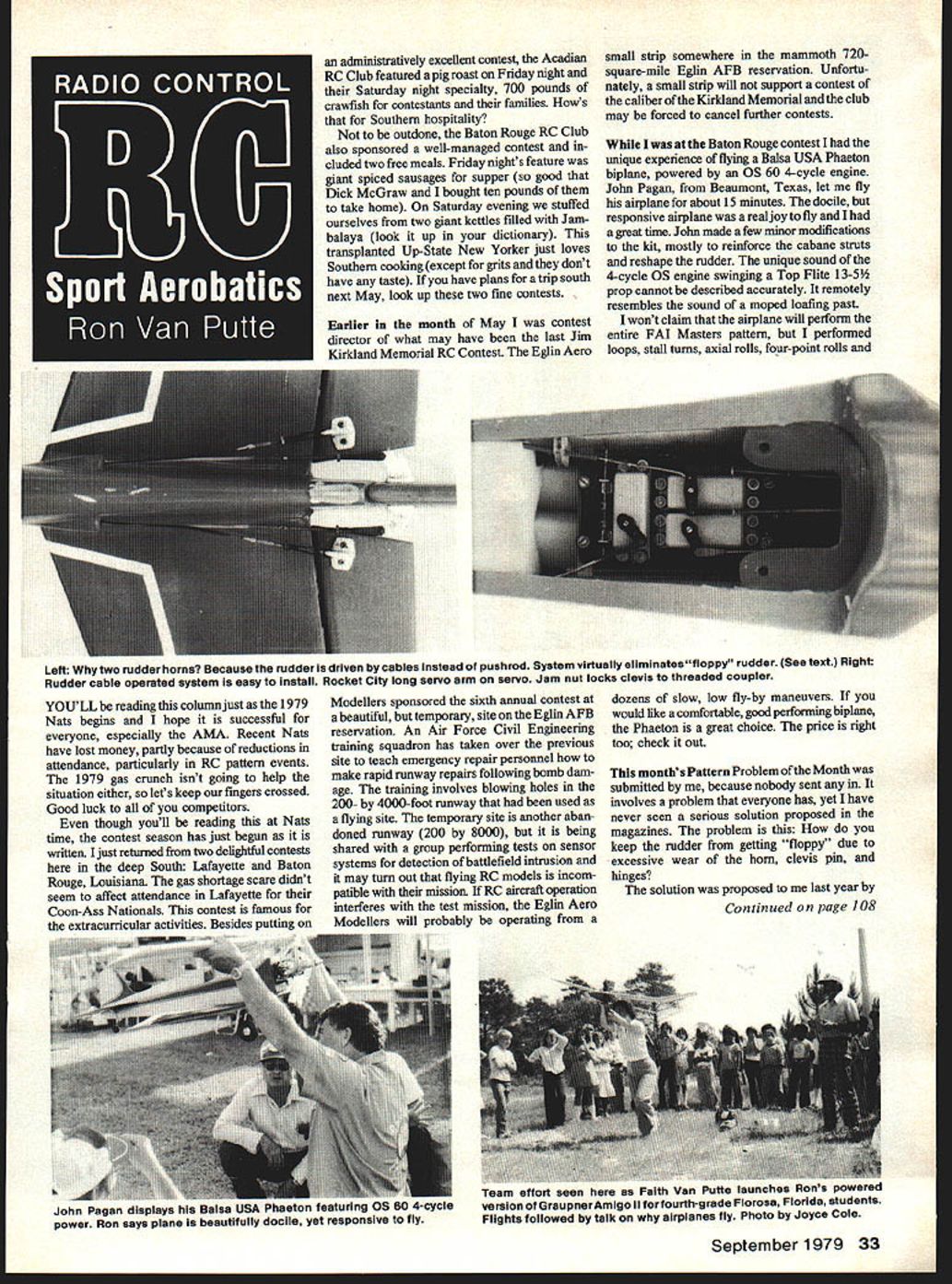
Master flier Jim Edwards (who won the 1968 Masters Tournament in Indianapolis, Indiana) suggested operating the rudder using two thin cables. I filed his suggestion away for almost a year until one of the judges for the Kirkland Memorial noted during a judge's training session that my rudder was getting pretty "floppy." After pondering what to do for about a week, I remembered Jim's suggestion and less than half an hour later the conversion to a cable-driven rudder was complete.
Parts and notes:
- Two Sullivan .030 cables and tubes
- Rocket City long servo arm
- Two IM control horns (cut down to use only the inside holes)
The new Sullivan cable packages come with small threaded couplers which sweat-solder neatly on the cable. The clevis at each end of the cable is locked on the threaded coupler with a jam nut to preclude movement. To install the cable system I simply put new horns on each side of the rudder, drilled an extra hole in the fuselage, installed the threaded cables and adjusted the cable tension. The entire rudder system is now very precise; the only slop is caused by gear backlash in the servos!
On Beginner and Simple Novice events
There seems to be a negative reaction by some manufacturers to the new Beginner and Simple Novice events, which limit the aircraft system to one without retracts, fuel pumps, tuned pipes or Schnuerle-ported engines. The attitude appears to imply that something is being taken away from them by having such events. The logic behind that conclusion escapes me.
These basic events are intended to draw new competitors into pattern flying and to provide a way for transition to the highly competitive Novice class. It seems to me that the manufacturers would welcome these events as a technique to develop new sources of income. The competitor who is encouraged to continue competition in pattern in a reasonable transition will soon be buying all the exotic products that make all the other classes so competitive.
Tips from readers
My mail often brings suggestions from other fliers. One recent letter from R. Gregg Lovick (Grapevine, Texas) "warned the cockles of my Scottish heart" (my mother was born in Scotland). His tip:
"I use a 'conductor's punch,' one of those little plier-like affairs that punch round holes in paper, to cut small circles out of those little scraps of trim MonoKote that we all accrue. I put red and green dots on my gel cell, whose polarity marks are molded into the case and tough to read; makes it easier to clip on the charger or power panel leads without making a mistake—just match the color code on the clip insulators. They also mark the proper switch positions on my transmitter switches for takeoff—low rate aileron and elevator (or whatever your own plane needs), gear down, and a dot by the throttle trim acts as a reminder that low trim kills the engine, so the lever must be centered."
This allows a quick "pre-flight" of all the lever positions before firing up, especially if the transmitter box was impounded and who knows who bumped what. The spots stick well on a clean surface, but can be scraped off with a fingernail if the need arises. I suppose those with two planes and different set-ups could use two sets of dots in different colors as a reminder — maybe color-keyed to a spot by the switch on each plane. These things are punched best, by the way, with the "anvil" on the paper and the "hole" on the mylar. Lots of uses, and I like the price. Me too; thanks for the idea.
Whether the Pattern Problem of the Month continues in the column depends on whether I get some interest from the readers in the form of suggestions. My store of ideas is about to run dry.
Ron Van Putte 12 Connie Drive Shalimar, FL 32579.
Transcribed from original scans by AI. Minor OCR errors may remain.

