
Radio Control: Sport Aerobatics
Ron Van Putte
For the past several months there have been two recurring topics in the club newsletters I receive: Fun-Fly events and flight instructor shortages. There seem to be almost two diametrically opposing philosophies about Fun-Fly events. One group favors events in which only the best pilots have a chance of going home with an intact airplane. The other group wants events in which the novice flier has a chance to beat the club hot shot but which don't endanger the airplane. I favor the latter because such events encourage new pilots to compete.
One of the best ways to improve flying ability is to be forced to improve by flying under pressure, while the risk to the airplane has been minimized. A pilot who faces a rebuild job on his airplane after a Fun Fly will probably not fly well anyway and could stand to lose a measure of his flying ability by being out of action during aircraft repairs.
Events which offer good competition at minimum risk to the airplane are more difficult to devise, but there are a lot of good ones around. The trick is to come up with ideas which don't favor certain airplane/engine combinations. Many events tend to favor the hot airplane or ones with trick devices. No one has a corner on all the good Fun-Fly event ideas, but there are a few events that nearly all the "safe and sane" Fun-Fly competitions have. They meet the following criteria:
- Offer good competition among pilots of varying flying ability.
- Do not cause undue risk to the airplane, pilot, or spectators.
- Do not favor a particular airplane/engine combination.
Le Mans Start
By far the most popular Fun-Fly event is the Le Mans Start. Although it has many variations, virtually all include starting from a point away from the airplane. The pilot carries the prop and prop nut to the airplane, installs the prop and nut, starts the engine and takes the airplane off. Of course, the minimum time wins. The event usually involves a helper/holder. The radio system is checked out before the event starts and the transmitter is left off to preclude takeoff before the start. Electric starters are forbidden for obvious reasons.
Most Loops
Since almost anybody can loop an airplane, another popular event is Most Loops. The flier controls the event, since he decides when he is ready to begin. He performs as many loops as possible in a certain time period, usually 30 seconds. There are a few things which can be done to make an airplane more competitive (like increasing elevator throw), but this event is generally a good leveler of aircraft/engine combinations. A technique many clubs use to reduce aircraft modifications is to insist that the same aircraft configuration be flown in all events. Since few fliers would like to fly a "touchy" airplane, the elevator throw is usually kept to a reasonable level.
Slalom Taxi
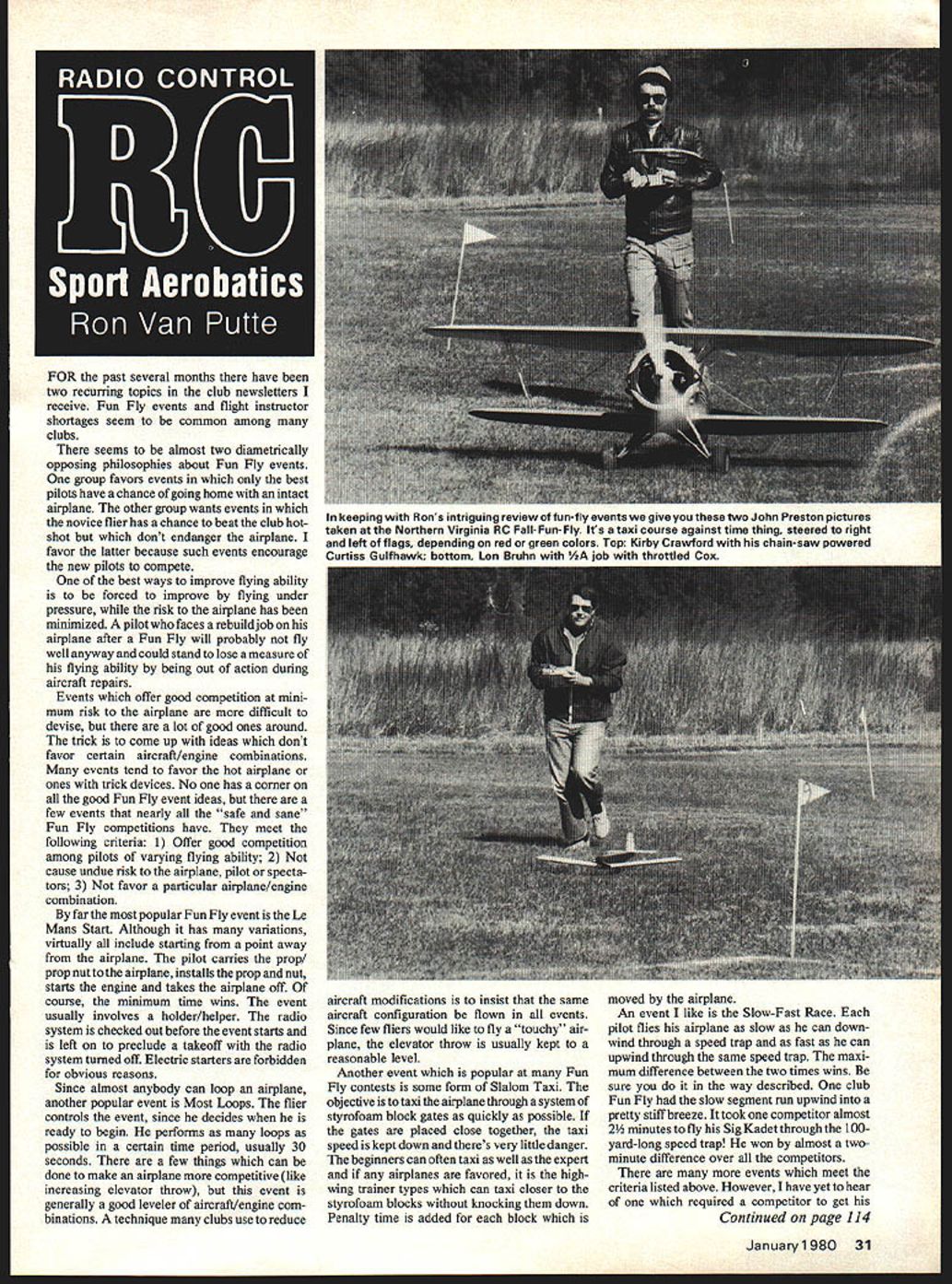
Another event popular at many Fun-Fly contests is some form of Slalom Taxi. The objective is to taxi the airplane through a system of styrofoam block gates as quickly as possible. If the gates are placed close together, the taxi speed is kept down and there's very little danger. Beginners can often taxi as well as the expert, and if any airplanes are favored it is the high-wing trainer types which can taxi closer to the styrofoam blocks without knocking them down. Penalty time is added for each block which is moved by the airplane.
Slow-Fast Race
An event I like is the Slow-Fast Race. Each pilot flies his airplane as slow as he can downwind through a speed trap and as fast as he can upwind through the same speed trap. The maximum difference between the two times wins. Be sure you run it the way described. One club Fun-Fly had the slow segment run upwind into a pretty stiff breeze. It took one competitor almost two and a half minutes to fly his Sig Kadet through the 100-yard-long speed trap! He won by almost a two-minute difference over all the competitors.
There are many more events which meet the criteria listed above. However, I have yet to hear of one which required a competitor to get his airplane on the ground as quickly as he could. Such events are "plane breakers" and should be avoided. If you have some good ideas for Fun-Fly events, let me hear about them so that I can share them with others who read Model Aviation.
Instructor Shortages
The second topic common among newsletters was the instructor problem. If your club has a good supply of qualified instructors, consider yourself lucky. There are a lot of clubs which aren't so fortunate. Many clubs have one or two overworked instructors who don't even have time to fly their own airplanes.
Our sport virtually requires an instructor to give a beginner a reasonable chance of learning to fly without breaking a lot of airplanes. Many other sports are not this way; an acceptable level of competence can be developed in numerous sports just by participating. Of course, the participant usually gets better faster with instruction, but instruction isn't necessary. Not so with flying radio-controlled airplanes. The beginner who can select, build and fly his first RC airplane successfully without help is so rare that we usually rave about the guy.
If good instructors are in short supply, is there anything which can be done to improve the situation? The answer depends on the makeup of the club and the attitude the club has toward beginners.
Developing Instructors
Usually the people who are club instructors fall into two general categories. The first instructor is the extrovert who seeks out the beginners and offers to teach them how to fly. The second type is basically an introvert, but he flies his airplane so well that beginners often ask him to help them learn to fly.
There is little which needs to be done to develop more of the first type of instructors; they are self-starters and most of them are already instructors anyway. However, many beginners are reluctant to approach the second type of instructor. This is where the attitude of the club toward beginners is important. If the club attitude is positive, there is usually an active effort on the part of club officers and members to get the beginners together with instructors. Clubs with a proper attitude toward beginners usually don't have an instructor problem. So, if there's an instructor problem in your club, why not pass on the favor your instructor did for you. Get some beginners in touch with competent but reticent good fliers who would be fine instructors if someone just asked them.
A Humorous Method to Weigh Your Airplane
One of the great things about receiving all the club newsletters is the opportunity to read the humorous items they contain. A sample from Don Tankersley of the Birmingham R/C News: "How Much Does Your Airplane Weigh?"
Many times it is desirable to know how much your latest creation weighs, but finding a suitable balance can be a problem. Bathroom scales are crude, and hauling the plane down to the market to weigh it on the check-out scales attracts a lot of attention. One method that can be used is to print your name, address and zip code, along with the words "First Class," on the wing and drop it in the mail. Then when your plane is delivered (allow six weeks), simply divide the postage due by $1.60 to determine the weight in pounds.
This method has certain drawbacks, however: occasionally an over-zealous postal worker will send the plane by Air Mail (allow eight weeks for delivery), in which case the answer obtained will be incorrect. Also, the plane may sustain some damage in passing through the cancellation and sorting machines.
Transcribed from original scans by AI. Minor OCR errors may remain.

