
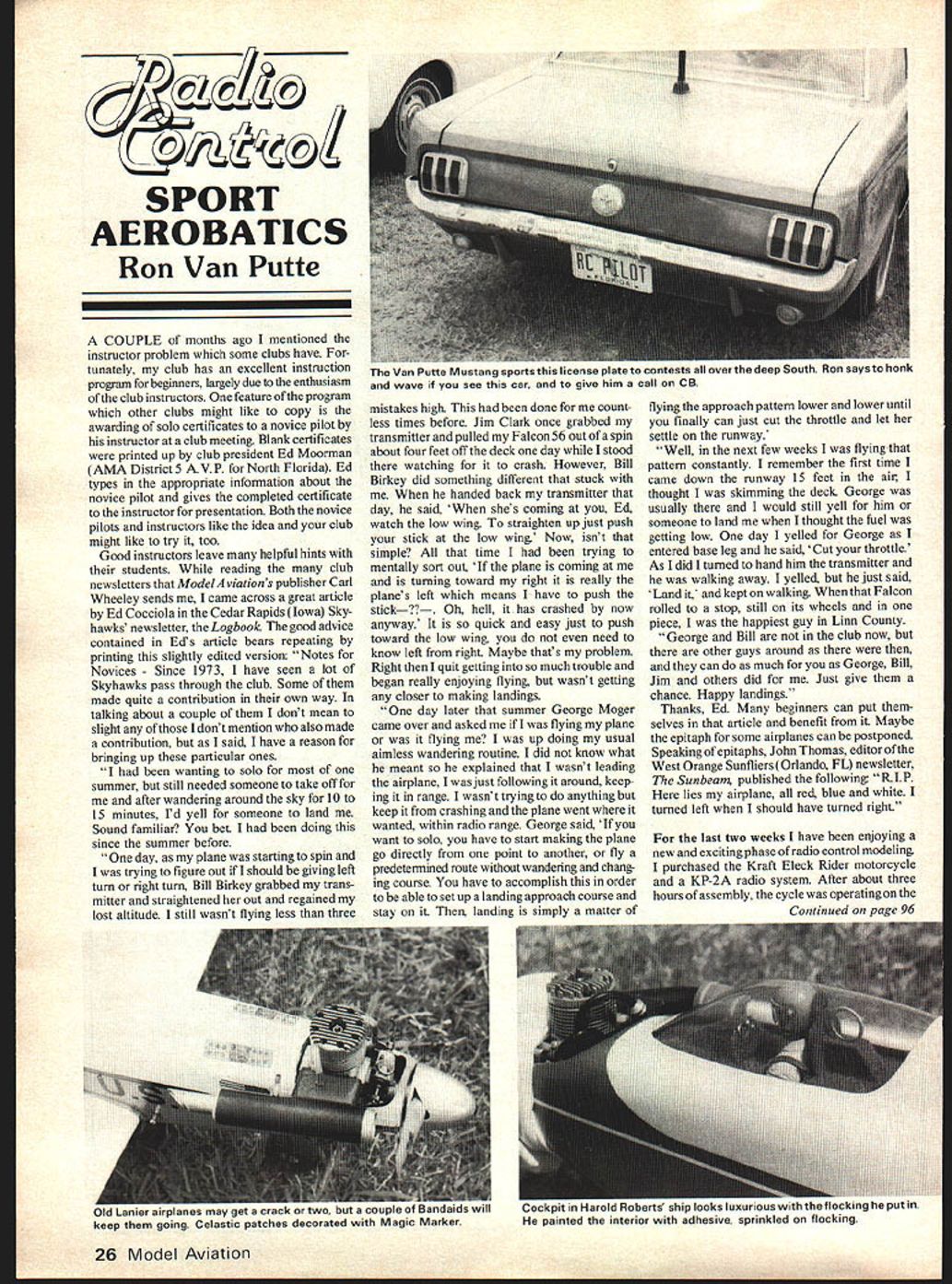
Radio Control: Sport Aerobatics
Ron Van Putte
Club instruction and solo certificates
A couple of months ago I mentioned the instructor problem which some clubs have. Fortunately, my club has an excellent instruction program for beginners, largely due to the enthusiasm of the club instructors. One feature of the program which other clubs might like to copy is the awarding of solo certificates to a novice pilot by his instructor at a club meeting. Blank certificates were printed up by club president Ed Moorman (AMA District 5 A.V.P. for North Florida). Ed types in the appropriate information about the novice pilot and gives the completed certificate to the instructor for presentation. Both the novice pilots and instructors like the idea and your club might like to try it, too.
Good instructors leave many helpful hints with their students. While reading the many club newsletters that Model Aviation's publisher Carl Wheeley sends me, I came across a great article by Ed Cocciola in the Cedar Rapids (Iowa) Skyhawks' newsletter, the Logbook. The good advice contained in Ed's article bears repeating; below is a slightly edited version.
Notes for Novices — Ed Cocciola (from the Cedar Rapids Skyhawks' newsletter, The Logbook)
Since 1973, I have seen a lot of Skyhawks pass through the club. Some of them made quite a contribution in their own way. In talking about a couple of them I don't mean to slight any of those I don't mention who also made a contribution, but, as I said, I have a reason for bringing up these particular ones.
I had been wanting to solo for most of one summer, but still needed someone to take off for me and after wandering around the sky for 10 to 15 minutes, I'd yell for someone to land me. Sound familiar? You bet. I had been doing this since the summer before.
One day, as my plane was starting to spin and I was trying to figure out if I should be giving left turn or right turn, Bill Birkey grabbed my transmitter and straightened her out and regained my lost altitude. I still wasn't flying less than three mistakes high. This had been done for me countless times before. Jim Clark once grabbed my transmitter and pulled my Falcon 56 out of a spin about four feet off the deck one day while I stood there watching for it to crash. However, Bill Birkey did something different that stuck with me. When he handed back my transmitter that day, he said, "When she's coming at you, Ed, watch the low wing. To straighten up, just push your stick at the low wing."
Now, isn't that simple? All that time I had been trying to mentally sort out, "If the plane is coming at me and is turning toward my right, is it really the plane's left which means I have to push the stick—?" Oh, hell, it has crashed by now anyway! It's so quick and easy just to push toward the low wing, you do not even need to know left from right. Maybe that's my problem. Right then I quit getting into so much trouble and began really enjoying flying, but wasn't getting any closer to making landings.
One day later that summer George Moger came over and asked me if I was flying my plane or was it flying me? I was up doing my usual aimless wandering routine. I did not know what he meant so he explained that I wasn't leading the airplane. I wasn't just following it around, keeping it in range. I wasn't trying to do anything but keep it from crashing and the plane went where it wanted, within radio range. George said, "If you want to solo, you have to start making the plane go directly from one point to another, or fly a predetermined route without wandering and changing course. You have to accomplish this in order to be able to set up a landing approach course and stay on it. Then, landing is simply a matter of flying the approach pattern lower and lower until you finally can just cut the throttle and let her settle on the runway."
Well, in the next few weeks I was flying that pattern constantly. I remember the first time I came down the runway 15 feet in the air. I thought I was skimming the deck. George was usually there and I would still yell for him or someone to land me when I thought the fuel was getting low. One day I yelled for George as I entered base leg and he said, "Cut your throttle." As I did I turned to hand him the transmitter and he was walking away. I yelled, but he just said, "Land it," and kept on walking. When that Falcon rolled to a stop, still on its wheels and in one piece, I was the happiest guy in Linn County.
George and Bill are not in the club now, but there are other guys around as there were then, and they can do as much for you as George, Bill, Jim and others did for me. Just give them a chance. Happy landings.
Thanks, Ed. Many beginners can put themselves in that article and benefit from it. Maybe the epitaph for some airplanes can be postponed.
Epitaph
John Thomas, editor of the West Orange Sunfliers (Orlando, FL) newsletter, The Sunbeam, published the following:
"R.I.P. Here lies my airplane, all red, blue and white. I turned left when I should have turned right."
Eleck Rider motorcycle
For the last two weeks I have been enjoying a new and exciting phase of radio control modeling. I purchased the Kraft Eleck Rider motorcycle and a KP-2A radio system. After about three hours of assembly, the cycle was operating on the street in front of my house.
If I said that my technique was faultless from the beginning and that the Eleck Rider performed perfectly, I'd only be half truthful. The cycle did perform perfectly, but my technique left a lot to be desired.
My initially poor driving ability had its advantages. Whenever I lost control and the cycle spun out, ran into the curb, dashed under a car or clobbered the mailbox post, it demonstrated the durability of the system. After two weeks of hard use by 13 novice drivers, my cycle has only scuff marks on the acetate fairing as evidence of its hard life. It's tough.
One of the first questions someone who has never seen it perform asks is, "How difficult is it to keep upright?" The answer is very simple. It's easy. Unless the driver does something to upset it, the cycle will happily drive forever in a straight line. If you want to turn, that's a different story. The Eleck Rider requires coordination of throttle and steering to negotiate a turn. The tighter the turn, the more coordination is required.
Steering is not accomplished by turning the front fork; it is done by tilting the fork. The front wheel/fork is castered and is free to turn in any direction. So how does the cycle steer? Very nicely, thank you, and it is extremely stable, too. I have hit a number of obstructions which include rocks, a manhole cover, cracks in the pavement, acorns, jumping ramps, etc., and with very few exceptions the cycle has stabilized itself and stayed on its course.
The electric motor is operated by a servo-driven rheostat. The throttle stick has a spring return to center. Forward movement of the stick provides proportional forward speed. Pulling back on the stick causes the motor to function like a generator and act as a brake. The "dead man" throttle feature is nice for beginners since the cycle will stop itself if you let go of the stick.
Operating tips
The best place to learn to operate the Eleck Rider is a large, smooth area like a parking lot. Once driving proficiency is achieved in a large area, smaller places can be tried out. The cycle is started by holding it upright, advancing the throttle and holding it stable briefly as it accelerates.
- Initial operation should be at about one-third throttle; attempt only gentle turns.
- Sharper turns must be accomplished by throttling back, turning the cycle, and throttling up halfway through the turn.
- The slower the cycle is, the sharper the turn can be, but the cycle will fall over if it gets too slow.
- The key to success is proper coordination of the throttle.
It takes a proficient RC pilot less than half an hour to learn how to operate the Eleck Rider. Part of the problem that RC newcomers will have is deciding which way to move the stick when the cycle is heading toward them. An experienced pilot has an advantage in this area because he has already learned how to control an airplane coming toward him. Unfortunately, the old rule of "stick toward the low wing" doesn't help much with a motorcycle.
Am I enjoying my Eleck Rider? Well, every weekday I hurry home from work and drive mine for 30 minutes before it gets dark. On weekends it is tough to get all the chores done before taking it out. So far I haven't been able to do any racing with others, because I was "the first kid on the block" to have one. However, several others are on the way and we will probably be racing around water-filled milk jugs at a local parking lot as you read this. Get one!
Pattern Problem of the Month
In case you've been wondering when the next Pattern Problem of the Month will appear, the answer is: when I receive one from someone. The response to my request for problems has been very underwhelming.
Ron Van Putte 12 Connie Drive Shalimar, FL 32579
Transcribed from original scans by AI. Minor OCR errors may remain.

