
SPORT AEROBATICS
Ron Van Putte
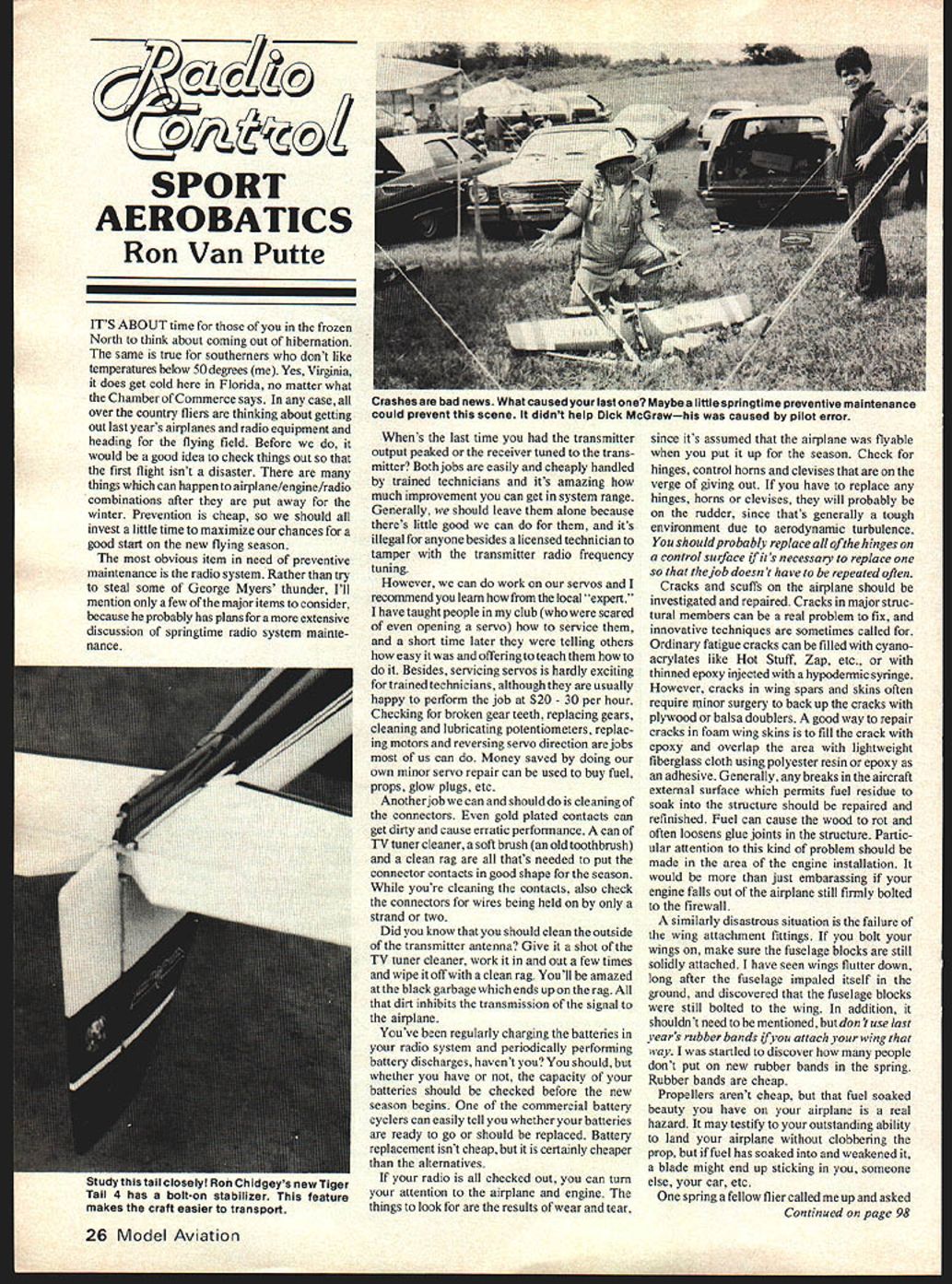
It's about time for those of you in the frozen North to think about coming out of hibernation. The same is true for southerners who don't like temperatures below 50 degrees (me). Yes, Virginia, it does get cold here in Florida, no matter what the Chamber of Commerce says. In any case, all over the country fliers are thinking about getting out last year's airplanes and radio equipment and heading for the flying field. Before we do, it would be a good idea to check things out so that the first flight isn't a disaster. There are many things which can happen to airplane/engine/radio combinations after they are put away for the winter. Prevention is cheap, so we should all invest a little time to maximize our chances for a good start on the new flying season.
Radio System
The most obvious item in need of preventive maintenance is the radio system. Rather than try to steal some of George Myers' thunder, I'll mention only a few of the major items to consider, because he probably has plans for a more extensive discussion of springtime radio system maintenance.
When's the last time you had the transmitter output peaked or the receiver tuned to the transmitter? Both jobs are easily and cheaply handled by trained technicians, and it's amazing how much improvement you can get in system range. Generally, we should leave RF tuning alone because there's little good we can do with it, and it's illegal for anyone besides a licensed technician to tamper with the transmitter radio frequency tuning.
Servos
However, we can do work on our servos and I recommend you learn how from the local "expert." I have taught people in my club (who were scared of even opening a servo) how to service them, and a short time later they were telling others how easy it was and offering to teach them how to do it. Besides, servicing servos is hardly exciting for trained technicians, although they are usually happy to perform the job at $20–30 per hour.
- Checking for broken gear teeth
- Replacing gears
- Cleaning and lubricating potentiometers
- Replacing motors
- Reversing servo direction
These are jobs most of us can do. Money saved by doing our own minor servo repair can be used to buy fuel, props, glow plugs, etc.
Connectors, Antenna, Batteries
Another job we can and should do is cleaning the connectors. Even gold-plated contacts can get dirty and cause erratic performance. A can of TV tuner cleaner, a soft brush (an old toothbrush), and a clean rag are all that's needed to put the connector contacts in good shape for the season. While you're cleaning the contacts, also check the connectors for wires being held on by a strand or two.
Did you know that you should clean the outside of the transmitter antenna? Give it a shot of TV tuner cleaner, work it in and out a few times, and wipe it off with a clean rag. You'll be amazed at the black garbage which ends up on the rag. All that dirt inhibits the transmission of the signal to the airplane.
You've been regularly charging the batteries in your radio system and periodically performing battery discharges, haven't you? You should, but whether you have or not, the capacity of your batteries should be checked before the season begins. One of the commercial battery cyclers can easily tell you whether your batteries are ready to go or should be replaced. Battery replacement isn't cheap, but it is certainly cheaper than the alternatives.
Airplane and Engine
If your radio is all checked out, you can turn your attention to the airplane and engine. The things to look for are the results of wear and tear, since it's assumed that the airplane was flyable when you put it up for the season.
Check for hinges, control horns, and clevises that are on the verge of giving out. If you have to replace any hinges, horns, or clevises, they will probably be on the rudder, since that's generally a tough environment due to aerodynamic turbulence. You should probably replace all of the hinges on a control surface if it's necessary to replace one so that the job doesn't have to be repeated often.
Cracks and scuffs on the airplane should be investigated and repaired. Cracks in major structural members can be a real problem to fix, and innovative techniques are sometimes called for. Ordinary fatigue cracks can be filled with cyanoacrylates (Hot Stuff, Zap, etc.) or with thinned epoxy injected with a hypodermic syringe. However, cracks in wing spars and skins often require minor surgery to back up the cracks with plywood or balsa doublers.
A good way to repair cracks in foam wing skins is to fill the crack with epoxy and overlap the area with lightweight fiberglass cloth using polyester resin or epoxy as an adhesive. Generally, any breaks in the aircraft external surface which permit fuel residue to soak into the structure should be repaired and refinished. Fuel can cause the wood to rot and often loosens glue joints in the structure. Particular attention to this kind of problem should be made in the area of the engine installation. It would be more than just embarrassing if your engine falls out of the airplane still firmly bolted to the firewall.
A similarly disastrous situation is the failure of the wing attachment fittings. If you bolt your wings on, make sure the fuselage blocks are still soundly attached. I have seen wings flutter down long after the fuselage impaled itself on the ground and discovered that the fuselage blocks were still bolted to the wing. In addition, it shouldn't need to be mentioned, but don't use last year's rubber bands if you attach your wing that way. I was startled to discover how many people don't put on new rubber bands in the spring. Rubber bands are cheap.
Propellers aren't cheap, but that fuel-soaked beauty you have on your airplane is a real hazard. It may testify to your outstanding ability to land your airplane without cogging the prop, but if fuel has soaked into and weakened it, a blade might end up sticking in you, somebody else, your car, etc.
Fuel, Tanks, and Oils
One spring a fellow flier called me up and asked if it was okay to use fuel that had turned blue (it was originally red). It turned out that he had left his airplane with a full fuel tank in the fall and the fuel had reacted with the brass tank tubing, turning it blue. Chances are you more or less emptied your tank last fall, but even a little bit of fuel can do peculiar things in a fuel tank. Filters can clog up, fuel line gets soft and gummy, and sediments can develop in the bottom of the tank.
Castor oil–based fuels can give real problems since the oil tends to spoil, actually turn rancid, in storage. The moral is to flush out the tank and check out the fittings and tubing for problems. If you have any of last year's castor oil–based fuel left, pour some into a clean container and look for little white flakes suspended in it. Those flakes are castor oil which precipitated out of the fuel mixture.
I wouldn't use it, but I don't like castor oils in fuel anyway because of the brown mess that gets all over the head and cooling fins of the engine. There are a lot of good commercial products for cleaning engines with baked-on castor oil. I just cleaned a dozen such engines, bought from a flier getting out of the hobby, with a quart of GMP Motor Kleen. It cleaned the last engine as nicely as the first one. Whatever you use, don't try commercial oven cleaner; it attacks aluminum.
After you've done everything else, check to see that the engine and servos are securely bolted down. Then, settle back and enjoy the good feeling that confidence in your equipment can give.
Club Notes and Miscellany
Clubs have all kinds of awards, but I never heard about the "Crasher Trophy" until reading the Bell Air R/C Flyer (Bellingham, Washington). Their new award was announced in a recent newsletter as follows:
"We now have a Crasher Trophy. The basic rules are as follows: To receive this award you must crash in the presence of the current holder of the trophy. To get rid of the trophy you must present it when the next guy crashes and you must present it to him immediately; that is, to retain the trophy you must hand the trophy with you. If you should happen to earn this award, you will not be permitted to fly without bringing the trophy with you."
Boy, that's ribbing, ain't it!
I've been reading in quite a few newsletters that the FCC is making refunds to Citizens Band operators who paid up to $20 for licenses in the years 1970 to 1976. To get the special booklet you need to apply for the refund, write to:
FCC Fee Refund Program Box 1788 Hyattsville, MD 20788
Ron Van Putte 12 Connie Drive Shalimar, FL 32579
Transcribed from original scans by AI. Minor OCR errors may remain.

