
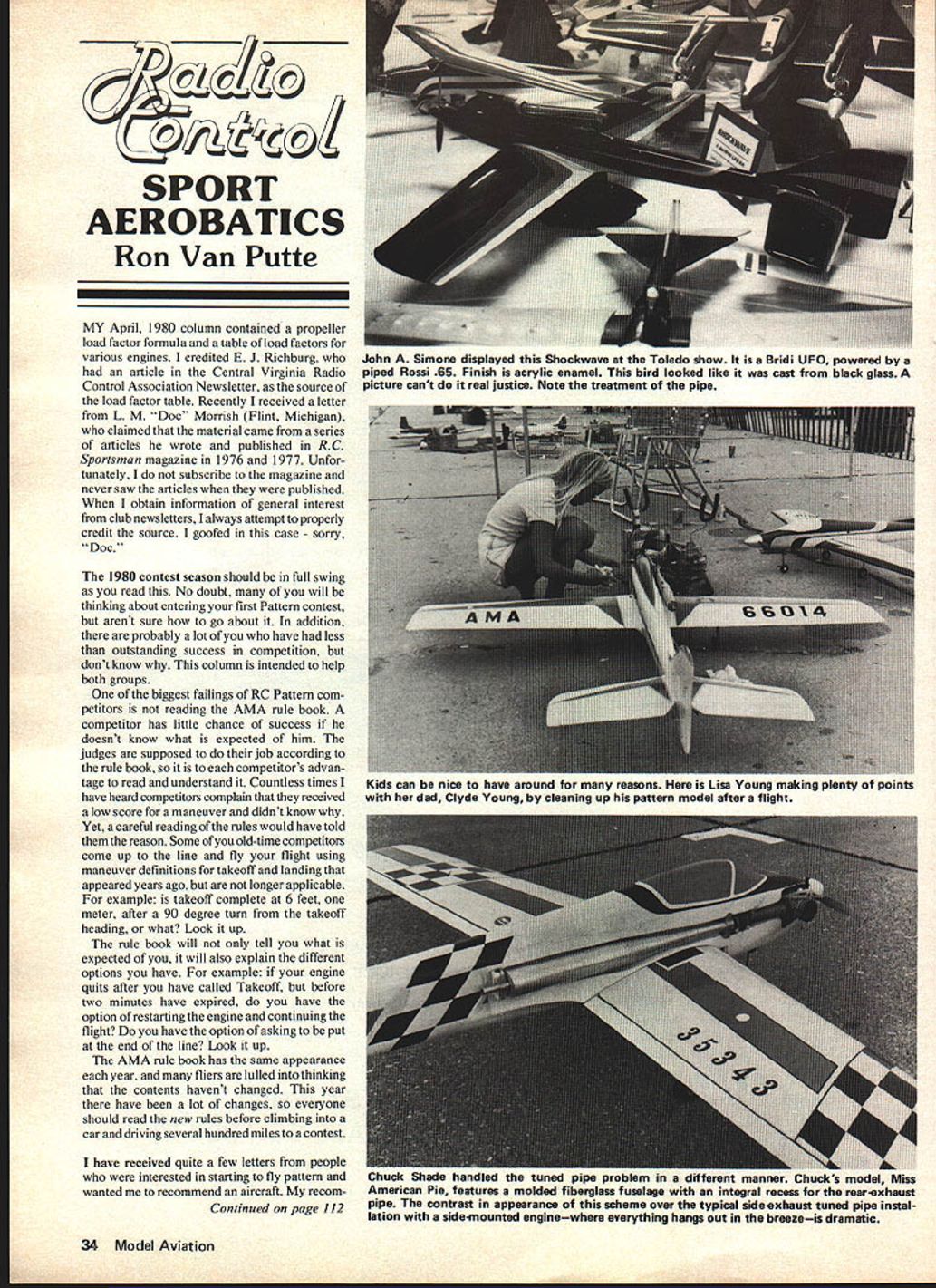
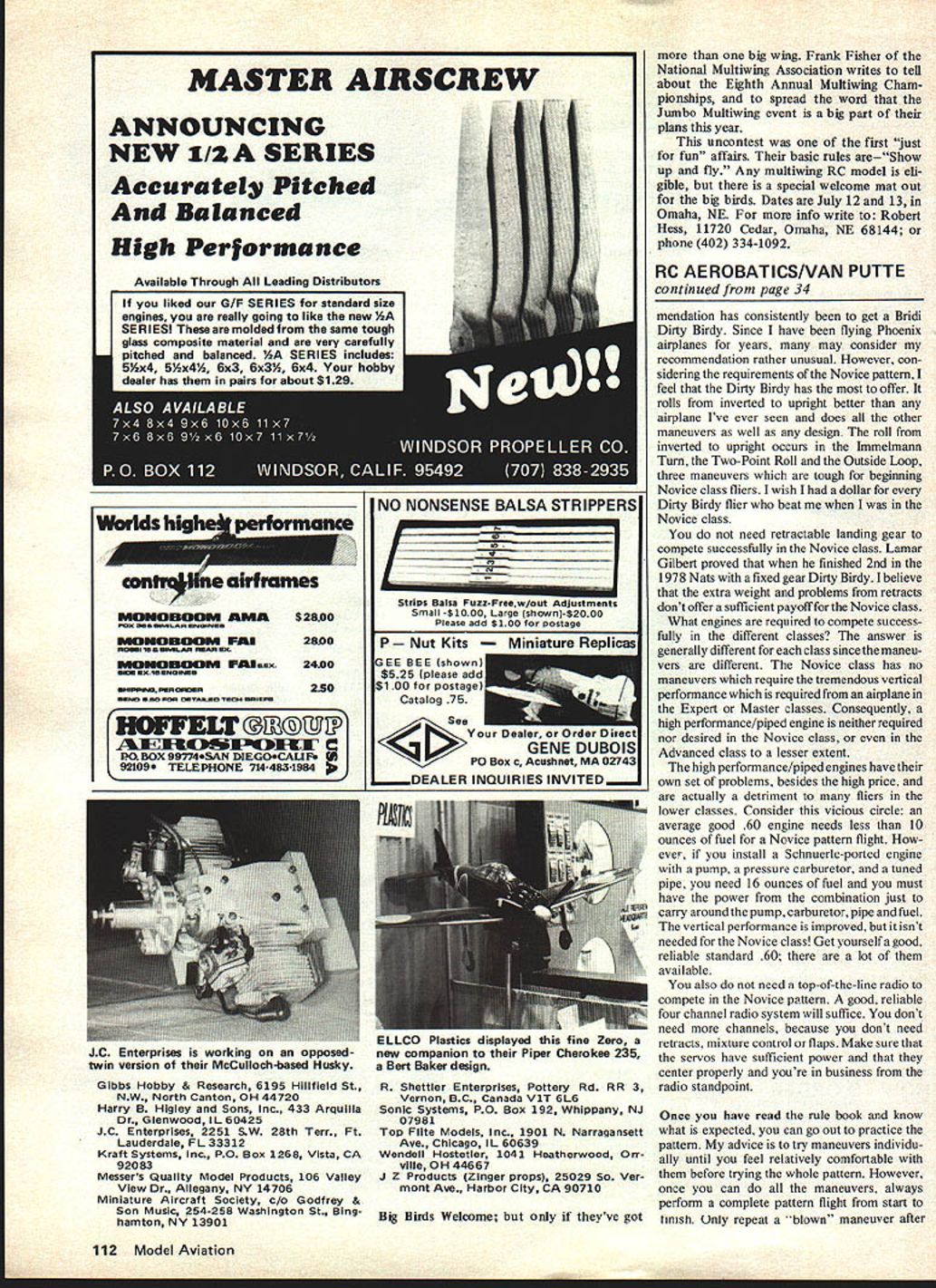
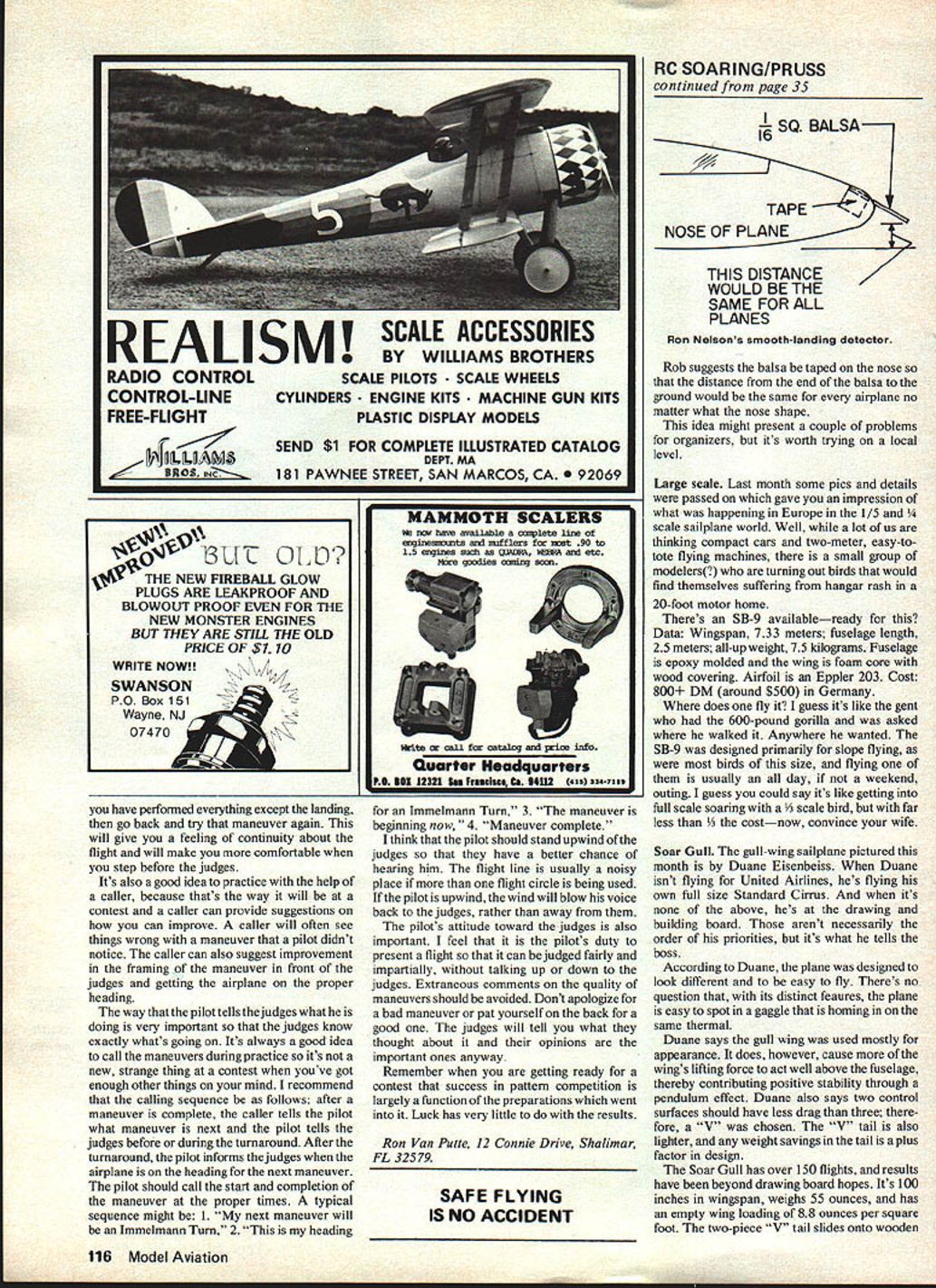
Radio Control: SPORT AEROBATICS
Ron Van Putte
My April 1980 column contained a propeller load factor formula and a table of load factors for various engines. I credited E. J. Richburg, who had an article in the Central Virginia Radio Control Association Newsletter, as the source of the load factor table. Recently I received a letter from L. M. "Doc" Morrish (Flint, Michigan), who claimed that the material came from a series of articles he wrote and published in R.C. Sportsman magazine in 1976 and 1977. Unfortunately, I do not subscribe to the magazine and never saw the articles when they were published. When I obtain information of general interest from club newsletters, I always attempt to properly credit the source. I goofed in this case—sorry, "Doc".
The 1980 contest season should be in full swing as you read this. No doubt many of you will be thinking about entering your first Pattern contest, but aren't sure how to go about it. In addition, there are probably a lot of you who have had less than outstanding success in competition, but don't know why. This column is intended to help both groups.
Reading the rules
One of the biggest failings of RC Pattern competitors is not reading the AMA rule book. A competitor has little chance of success if he doesn't know what is expected of him. The judges are supposed to do their job according to the rule book, so it is to each competitor's advantage to read and understand it. Countless times I have heard competitors complain that they received a low score for a maneuver and didn't know why. Yet a careful reading of the rules would have told them the reason.
Some of you old-time competitors come up to the line and fly your flight using maneuver definitions for takeoff and landing that appeared years ago, but are no longer applicable. For example: is takeoff complete at 6 feet, one meter, after a 90-degree turn from the takeoff heading, or what? Look it up.
The rule book will not only tell you what is expected of you, it will also explain the different options you have. For example: if your engine quits after you have called "Takeoff," but before two minutes have expired, do you have the option of restarting the engine and continuing the flight? Do you have the option of asking to be put at the end of the line? Look it up.
The AMA rule book has the same appearance each year, and many fliers are lulled into thinking that the contents haven't changed. This year there have been a lot of changes, so everyone should read the new rules before climbing into a car and driving several hundred miles to a contest.
Choosing an aircraft
I have received quite a few letters from people who were interested in starting to fly pattern and wanted me to recommend an aircraft. My recommendation has consistently been to get a Bridi Dirty Birdy. Since I have been flying Phoenix airplanes for years, many may consider my recommendation unusual. However, considering the requirements of the Novice pattern, I feel that the Dirty Birdy has the most to offer.
It rolls from inverted to upright better than any airplane I've ever seen and does all the other maneuvers as well as any design. The roll from inverted to upright occurs in the Immelmann Turn, the Two-Point Roll, and the Outside Loop—three maneuvers that are tough for beginning Novice-class fliers. I wish I had a dollar for every Dirty Birdy flier who beat me when I was in the Novice class.
You do not need retractable landing gear to compete successfully in the Novice class. Lamar Gilbert proved that when he finished 2nd in the 1978 Nats with a fixed-gear Dirty Birdy. I believe that the extra weight and problems from retracts don't offer a sufficient payoff for the Novice class.
Engines and radios
What engines are required to compete successfully in the different classes? The answer is generally different for each class since the maneuvers are different. The Novice class has no maneuvers which require the tremendous vertical performance that is required from an airplane in the Expert or Master classes. Consequently, a high-performance/piped engine is neither required nor desired in the Novice class, and to a lesser extent, the Advanced class.
High-performance/piped engines have their own set of problems besides the high price, and are actually a detriment to many fliers in the lower classes. Consider this vicious circle: an average good .60 engine needs less than 10 ounces of fuel for a Novice pattern flight. However, if you install a Schnuerle-ported engine with a pump, a pressure carburetor, and a tuned pipe, you need 10 ounces of fuel and you must have the power from the combination just to carry around the pump, carburetor, pipe, and fuel. The vertical performance is improved, but it isn't needed for the Novice class! Get yourself a good, reliable standard .60; there are a lot of them available.
You also do not need a top-of-the-line radio to compete in the Novice pattern. A good, reliable four-channel radio system with a single aileron servo and two-channel mixing will suffice. You don't need more channels, because you don't need flaps, retracts, or mixture control. Make sure that the servos have sufficient power and that the radio is reliable, and you're in business from the radio standpoint.
Practice and contest technique
Once you have read the rule book and know what is expected, you can go out to practice the pattern. My advice is to try maneuvers individually until you feel relatively comfortable with them before trying the whole pattern. However, once you can do all the maneuvers, always perform a complete pattern flight from start to finish.
Only repeat a "blown" maneuver after you have performed everything except the landing; then go back and try that maneuver again. This will give you a feeling of continuity about the flight and will make you more comfortable when you step before the judges.
It's also a good idea to practice with the help of a caller, because that's the way it will be at a contest and a caller can provide suggestions on how you can improve. A caller will often see things wrong with a maneuver that a pilot didn't notice. The caller can also suggest improvements in the framing of the maneuver in front of the judges and getting the airplane on the proper heading.
The way that the pilot tells the judges what he is doing is very important so that the judges know exactly what's going on. It's always a good idea to call the maneuvers during practice so it's not a new, strange thing at a contest when you've got enough other things on your mind.
I recommend that the calling sequence be as follows:
- Caller tells the pilot what maneuver is next.
- The pilot tells the judges before or during the turnaround.
- After the turnaround, the pilot informs the judges when the airplane is on the heading for the next maneuver.
- The pilot calls the start and completion of the maneuver at the proper times.
A typical sequence might be:
- "My next maneuver will be an Immelmann Turn."
- "This is my heading for an Immelmann Turn."
- "The maneuver is beginning now."
- "Maneuver complete."
I think that the pilot should stand upwind of the judges so that they have a better chance of hearing him. The flight line is usually a noisy place if more than one flight circle is being used. If the pilot is upwind, the wind will blow his voice back to the judges rather than away from them.
The pilot's attitude toward the judges is also important. It is the pilot's duty to present a flight so that it can be judged fairly and impartially, without talking up or down to the judges. Extraneous comments on the quality of maneuvers should be avoided. Don't apologize for a bad maneuver or pat yourself on the back for a good one. The judges will tell you what they thought about it and their opinions are the important ones anyway.
Remember when you are getting ready for a contest that success in pattern competition is largely a function of the preparations which went into it. Luck has very little to do with the results.
Ron Van Putte 12 Connie Drive Shalimar, FL 32579.
Transcribed from original scans by AI. Minor OCR errors may remain.

