
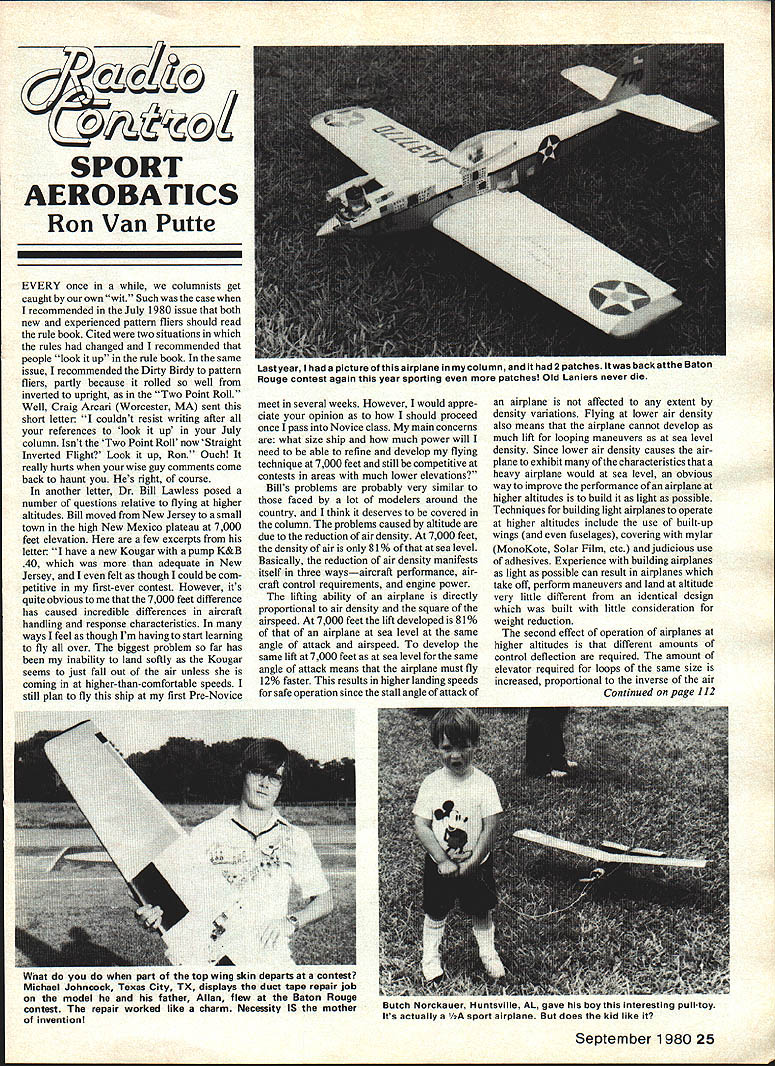
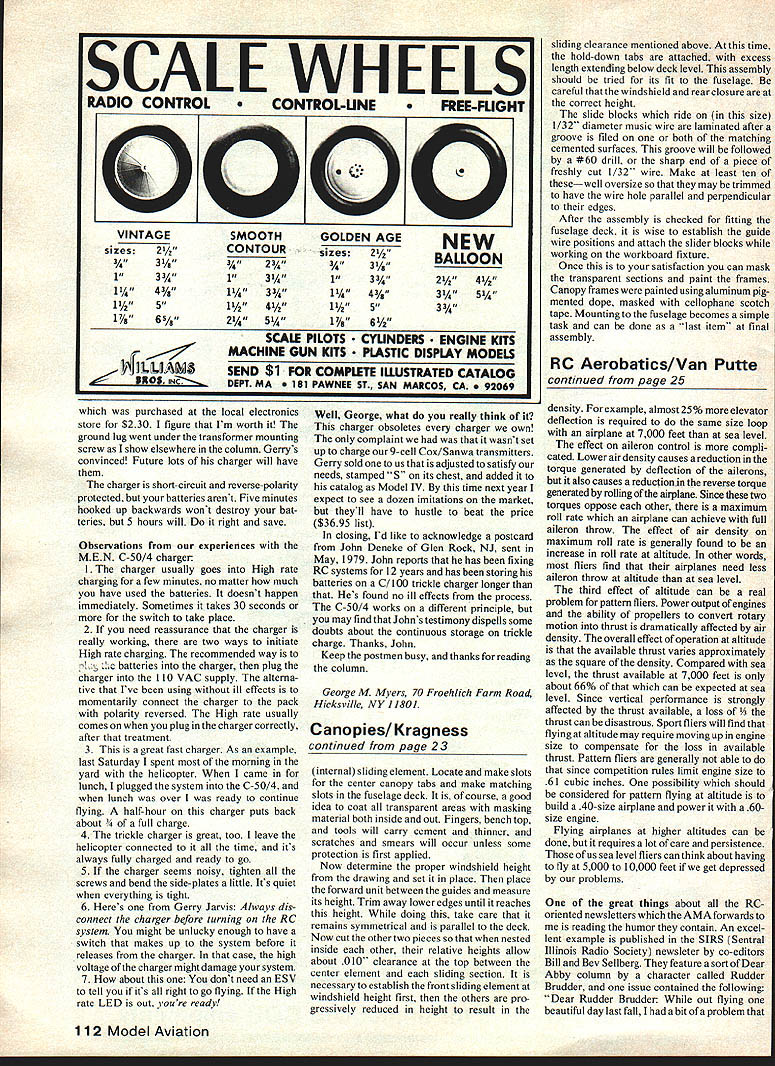
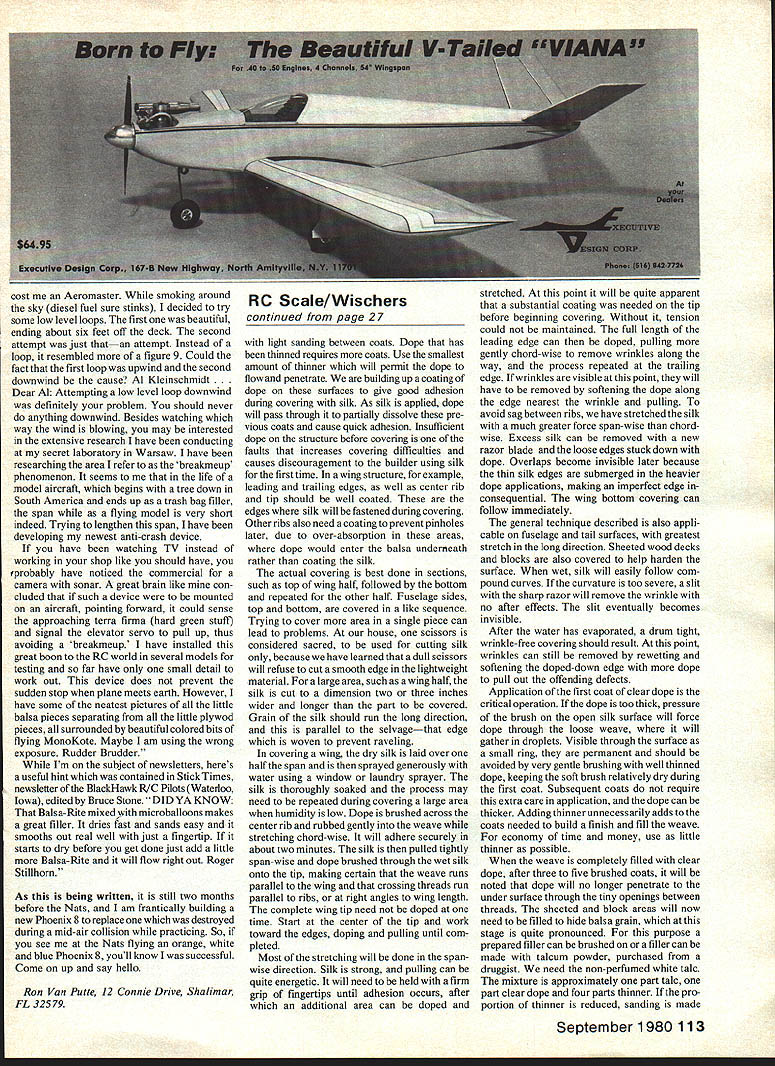
Radio Control: Sport Aerobatics
Ron Van Putte
EVERY once in a while, we columnists get caught by our own wit. Such was the case when I recommended in the July 1980 issue that both new and experienced pattern fliers should read the rule book. I cited two situations in which the rules had changed and recommended that people "look it up" in the rule book. In the same issue I recommended the Dirty Birdy to pattern fliers, partly because it rolled so well inverted as well as upright — as in the "Two-Point Roll." Well, Craig Arcari (Worcester, MA) sent a short letter: "I couldn't resist writing after all your references to 'look it up' in your July column. Isn't the 'Two-Point Roll' now 'Straight Inverted Flight'? Look it up, Ron." Ouch — it really hurts when your wise‑guy comments come back to haunt you. He's right, of course.
Flying at High Altitude — Letter from Bill Lawless
Dr. Bill Lawless posed several questions about flying at higher altitudes after moving from New Jersey to the high New Mexico plateau at about 7,000 feet elevation. Excerpts from his letter:
"I have a new Kougar with a pumped K&B .40, which was more than adequate in New Jersey, and I even felt as though I could be competitive in my first-ever contest. However, it's quite obvious to me that the 7,000 feet difference has caused incredible differences in aircraft handling and response characteristics. In many ways I feel as though I'm having to start learning to fly all over. The biggest problem so far has been my inability to land softly as the Kougar seems to just fall out of the air unless coming in at higher‑than‑comfortable speeds. I still plan to fly this ship at my first Pre‑Novice meet in several weeks. However, I would appreciate your opinion as to how I should proceed once I pass into Novice class. My main concerns are what size ship and how much power will I need to be able to refine and develop my flying technique at 7,000 feet and still be competitive at contests in areas with much lower elevations?"
Bill's problems are likely similar to those faced by many modelers around the country. They stem from the reduction of air density at altitude. At 7,000 feet, the air density is only about 81% of that at sea level. The reduction of air density manifests itself in three main ways:
- Aircraft performance
- Aircraft control requirements
- Engine and propeller power
1. Aircraft performance
Lifting ability is directly proportional to air density and to the square of airspeed. At 7,000 feet the lift developed is roughly 81% of that at sea level for the same angle of attack and airspeed. To develop the same lift at 7,000 feet as at sea level (for the same angle of attack), the airplane must fly approximately 12% faster. This results in higher landing speeds and less margin for safe operation since stall angle of attack is essentially unaffected by density variations.
Lower air density also reduces the lift available for maneuvers such as loops, so airplanes will behave as if they were heavier compared to the same design at sea level. An obvious mitigation is to build as light as possible.
#### Techniques for building light airplanes (for high-altitude operation)
- Use built‑up wings and fuselages rather than heavy sheet construction.
- Cover with lightweight films such as Mylar, MonoKote, or Solarfilm.
- Use adhesives judiciously — avoid excess glue and unnecessary reinforcement.
- Consider overall weight‑saving practices learned from experience to improve takeoff, maneuvering, and landing performance at altitude.
Experience with lightweight construction can make an airplane take off, perform maneuvers, and land at altitude with very little difference from an identical design optimized for sea level.
2. Aircraft control requirements
Reduced air density changes the amounts of control deflection required.
- Elevator: The amount of elevator required for loops of the same size increases in proportion to the inverse of the air density. For example, almost 25% more elevator deflection is required to fly the same size loop at 7,000 feet than at sea level.
- Ailerons: The effect on aileron control is more complex. Lower air density reduces the aerodynamic torque generated by aileron deflection, but it also reduces the reverse (gyroscopic or damping) torque created by the rolling motion of the airplane. Since these torques oppose each other, there is a maximum roll rate achievable with full aileron throw. In practice, many fliers find that roll rates increase at altitude, and that their airplanes need less aileron throw at altitude than at sea level.
3. Engine and propeller power
Power output of engines and thrust developed by propellers are reduced by lower air density. At 7,000 feet the available thrust is only about 81% of that at sea level. Significant loss of thrust can be critical for some airplanes.
- Sport fliers may need to increase engine size to compensate for the loss in available thrust.
- Pattern fliers are generally limited by competition rules on engine displacement; where rules permit, one compromise is to fly a design intended for a .40–.45 engine but power it with a .60‑size engine at altitude.
Making the airplane as light as possible, adjusting control throws and expo, and increasing power where allowed will help you refine and develop flying technique at altitude while remaining competitive at lower elevations.
Ron Van Putte 12 Connie Drive Shalimar, FL 32579
Transcribed from original scans by AI. Minor OCR errors may remain.

