
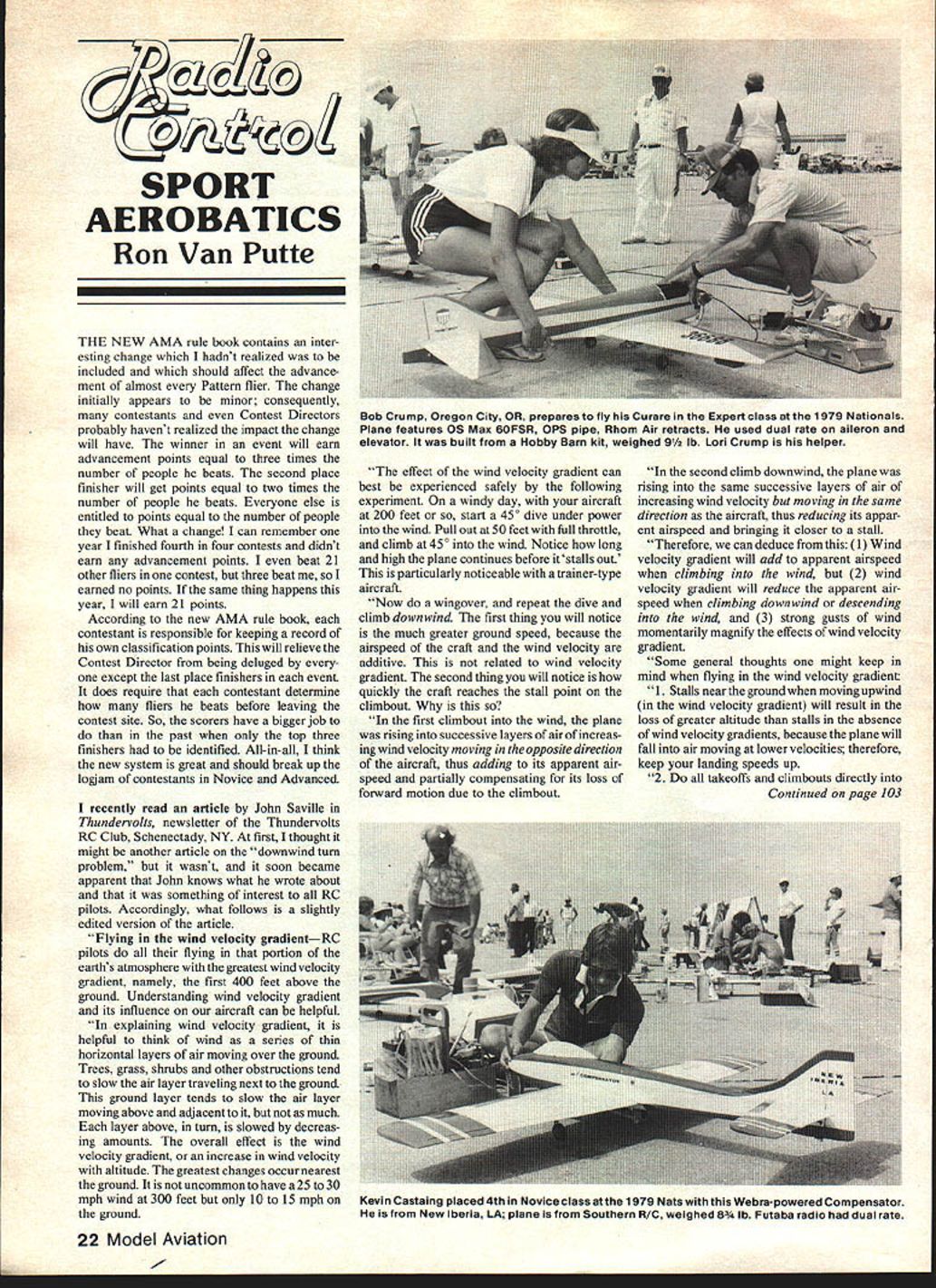
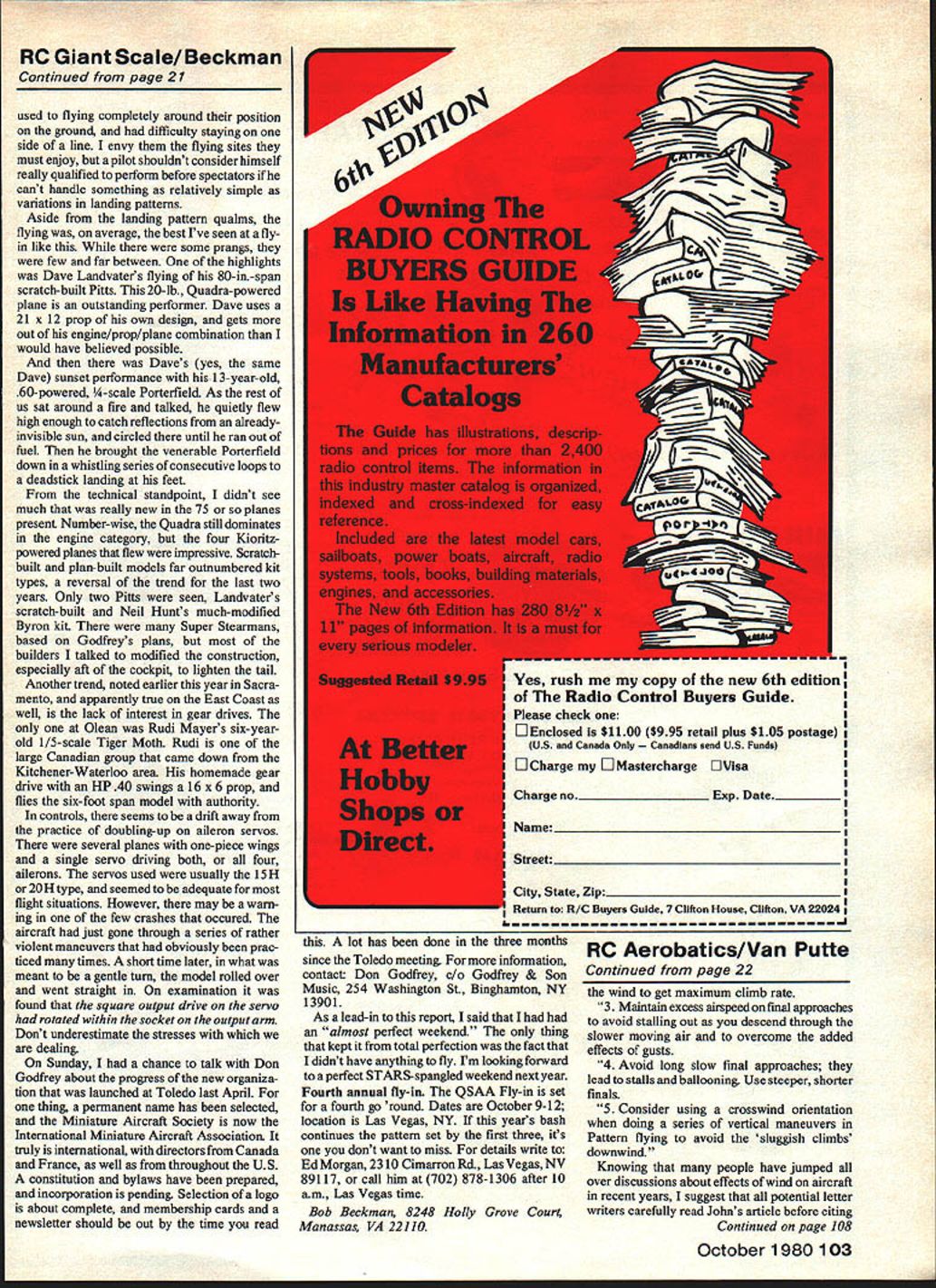
Radio Control: Sport Aerobatics
Ron Van Putte
AMA rule change
The new AMA rule book contains an interesting change which I hadn't realized was to be included and which should affect the advancement of almost every Pattern flier. The change initially appears to be minor; consequently, many contestants and even Contest Directors probably haven't realized the impact it will have.
Under the new rule, the winner in an event will earn advancement points equal to three times the number of people he beats. The second-place finisher will get points equal to two times the number of people he beats. Everyone else is entitled to points equal to the number of people they beat. What a change! I can remember one year I finished fourth in four contests and didn't earn any advancement points. I even beat 21 other fliers in one contest, but three beat me, so I earned no points. If the same thing happens this year, I will earn 21 points.
According to the new AMA rule book, each contestant is responsible for keeping a record of his own classification points. This will relieve the Contest Director from being deluged by everyone except the last-place finishers in each event. It does require that each contestant determine how many fliers he beats before leaving the contest site. So, the scorers have a bigger job to do than in the past when only the top three finishers had to be identified. All in all, I think the new system is great and should break up the logjam of contestants in Novice and Advanced.
Wind velocity gradient (article by John Saville)
I recently read an article by John Saville in Thundervolts, the newsletter of the Thundervolts RC Club, Schenectady, NY. At first I thought it might be another article on the "downwind turn problem," but it wasn't. It soon became apparent that John knows what he wrote about and that it is of interest to all RC pilots. What follows is a slightly edited version of his article.
Flying in the wind velocity gradient — RC pilots do all their flying in that portion of the earth's atmosphere with the greatest wind velocity gradient, namely, the first 400 feet above the ground. Understanding wind velocity gradient and its influence on our aircraft can be helpful.
In explaining wind velocity gradient, it is helpful to think of wind as a series of thin horizontal layers of air moving over the ground. Trees, grass, shrubs, and other obstructions tend to slow the air layer traveling next to the ground. This ground layer tends to slow the air layer moving above and adjacent to it, but not as much. Each layer above, in turn, is slowed by decreasing amounts. The overall effect is the wind velocity gradient, or an increase in wind velocity with altitude. The greatest changes occur nearest the ground. It is not uncommon to have a 25 to 30 mph wind at 300 feet but only 10 to 15 mph on the ground.
The effect of the wind velocity gradient can best be experienced safely by the following experiment. On a windy day, with your aircraft at 200 feet or so, start a 45° dive under power into the wind. Pull out at 50 feet with full throttle, and climb at 45° into the wind. Notice how long and high the plane continues before it "stalls out." This is particularly noticeable with a trainer-type aircraft.
Now do a wingover, and repeat the dive and climb downwind. The first thing you will notice is the much greater ground speed, because the airspeed of the craft and the wind velocity are additive. This is not related to wind velocity gradient. The second thing you will notice is how quickly the craft reaches the stall point on the climbout. Why is this so?
In the first climbout into the wind, the plane was rising into successive layers of air of increasing wind velocity moving in the opposite direction of the aircraft, thus adding to its apparent airspeed and partially compensating for its loss of forward motion due to the climbout.
In the second climb downwind, the plane was rising into the same successive layers of air of increasing wind velocity but moving in the same direction as the aircraft, thus reducing its apparent airspeed and bringing it closer to a stall.
Therefore, we can deduce from this:
- Wind velocity gradient will add to apparent airspeed when climbing into the wind.
- Wind velocity gradient will reduce the apparent airspeed when climbing downwind or descending into the wind.
- Strong gusts of wind momentarily magnify the effects of wind velocity gradient.
Practical tips when flying in the wind velocity gradient
Some general thoughts one might keep in mind when flying in the wind velocity gradient:
- Stalls near the ground when moving upwind (in the wind velocity gradient) will result in the loss of greater altitude than stalls in the absence of wind velocity gradients, because the plane will fall into air moving at lower velocities; therefore, keep your landing speeds up.
- Do all takeoffs and climbouts directly into the wind to get maximum climb rate.
- Maintain excess airspeed on final approaches to avoid stalling out as you descend through the slower moving air and to overcome the added effects of gusts.
- Avoid long, slow final approaches; they lead to stalls and ballooning. Use steeper, shorter finals.
- Consider using a crosswind orientation when doing a series of vertical maneuvers in Pattern flying to avoid the "sluggish climbs" downwind.
Knowing that many people have jumped all over discussions about effects of wind on aircraft in recent years, I suggest that all potential letter writers carefully read John's article before citing Newton's laws, 20 years of experience flying private airplanes, or other irrefutable sources to support contradictory arguments. He's right.
Letters about the Dirty Birdy
Among several letters I received recently were two about the same subject: my recommendation of the Dirty Birdy as a good beginning (and beyond) Pattern airplane. One was from Dale Johnson (APO New York), who thanked me for helping him make up his mind.
The other letter was from Glen Dean (San Diego, CA), who wrote, "I agree that the Dirty Birdy is a good plane, but your wholesale recommendation of any particular plane should be tempered with more basic prerequisites such as how straight and true the aircraft is built. I think, all too often, people focus on trend-setting fliers without due regard for how they became good. The illusion that the purchase of the 'right equipment' guarantees success is advice misplaced. I believe that fliers like Jim Kimbro, Joe Bridi, and Jim Oddino could 'blow out' most of us with an RCM Trainer. In other words, I believe that the person pushing the sticks is, by far and away, the single largest factor. Aircraft design is secondary to aircraft trueness, but practice is next to trueness."
He's right, of course. However, there are airplanes which make it easier to perform many of the maneuvers, and there's no sense trying to learn how to fly the pattern and compete with an inferior airplane. My objective in recommending the Dirty Birdy was solely to give a beginner a good starting place in competition.
Would more of you like to read about what the "big boys" do to improve their flying? If enough of you respond, I'll try to include several features on the subject.
Are any of you hoarding any good black-and-white pictures which could be used in this column? Why not send me a few and maybe you'll become rich and famous when you get $5 a picture when published, and have your name in the picture caption. So, maybe you won't become rich and famous — I'd still like to get some good pictures. (Editor's note: Good-quality color prints (not slides) are also acceptable. We have also received black-and-white Polaroid pictures which were of acceptable quality for our use.)
Ron Van Putte 12 Connie Drive Shalimar, FL 32579
Transcribed from original scans by AI. Minor OCR errors may remain.

