
Radio Control: Sport Aerobatics
Ron Van Putte
Reader's letter: "Agony of Defeat"
A short while ago I received a depressing letter that was often too close to the truth, and I want to share it because I don't think the writer's situation is uncommon. Since the writer might appreciate not having his name printed, I won't identify him. He writes:
"Just a few thoughts — 'Agony & Defeat.'
- False propaganda. The RC business calls this hobby 'for people of all walks of life.' Is that true? The average man with a family can't afford it.
- Products. Manufacturers claim they have easy-starting, reliable engines. My $55 engine was not easy to start and wasn't reliable. It would take a half-hour and three ounces of fuel just to start it, if it ran at all. If it ran, about one or two minutes on the sticks and it would run out of fuel, and someone would have to 'dead stick' it in.
Radio manufacturers also claim to have reliable products and good service. Last summer mine got erratic before it was a month old and had to be sent in. It was gone for two months before I got it back (so much for good service). Iowa summers are short enough as it is.
- People. So‑called club instructors don't seem really interested in helping a newcomer unless you join the club right away. They made jokes about my 'cheap equipment.' Sure, they would take it up, let me play with it until it ran out of fuel, then would 'dead stick' it in, but they really didn't teach me any sort of takeoff or landing procedures. I asked a couple of them to go out with me alone and really work with me, but they were too busy to bother.
I don't think $500 or more invested in one trainer plane can be called 'cheap equipment' in anybody's book. I think $500 ought to buy you more than maybe 30 minutes on the sticks in two years of trying. If it takes thousands of bucks and years just to get one of these so-called 'inexpensive trainer planes' up and down in one piece, it definitely is not a sport for the average man."
My response
That letter bothered me. We have all suffered from manufacturers with lousy products and from fellow RC fliers who are too selfish to be courteous to a stranger. I can understand a manufacturer putting out a bad product because he's in it for the money. However, I can't explain why some RC fliers are unwilling to be friendly and helpful to flying-site visitors and novice fliers who need a hand.
I've received several letters from readers who responded favorably to my October 1980 column about wanting to see what the "big boys" do to improve their flying. Consequently, I'll attempt to get several Master-class fliers — names like Dave Brown, Steve Helms, Don Lowe, Mark Radcliff, Dean Koger, etc. — to contribute short pieces on the subject. Hopefully I can begin the feature next month and run one every month or two until I run out of Master fliers who are willing to cooperate.
Personal note and projects
I hope Santa was good to you this year and brought some RC goodies. My Christmas present to myself was to cut down on some other activities so I can devote more time to building new airplanes. Before the flying season starts next spring I hope to finish:
- a new Phoenix 8,
- a Balsa USA Phaeton (piped, .40-powered), and
- a sport airplane called the Tiger using a fiberglass fuselage I've had around the shop for about 10 years.
Update: Kraft RC motorcycle
Now is the time to pick them up at about 50% off retail. The big boom in the Eleck Rider never happened, making false prophets out of a lot of people — including me. As a result, they are being unloaded at substantially reduced prices.
I bought one of the first available back around Thanksgiving last year. After heavy use by about 50 people of varying proficiency, my cycle is in fine shape. I did replace the pinion gear once because I ran it in sand. Vibration made a couple of nuts come loose, and they had to be tightened, but aside from needing a new plastic fairing set, mine's as good as new. It still runs like a scalded cat and attracts spectators like locals at an automobile wreck. My consistent response to the perennial question, "How does it stay up?" is to smile and say, "Just fine." Ask someone who owns one to give you a test drive and you'll be as excited about it as I am.
Notes from readers and contest mentions
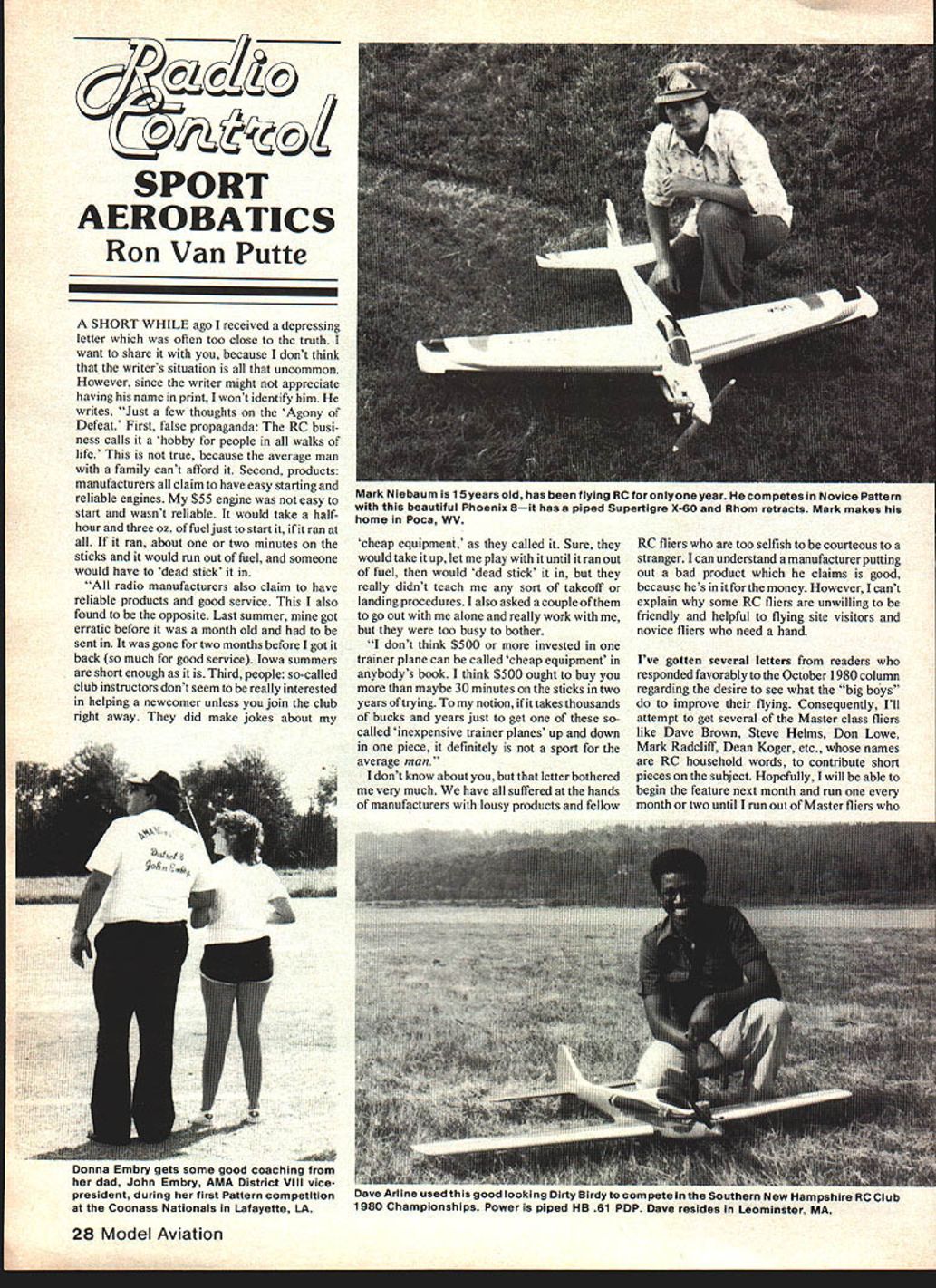
Mark Niebaum is 15 years old, has been flying RC for only one year, and competes Novice Pattern. His beautiful Phoenix 8 is piped, with a Supertigre X-60 and Rhom retracts. Mark makes his home in Poca, WV, and gets good coaching from his dad, John Embry, AMA District VIII vice-president.
During the first Pattern competition at the Coonass Nationals in Lafayette, LA, Dave Arline used a good-looking Dirty Birdy to compete in the Southern New Hampshire RC Club 180 Championships. His power was a piped HR 61 PDP. Dave resides in Leominster, MA, and is willing to cooperate.
Propeller notes (from Doug Dahlke, "The Oshkosh Kid")
Doug Dahlke wrote another letter about propellers after reading my November column. His letter contained items many people will find interesting, so here is an edited version.
"Since my last letter to you on the subject of props/engines not going at the speed they are supposed to, I continued to check additional sources and found some interesting stuff. For one thing, not all prop makers measure pitch the same way! (Oh, thanks, Doug, I really needed yet another can of worms. — RVP.) Yup, good buddy, there are three different ways prop makers can measure pitch.
My understanding is:
- One reference is the flat-face measurement because it is the most convenient.
- Another is the 'zero-lift' line, which would be the most accurate aerodynamic reference.
- Manufacturers also consider geometric pitch distribution across the blade; the only station commonly taken as strictly correct is the 75% station, where pitch is often measured.
Typically, the tip of the propeller is pitched up slightly (about 1° to 1½°) above the established pitch, and the center section is pitched down slightly. All other stations are a little above or below the geometric pitch. The net effect is to slightly increase the average pitch of the prop, so manufacturers must experiment with pitch distribution and stick to it with all props they design to know how the prop will perform.
Efficiency is constantly changing with rpm. Model props turn at such high rpm that they have efficiencies of only about 40% to 50%.
Doug also asked about the two components of prop thrust: whether thrust is generated on both the upper (suction) side and the face (pressure) side of the prop, and what percentage each contributes at various speeds. My comments in this column must be short due to lack of space, but next month I'll talk about the percentage of thrust generated by the two sides of the prop. Basically, I agree with everything Bill Cassidy is alleged to have said. I also alluded to many differences in how prop manufacturers make their products in the April 1980 column."
Closing
If you have complex or controversial letters, send them along. If they are of general interest, I'll see that they get printed.
Ron Van Putte 111 Sleepy Oaks Rd. Fort Walton Beach, FL 32548
Transcribed from original scans by AI. Minor OCR errors may remain.

