
Radio Control: Sport Aerobatics
Ron Van Putte
Answering Doug Dahlke's question
Last month I promised to answer the question Doug Dahlke (Oshkosh, WI) sent about what part of the propeller is more important in producing thrust. Part of the reason I put off answering was that last month's article was already too long; the other reason is that it is a difficult question to answer for a reader group with widely varying backgrounds. My background is in aeronautical engineering. I could make an explanation that would satisfy an engineer but leave many other readers scratching their heads. On the other hand, I could make the explanation so simple that I'd insult most readers.
By the way, I don't mean to confuse background and experience with intelligence. Just because someone has a lot of college training doesn't mean he's any more intelligent than someone who hasn't. It is often more a matter of background and experience than of intelligence when deciding who is an expert on a particular subject. For example, I doubt that there are very many people with a Ph.D. in astrophysics who know much about doing a carburetor overhaul on their cars. Even more to the point, most aeronautical engineers don't know much about propeller theory because they were never exposed to it in their training.
What I'm going to do is present a physical description of how a propeller works and show which part of it contributes most to producing thrust. If you would like more details, let me know and we can exchange letters; or I can put it in the column if there appears to be sufficient interest.
How a propeller produces thrust
Each section of a propeller blade is a small airfoil, just like you might find on a wing. The object of these airfoil sections is to cause a change in momentum of the air in a direction perpendicular to the plane of the propeller disc. The amount of thrust a propeller produces is equal to the rate of change of the momentum of the air (Newton's second and third laws). Note that what I'm saying about propellers can also be said about wings if you substitute the word lift wherever you see thrust.
Airfoil shapes and efficiency
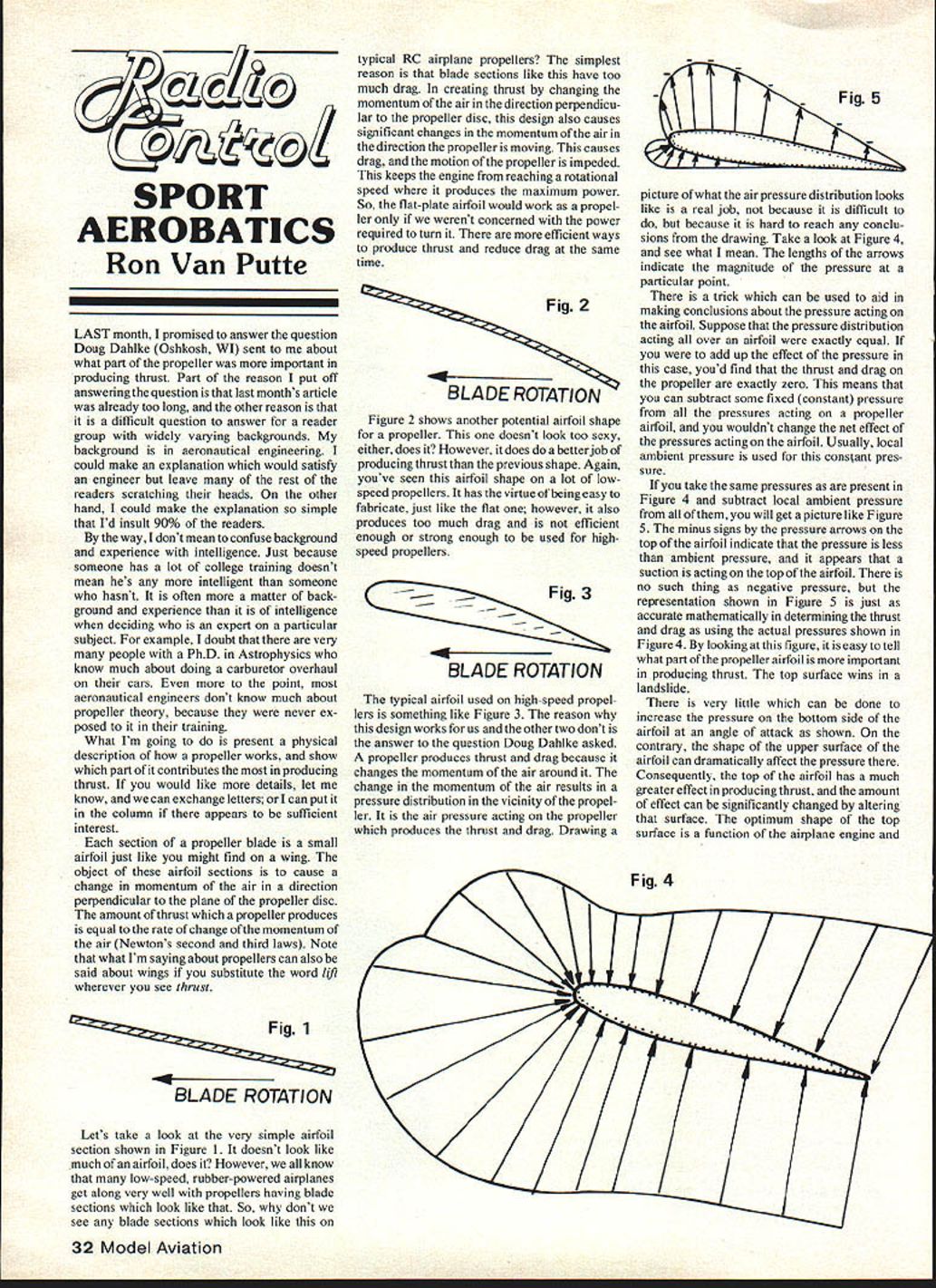
Let's take a look at three simple airfoil section shapes often discussed for propellers:
- Flat-plate section (Figure 1)
- It doesn't look like much of an airfoil, yet many low-speed, rubber-powered airplanes get along well with propellers having blade sections like this. The problem is that such blade sections have too much drag. In creating thrust by changing the momentum of the air perpendicular to the propeller disc, this design also causes significant changes in momentum in the direction the propeller is moving. That causes drag and impedes the motion of the propeller, keeping the engine from reaching the rotational speed where it produces maximum power. The flat-plate would work only if we weren't concerned with the power required to turn it.
- Simple cambered section (Figure 2)
- This shape does a better job of producing thrust than the flat plate and is easy to fabricate, which is why you see it on many low-speed propellers. However, it still produces too much drag and is not efficient or strong enough for high-speed propellers.
- Typical high-speed propeller airfoil (Figure 3)
- This is the common design used on high-speed propellers. It produces thrust efficiently while keeping drag down, which is why it is favored over the other two shapes for higher-performance applications.
Pressure distribution and why the top surface matters
A propeller produces thrust and drag because it changes the momentum of the air around it. The change in momentum results in a pressure distribution in the vicinity of the propeller, and it is this air pressure acting on the propeller that produces thrust and drag. Drawing the actual pressure distribution is a real job — not because it's hard to do, but because it is hard to reach clear conclusions from the drawing (see Figure 4). The lengths of the arrows in such drawings indicate the magnitude of the pressure at particular points.
There is a trick that makes drawing conclusions easier. Suppose the pressure distribution acting all over an airfoil were exactly equal (a constant pressure). If you added up the effect of that pressure, you'd find the thrust and drag are exactly zero. This means you can subtract some fixed pressure (usually local ambient pressure) from all of the pressures acting on a propeller airfoil without changing the net effect.
If you take the pressures in Figure 4 and subtract local ambient pressure from all of them, you get a picture like Figure 5. The minus signs by the pressure arrows on the top of the airfoil indicate the pressure is less than ambient — it appears as suction on the top of the airfoil. There is no such thing as negative pressure in absolute terms, but this representation is just as accurate mathematically for determining thrust and drag as using the actual pressures.
By looking at this adjusted pressure picture, it is easy to tell which part of the propeller airfoil is more important in producing thrust: the top surface. There is very little that can be done to increase the pressure on the bottom side of the airfoil at the angle of attack shown. On the contrary, the shape of the upper surface can dramatically affect the pressure there. Consequently, the top of the airfoil has a much greater effect in producing thrust, and its effect can be significantly changed by altering that surface. The optimum shape of the top surface is a function of the airplane engine and the purpose of the aircraft system. It's not easy to determine, or all the problems of propeller design would have been solved years ago.
Propeller pitch and airplane speed
I've received several letters taking me to task over statements about the relationship of propeller pitch to airplane speed. Most of the letters claim their authors' airplanes are traveling faster than they are "supposed" to. One example is a long letter from Donald Stephens (Oklahoma City, OK), who wrote:
"Some of us here recently got quite a surprise when one of the local clubs ran a cross-country RC air race to a town about 47 miles to the northeast, and back. One of my friends flew a Supertrig .23-powered MEN Trainer in this, and another flew an old Sig Cadet, with an eye to being able to land them anywhere. The chase car for the MEN Trainer was an old WWII surplus Jeep with a top speed of about 60 mph, and there was a 15 mph south breeze. On the crosswind legs the Jeep was wide open to keep up with the MEN at less than half throttle, and on the downwind legs the MEN had to be flown at minimum power and in a sinuous course for the Jeep to keep up. The Cadet pilot had the same problems, except he was at less than 3/4 power crosswind, and the only comfortable flying for either of them was coming back upwind!"
My only response to claims that airplanes can fly faster than one would think based on propeller pitch and engine rotational speed is that one or the other of the factors must be wrong — perhaps both. Propeller pitch is described in many ways by manufacturers, and many of them are wrong. Secondly, engines unload substantially as the airplane speeds up, and the rotational speed of the engine can end up much higher than published values. I'll say again: you don't get something for nothing. When the forward speed of the aircraft approaches the value for the zero-lift angle of the propeller (based on published propeller pitch and engine speed), either one or both values are wrong — or black magic is present.
Ron Van Putte 111 Sleepy Oaks Rd. Ft. Walton Beach, FL 32548
Transcribed from original scans by AI. Minor OCR errors may remain.

