
Radio Control: Sport & Aerobatics
Ron Van Putte
Newsletters and exposure
Being a former club newsletter editor, I enjoy getting the newsletters from RC-oriented clubs which AMA HQ passes on to me. Nearly all of them bear the red‑penned initials C.W. (Carl Wheeley, Model Aviation's publisher) and J.W. (John Worth, AMA's Executive Director). Some have as many as six initials from AMA and Model Aviation staff members. Your club newsletters do get wide exposure — keep them coming to AMA HQ!
For unknown reasons, batches of newsletters will often arrive with feature articles about the same subject. The latest common subject (and the subject of a letter I recently received) is training beginners.
Training beginners — the need for a helper
Sooner or later you'll probably be asked to help a newcomer. What you say and do will be influenced by how you learned, and that may or may not be good for the beginner. Some of us got great assistance from dedicated modelers; others got poor help from people who barely knew how to fly themselves. Beginners often cannot tell a good instructor from a poor one.
A local hotshot pilot may be the worst choice if he cannot communicate the many "why and how" aspects of RC flying. Conversely, a pilot who flies slower sport airplanes may be the best choice — he is more likely to be sympathetic and familiar with the type of airplane the beginner will use.
Some people have little choice about who helps them learn, but almost everyone needs someone. In 30 years I've met only a handful of true self‑taught fliers; one told me he flew six years before his first crash — rare indeed. I usually tell beginners thinking of learning on their own: a doctor who plans to treat his own ailments will have an idiot for a patient.
Hobby shop owners love to sell things, and beginners who try to learn without help often end up buying lots of kits, engines, accessories, and radios before they finally learn to fly — if ever. As a long‑time modeler, it bothers me to see many people briefly involved in RC because they spent what they could afford and never learned to fly.
Choosing an instructor
Choosing an instructor is important. Beginners should:
- Visit local hobby shops and flying fields to find out who the potential instructors are.
- Look for a local club with an active instruction program if possible.
- Talk to a lot of people if clubs aren't formal before investing in expensive airplanes, engines, or radios.
A good starter setup is a stable, easy‑to‑build .25–.40‑powered airplane controlled by a modest, reliable radio (for example, a new $100 radio).
Help with purchases and terminology
Seek advice before buying anything. Ask experienced flyers for assistance in selecting:
- Airplane
- Engine
- Radio and transmitter mode (Mode II or Mode I, single‑stick)
- Accessories
- Adhesives and finishing materials (CA/Super Glue, aliphatic resin, plastic dope, MonoKote, covering materials)
Beginners usually aren't stupid — they just haven't heard the jargon yet. Experienced RC modelers expect to be asked for assistance; helping someone boosts the helper's ego and is a way of passing the torch.
The training process — first flights and objectives
Once a beginner is linked up with an instructor and the airplane is bought and built, it's time to learn how to fly. The instructor should fly the airplane for a flight or two to:
- Adjust control surface trimmings and throws
- Set the carburetor
- Get the feel of the airplane
The beginner should listen carefully to learn how the airplane behaves and how they should try to fly it. Some airplanes turn easier to the left than to the right and need less control input when turning left. Some like to be landed nose high and slow; others demand a flatter, faster landing approach.
Before each flight, the instructor and student should discuss the objectives. For example, on the first training flight I try to get the student to keep the wings level and turn left. Depending on the student, the objectives may remain the same for the first several flights.
Practice maneuvers and turning preference
I can already hear a beginner saying, "Turn left?" Most of us are right‑handed, and it's often easier to learn to turn left. Think about rolling, skating, or turning in sports — many right‑handers find certain directions easier. If you can fly straight and turn left reliably, you greatly reduce the chance of crashing (except during landing — which comes later).
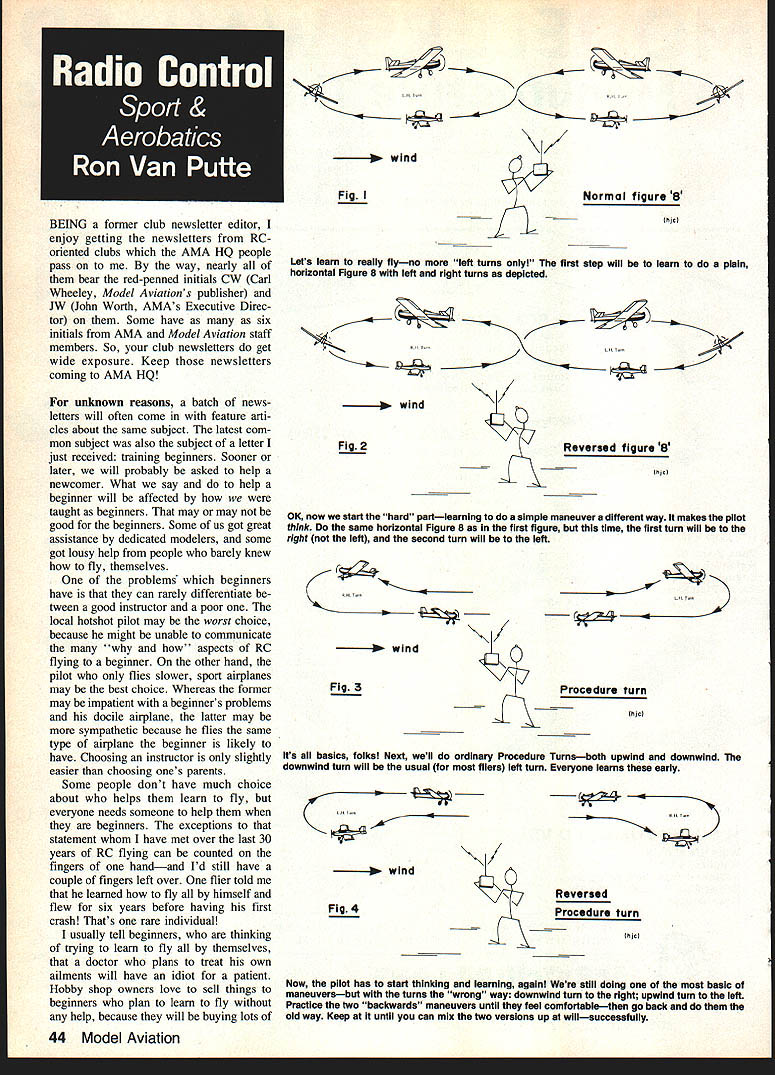
Practice basic maneuvers in both directions. Instructors sometimes teach the turns "the wrong way" first (for example, downwind turn to the right; upwind turn to the left). Practice these "backwards" maneuvers until they feel comfortable, then practice the standard versions. Keep at it until you can mix both versions at will.
I once watched a pilot at a strange field who always flew straight and turned left; when I asked why he never turned right he said he had never learned to turn right. That illustrates the importance of deliberate practice.
Final thoughts
Beginners should ask for help — experienced modelers expect and like to assist. For instructors, be patient, communicate clearly, and set simple, consistent objectives for each flight. Passing on the guidance you received is how the hobby grows and how newcomers become confident, competent pilots.
Transcribed from original scans by AI. Minor OCR errors may remain.

