
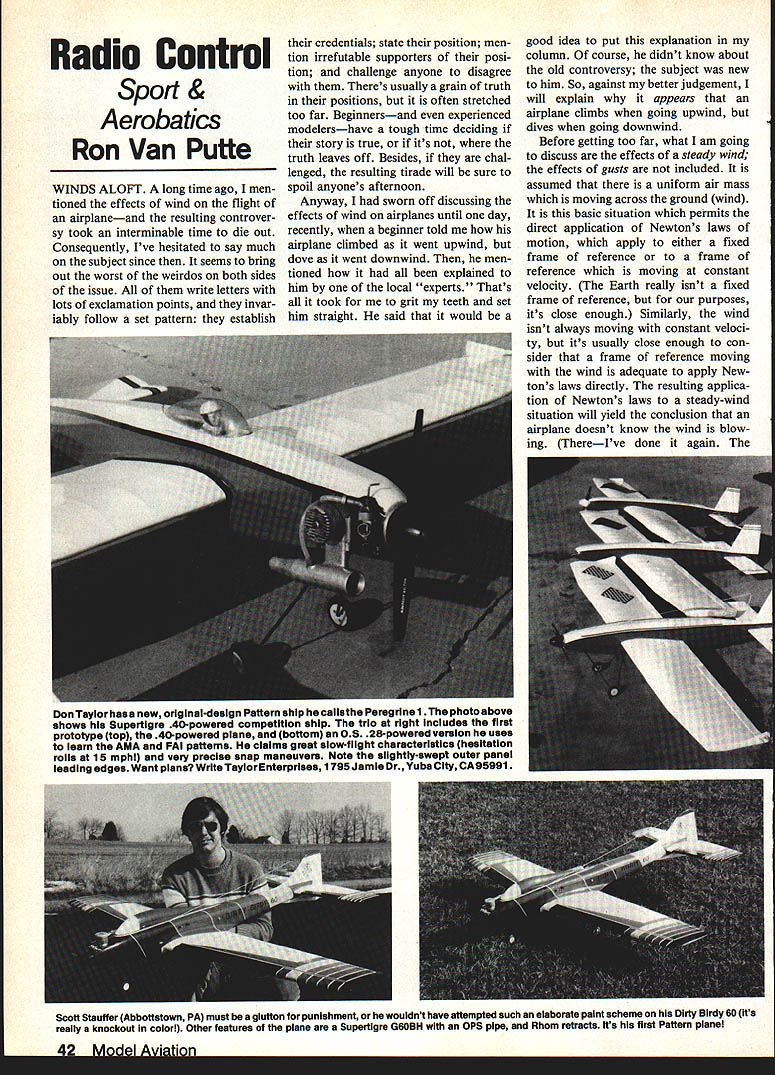


Radio Control: Sport Aerobatics
Ron Van Putte
Winds Aloft
A long time ago someone mentioned the effects of wind on the flight of an airplane and the resulting controversy took an interminable time to die out. Consequently I've hesitated to say much on the subject since it seems to bring out the worst of the weirdos on both sides. Their letters follow a familiar pattern: establish credentials, state a position, name irrefutable supporters, and challenge anyone to disagree. There's usually a grain of truth, but it is often stretched, and beginners (and even experienced modelers) have a hard time deciding where the truth ends.
Recently a beginner told me his airplane climbed going upwind and dove going downwind, and that a local "expert" had explained why. The explanation prompted me to set the record straight and put it in this column.
First, some assumptions: I'm discussing the effects of a steady wind (not gusts). Assume a uniform mass of air moving across the ground. This permits the direct application of Newton's laws in a frame of reference moving at constant velocity. In that frame the conclusion is straightforward: an airplane doesn't "know" the wind is blowing.
The apparent upwind-climb / downwind-dive effect hinges on how airplanes are trimmed. Most pilots trim an airplane to climb slightly:
- Beginners usually use more up trim.
- Experienced fliers also trim to a slight climb because they don't like seeing an airplane head for the ground.
Because of the way our eyes work, an airplane traveling horizontally appears to be diving as it approaches the horizon. Pattern fliers and judges are particularly affected; inexperienced judges may downgrade Straight Flight even when the airplane maintains constant altitude. To avoid this optical illusion, pilots trim so the airplane climbs slightly in calm air.
What happens in a steady wind? An airplane trimmed to climb in calm air will still be trimmed to climb in a steady wind. Going upwind, the wind reduces ground speed while not affecting the airplane's vertical speed, so the track relative to the ground makes the climb angle appear steeper. Going downwind, the ground speed is higher, so the same vertical speed is spread over a greater horizontal ground distance and the climb angle looks shallower—often appearing as a dive. The stronger the wind, the more pronounced this visual stretching or compressing of the climb angle becomes.
If you write about this subject, please stick to mechanics in a frame of reference moving at constant velocity rather than invoking high‑school tirades about conservation of kinetic energy and momentum.
Finishing a Balsa Fuselage
When contest season came up I needed a new Pattern airplane and decided to finish an all‑balsa‑fuselage Curare rather than start from scratch with a fiberglass Phoenix 8. Big mistake—I’d forgotten how much work finishing a balsa fuselage entails. It had been eight to ten years since I did wing fillets and fuselage finishing; there are many tedious steps I’d rather avoid. Fiberglassing a balsa fuselage is also near the top of my least‑favorite tasks. Some useful techniques for both fillets and fiberglassing would be welcome.
Problems with fillets include getting the fillet material to accept a smooth contour without shifting during cure, and using a material that sands well but is strong enough to handle flight and handling stresses. Less important today, with epoxy glues and slow‑shrink paints, is paint adhesion, but a surface that doesn’t pull loose during drying is still desirable.
Desirable properties for fillet material:
- Forms a good contour quickly and resists shifting while curing
- Sands smoothly
- Has enough strength for flight stresses and handling
- Accepts paint without lifting or pulling loose
Fiberglassing Technique
In the absence of a proven technique for applying one‑ounce (per square yard) fiberglass cloth to a fuselage, I plan to brush Dave Brown Mix‑A‑Matic epoxy through the cloth and use a modified toilet‑paper roll to blot up the excess epoxy. I’ve used this method to adhere lightweight glass cloth to wing skins, but I don't know how well it will work on a fuselage. Suggestions for alternate techniques would be appreciated.
RC Flight Simulator
I received a letter from Dr. John Kallend, a professor of engineering who consults on engineering and software. He developed an RC flight simulator for Apple IIe or II+ computers. It provides a three‑dimensional graphic animation of RC airplane flight and accepts proportional joystick control for elevator, ailerons, rudder, and throttle. Dr. Kallend claims novices can learn basic control and overcome orientation problems, and experienced fliers can practice advanced maneuvers—without risk to a model.
Dave Brown demonstrated impressive displays with it at the Toledo Conference, and Dr. Kallend reports others have as well. The RC Flight Simulator is available on diskette from Dave Brown Products (4560 Layhigh Rd., Hamilton, OH 45013). I don't know the price, but Dave Brown can provide details.
Transcribed from original scans by AI. Minor OCR errors may remain.

