
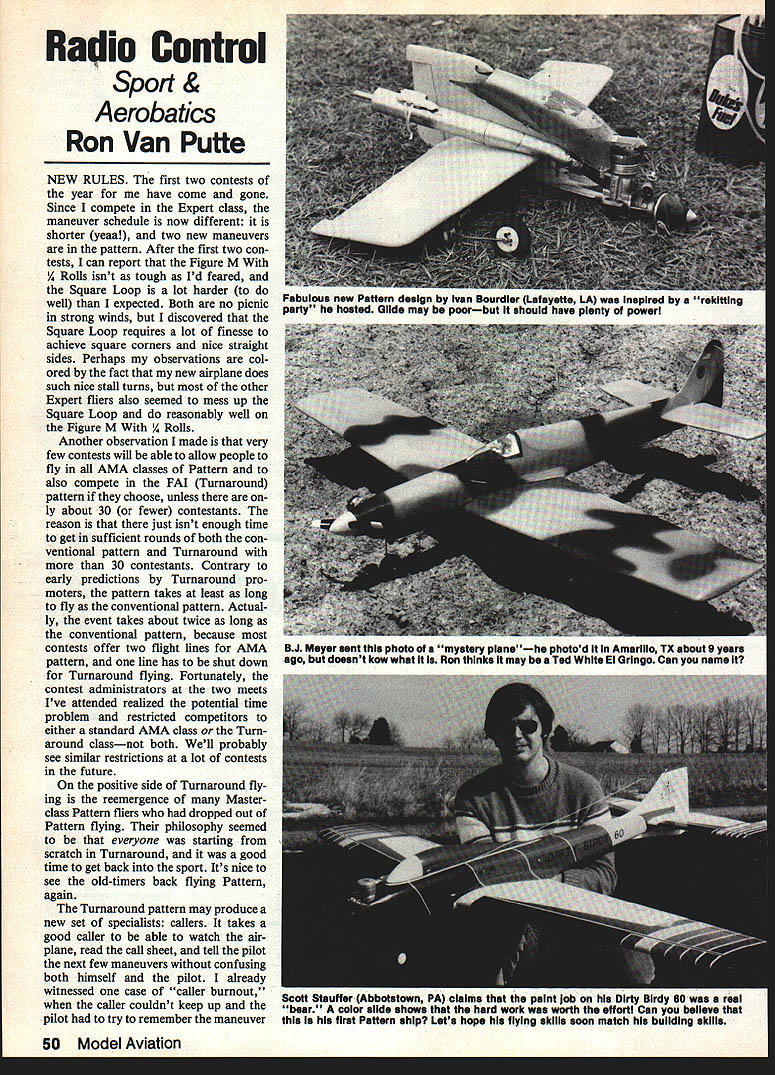
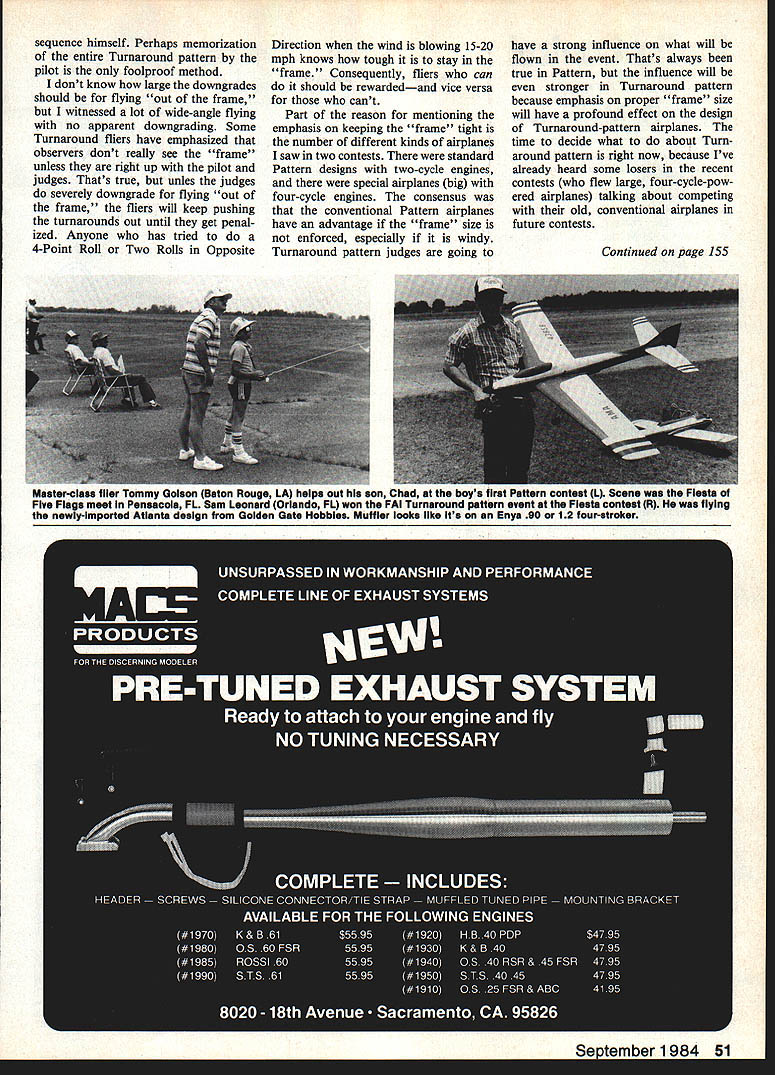
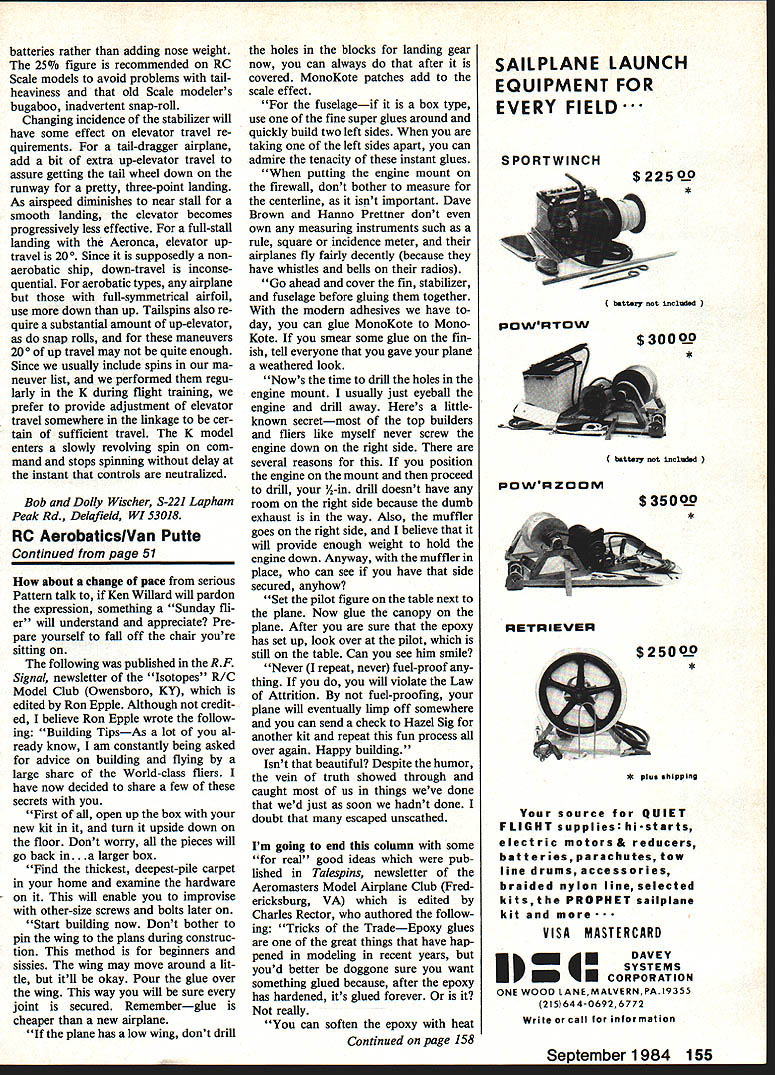
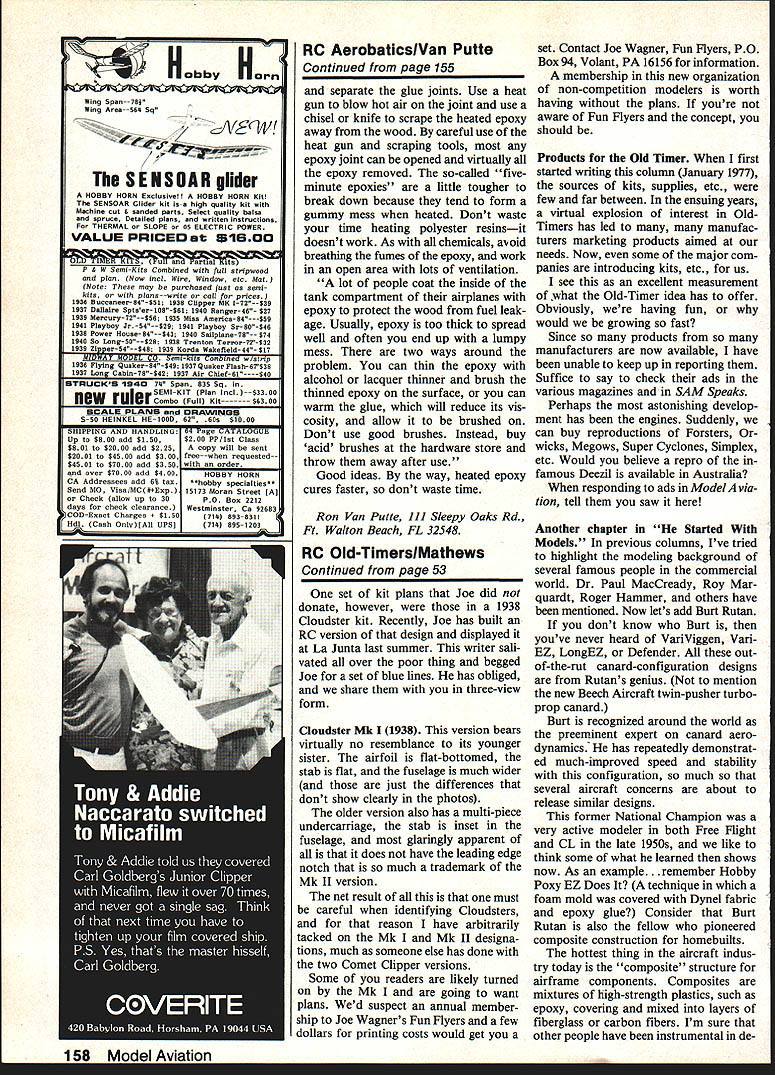
Radio Control: Sport & Aerobatics
Ron Van Putte
New Rules
The first two contests of the year for me have come and gone. Since I compete in the Expert class, the maneuver schedule is now different; it is shorter (yea!), and two new maneuvers are in the pattern. After the first two contests, I can report that the Figure M with 1/4 Rolls isn't as tough as I'd feared, and the Square Loop is a lot harder (to do well) than I expected. Both are no picnic in strong winds, but I discovered that the Square Loop requires a lot of finesse to achieve square corners and nice straight sides. Perhaps my observations are colored by the fact that my new airplane does such nice stall turns, but most of the other Expert fliers also seemed to mess up the Square Loop and do reasonably well on the Figure M with 1/4 Rolls.
Turnaround Pattern and Contest Logistics
Another observation I made is that very few contests will be able to allow people to fly in all AMA classes of Pattern and also compete in the FAI (Turnaround) pattern at the same meet unless there are about 30 (or fewer) contestants. The reason is that there just isn't enough time to get in sufficient rounds of both the conventional pattern and Turnaround with more than 30 contestants.
Contrary to early predictions by Turnaround promoters, the Turnaround pattern takes at least as long to fly as the conventional pattern. In practice, the event often takes about twice as long because most contests offer two flight lines for AMA pattern, and one line has to be shut down for Turnaround flying. Fortunately, the contest administrators at the two meets I've attended realized this potential time problem and restricted competitors to either a standard AMA class or the Turnaround class—not both. We'll probably see similar restrictions at many contests in the future.
On the positive side, Turnaround flying has encouraged many Master-class pattern fliers who had dropped out of pattern flying to reemerge. Their philosophy seemed to be that everyone was starting from scratch in Turnaround, and it was a good time to get back into the sport. It's nice to see the old-timers back flying pattern again.
Callers, Frame Size and Judging
The Turnaround pattern may produce a new set of specialists: callers. It takes a good caller to watch the airplane, read the call sheet, and tell the pilot the next maneuvers without confusing both himself and the pilot. I already witnessed one case of "caller burnout," when the caller couldn't keep up and the pilot had to try to remember the maneuver sequence himself. Perhaps memorization of the entire Turnaround pattern by the pilot is a foolproof method — I don't know.
I saw large downgrades for flying out of frame, yet I also witnessed a lot of wide-angle flying with no apparent downgrading. Some Turnaround fliers have emphasized that observers don't really see the frame unless they're right up with the pilot judges. That's true, but unless judges severely downgrade flying out of frame, fliers will keep pushing turnarounds out until they get penalized. Anyone who has tried 4-point roll or two rolls in opposite directions with a 15–20 mph wind knows how tough it is to stay in the frame. Consequently, fliers who can stay in frame should be rewarded — and vice versa if they can't.
Aircraft Types and Event Influence
Part of the reason I'm emphasizing keeping the frame tight is the variety of airplanes I saw at the two contests: standard pattern designs with two-cycle engines and special airplanes with big four-cycle engines. The consensus seems to be that conventional pattern airplanes have an advantage when frame size is enforced, especially in windy conditions. Turnaround pattern judges are going to have a strong influence on what will be flown at the events. Pattern influence will be stronger in the Turnaround pattern because the emphasis on proper frame size will have a profound effect on design. Time will tell what people decide about Turnaround pattern; already I've heard some entrants who flew large four-cycle-powered airplanes say they plan to compete with their old conventional airplanes in future contests.
A Change of Pace: Building Tips (from R.F. Signal)
How about a change of pace from serious pattern talk to something a "Sunday flier" will understand and appreciate? The following was published in the R.F. Signal, newsletter of the "Isotopes" R/C Model Club (Owensboro, KY), edited by Ron Epple. Although not credited in the item, I believe Ron Epple wrote it:
- Open the kit box and turn it upside down on the floor. Don't worry — all the pieces will go back in... a larger box.
- Find the thickest, deepest-pile carpet in your home and examine the hardware in your kit on it. This will enable you to improvise with other-size screws and bolts later on.
- Start building now. Don't bother to pin the wing to the plans during construction — that's for beginners and sissies. The wing may move around a little, but it'll be okay. Pour the glue over the wing so every joint is secured. Remember — glue is cheaper than a new airplane.
- If the plane has a low wing, don't drill the holes in the blocks for landing gear yet; you can always do that after it is covered. MonoKote patches add to the scale effect.
- For a box-type fuselage, use super glue around seams and quickly build two left sides. When you take one left side apart, you can admire the tenacity of those instant glues.
- When putting the engine mount on the firewall, don't bother to measure for the centerline; it's not important. If you position the engine and then drill, the 1/2-in. drill may not have room on the right side because the exhaust is in the way. The muffler on the right side will provide enough weight to hold the engine down — who can see if that side is secured anyway?
- Set the pilot figure on the table next to the plane. Now glue the canopy on the plane. After the epoxy has set up, look over at the pilot on the table — can you see him smile?
- Never (I repeat, never) fuel-proof anything. If you do, you will violate the Law of Attrition. By not fuel-proofing, your plane may eventually limp off somewhere and you can send a check to Hazel Sier for another kit and repeat the fun process all over again.
Despite the humor, the piece contains a vein of truth that many of us recognize.
Tricks of the Trade — Epoxy and Practical Tips
Here are some practical, "for real" ideas published in Talepins, newsletter of the Aerosmasters Model Airplane Club (Fredericksburg, VA), edited by Charles Rector:
- Epoxy glues are great for modeling, but be sure you want something glued — after the epoxy hardens, it's effectively permanent. You can, however, soften epoxy with heat to separate glue joints. Use a heat gun to blow hot air on the joint and carefully scrape the heated epoxy away with a chisel or knife. With careful use of heat and scraping tools, most epoxy joints can be opened and virtually all the epoxy removed.
- Five-minute epoxies are tougher to break down because they tend to form a gummy mess when heated.
- Don't waste time heating polyester resins — it doesn't work.
- Avoid breathing epoxy fumes; work in a well-ventilated area.
- For coating the inside of the tank compartment, epoxy is often too thick and can create a lumpy mess. Two solutions:
- Thin the epoxy with alcohol or lacquer thinner and brush the thinned epoxy on the surface.
- Warm the epoxy to reduce viscosity and allow it to be brushed on.
- Use inexpensive "acid" brushes from the hardware store for applying thinned or warmed epoxy and discard them after use.
- Heated epoxy cures faster — plan accordingly.
Good ideas — and by the way, warmed epoxy cures faster, so don't waste time.
Ron Van Putte 111 Sleepy Oaks Rd. Ft. Walton Beach, FL 32548
Transcribed from original scans by AI. Minor OCR errors may remain.

