
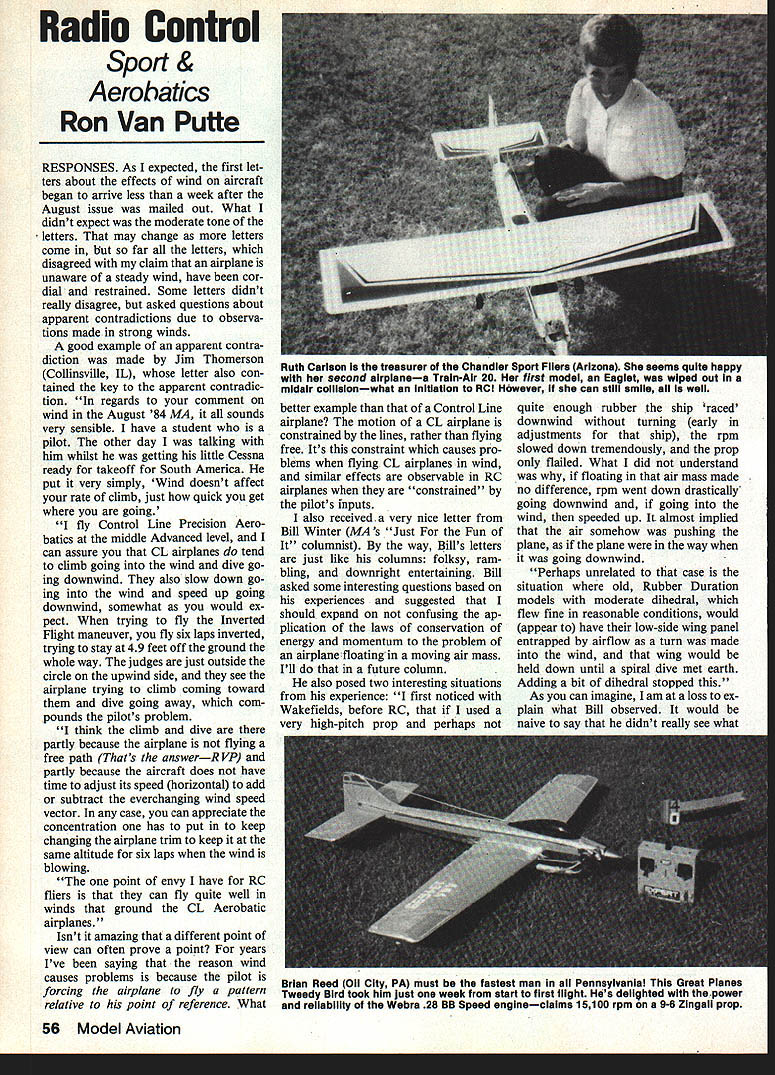


Radio Control: Sport & Aerobatics
Ron Van Putte
Responses
As I expected, the first letters about the effects of wind on aircraft began to arrive less than a week after the August issue was mailed out. What I didn't expect was the moderate tone of the letters. That may change as more letters come in, but so far all the letters that disagreed with my claim that an airplane is unaware of a steady wind have been cordial and restrained. Some letters didn't really disagree; they asked questions about apparent contradictions arising from observations made in strong winds.
Jim Thomerson (Collinsville, IL)
A good example of an apparent contradiction came from Jim Thomerson, whose letter also contained the key to the puzzle. He wrote about a conversation with a student pilot getting a Cessna ready for takeoff: "Wind doesn't affect your rate of climb, just how quick you get where you are going."
Jim compared this to control-line (CL) precision aerobatics at the middle/advanced level. CL airplanes do tend to climb going into the wind and dive going downwind; they also slow down going into the wind and speed up going downwind. For example, in the inverted-flight maneuver you fly six laps inverted trying to stay about 4.9 feet off the ground the whole way. The judges, positioned just outside the circle on the upwind side, see the airplane trying to climb as it comes toward them and dive as it goes away—compounding the pilot's problem.
I think the climb and dive are partly because the airplane is not flying a free path (that's the answer—RVP) and partly because the aircraft does not have time to adjust its horizontal speed to add or subtract the ever-changing wind-speed vector. In any case, you can appreciate the concentration needed to keep changing the airplane's trim to maintain the same altitude for six laps when the wind is blowing. What better example than a control-line airplane? Its motion is constrained by the lines rather than flying free. It's this constraint that causes problems when flying CL airplanes in wind, and similar effects are observable in RC airplanes when they are "constrained" by the pilot's inputs.
Bill Winter (MA "Just For the Fun of It" columnist)
I also received a very nice letter from Bill Winter. Bill's letters are just like his columns—folksy, rambling, and entertaining. He asked interesting questions and suggested I expand on the confusing application of the laws of conservation of energy and momentum to the problem of an airplane floating in a moving air mass; I'll do that in a future column.
Bill posed two observational puzzles:
- With Wakefields (pre-RC), using a very high-pitch prop and perhaps not quite enough rubber, the ship would race downwind without turning early in trimming. After adjustments, the rpm slowed down tremendously and the prop just flailed. He couldn't understand why, if floating in an air mass made no difference, rpm would go down drastically going downwind and speed up going into the wind—almost as if the air were somehow pushing the model when it went downwind.
- Old rubber-duration models with moderate dihedral would sometimes have the low-side wing panel "entrapped" by airflow when a turn was made into the wind; that wing would be held down until a spiral dive met the earth. Adding a bit more dihedral cured the problem.
As you can imagine, I'm at a loss to fully explain Bill's observations. Change of reference frames and subtle aerodynamic effects can be confusing, and simple descriptions sometimes fail to capture what's really happening.
Landing in Gusty Winds — A Suggestion
Before leaving the subject of wind, I have a practical suggestion for pilots, especially beginners. At our club flying site the other day I watched an experienced pilot make an approach in a stiff, gusty wind. With the engine at idle for the last hundred yards, the airplane looked fine for landing—then it suddenly stalled and dropped a few feet onto the runway.
What happened: the stiff wind reduced slightly as the aircraft descended into a lee, the airspeed fell below stall speed, and the airplane stalled. The practical point is to carry a bit of extra airspeed when landing in gusty conditions. Keep enough power so that a gust-induced drop in airspeed won't immediately bring you below stall. Reduce the engine to idle only just before the airplane is ready to touch down. It will save broken props and bruised egos.
Engine Troubleshooting — Glow Plug Anecdote
History has a way of repeating itself. My new Super Tigre S40 ABC had been doing a great job powering my new .40-size pattern airplane—until it started acting sickly. After adjusting the needle valve, checking the fuel filter, tightening head and crankcase bolts, and doing a lot of head‑scratching, I discovered the glow plug was marginal. It looked okay and the glow driver current was normal, but replacing the plug cured the problem. I remembered a similar episode a year or so earlier that had also turned out to be a bad plug.
One thing we older RC pilots have learned (and sometimes forgotten) is: with piped engines, use standard (no idle‑bar) glow plugs. Piped engines often develop more power with standard plugs than with idle‑bar plugs, and I haven't noticed deterioration in idling. Many top fliers prefer Rossi and OPS plugs, but they are expensive. One plug that isn't expensive and has worked well for me is the K&B KB11L.
Ron Van Putte 111 Sleepy Oaks Rd. Ft. Walton Beach, FL 32548
Transcribed from original scans by AI. Minor OCR errors may remain.

