

Radio Control: Sport & Aerobatics
Ron Van Putte
Letters
Letters — I got letters, stacks and stacks of letters! Modelers get windy on the subject of wind effects. Of course, most of the letters took exception with my contention that an airplane is unaware of a steady wind. Very few people will write to agree with you, but opponents don't hesitate.
A notable exception was Gene Mathis (Daphne, AL), who wrote:
"I appreciate your effort to put the wind myth/optical illusion to rest. Were it true that an aircraft can 'feel' the wind, yours truly and countless other professional pilots and navigators would have been spared a lot of heartburn trying to answer the essential question, 'whence cometh the wind and how strong does it bloweth?'
"For instance, out in the middle of the Pacific, my navigator could have said, 'Do a standard-rate 360° turn, holding your airspeed constant. I will keep an eye on the directional gyro and altimeter; when we start climbing or diving we'll know the direction of the wind. Based on experience, we can also tell the magnitude of the wind.' Alas, it won't work.
"In the early days of high-altitude flying, the jet streams, of which we were ignorant, played havoc with our navigation because we blundered into them totally unaware. 'Egad navigator, redo your sums — we can't be bucking a 150-knot headwind!'
"Anyone observing a contrail knows that it stays lined up with the longitudinal axis of the aircraft, even when flying athwart a jet stream. Here is how to have a little fun with your disbelievers: use a long crepe streamer or smoke and fly a straight and level course crosswind over the troops (get a variance of your safety rule for this demonstration). They will see that, although the aircraft is crabbing, the streamer or smoke will remain perfectly in the trail position (in line with the airplane, R.V.P.).
"Even old pro Bill Winter wrote not long ago about an oversized fin causing 'weathervaning,' so I know that demolishing this cherished myth is impossible."
Thanks, Gene. Impossible or not, I intend to keep trying. Fortunately there's help. John Preston had a great example on the effects of wind in his August column ("Safety Comes First"). Check it out if you haven't read it.
Questions and confusion
As I mentioned earlier, many of the people who wrote to me do not agree that an airplane doesn't "know" when a steady wind is blowing. Several argued that there was no such thing as a steady wind, while others claimed what they observed resulted from wind-shear layers near the ground; a few were puzzled about what they observed in heavy wind situations. Most, however, genuinely believe that an airplane feels the wind.
Typical of such letters was one from Allan Kass, Big Sky, MT. His comments raised several common observations and questions:
- Planes may appear to dive when going downwind and appear to climb when going upwind.
- After flying real airplanes for thousands of hours, he knows a crosswind takeoff followed by a downwind turn has a "mushy" control feel; the opposite, turning into the wind, has a brisk control response.
- His model planes sometimes sink or seem mushy at the first turn after a crosswind takeoff downwind.
- Flying a 22-pound quarter-scaler in 35-knot wind, he had a devil of a time turning upwind; the airplane got broadside and didn't want to go the remainder of the turn, almost like a sailboat in "irons."
He asks: Why — if the airplane doesn't know the wind is blowing?
Frame of reference — the key to understanding
I think that virtually all the questions contained in Allan Kass' letter (and in many other letters I received) can be answered by considering the frame of reference of the observer. When we are flying R/C, we are usually standing on the ground and attempting to make the airplane fly maneuvers in a prescribed manner, regardless of how the wind is blowing.
You may have heard how dangerous a downwind turn is. The downwind turn is a 180° turn started when an airplane is heading downwind. Usually the turn starts out all right, but a little past halfway around the airplane stalls out and crashes. Why? Basically, it's because the pilot crashed it. The wind is a contributing factor, but it is the pilot's faulty understanding of the effects of wind that causes the stall and crash.
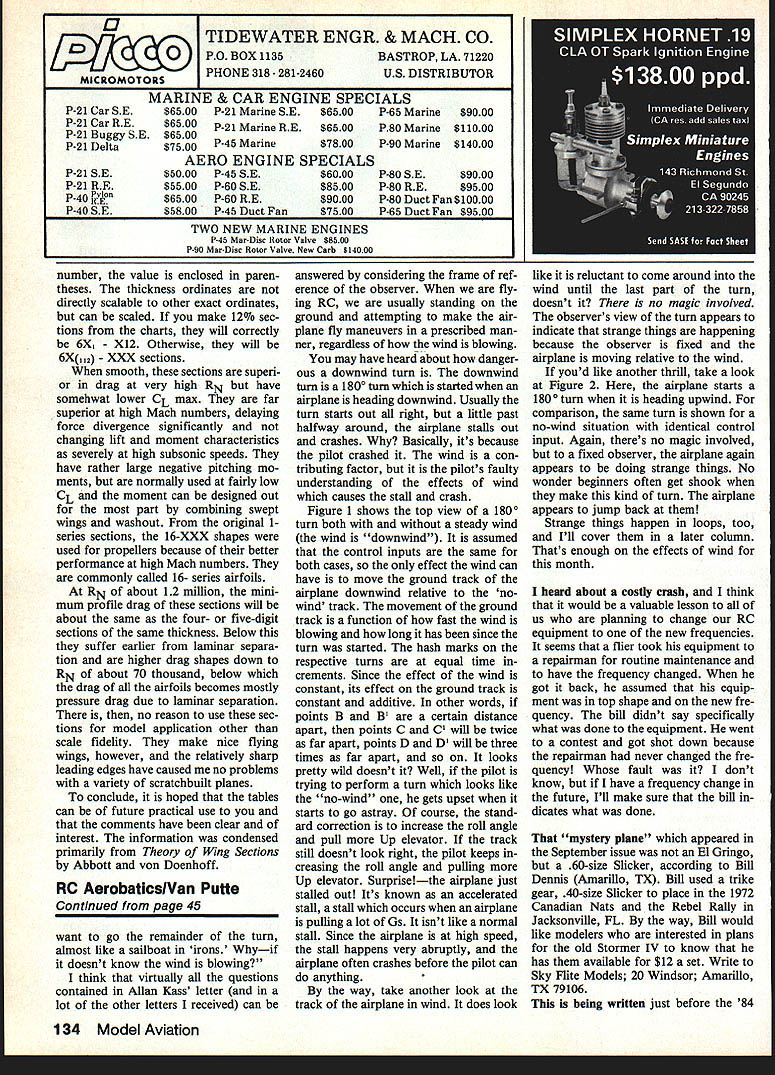
Figure 1 shows a top view of a 180° turn both with and without a steady wind (the wind is "downwind"). It is assumed that the control inputs are the same for both cases, so the only effect the wind can have is to move the ground track of the airplane downwind relative to the "no-wind" track. The movement of the ground track is a function of how fast the wind is blowing and how long it has been since the turn was started. The hash marks on the respective turns are at equal time increments.
Since the effect of the wind is constant, its effect on the ground track is constant and additive. In other words, if points B and B' are a certain distance apart, then points C and C' will be twice as far apart, points D and D' will be three times as far apart, and so on. It looks pretty wild, doesn't it? Well, if the pilot is trying to perform a turn that looks like the "no-wind" one, he gets upset when it starts to go astray.
Of course, the standard correction is to increase the roll angle and pull more up elevator. If the track still doesn't look right, the pilot keeps increasing the roll angle and pulling more up elevator. Surprise — the airplane just stalled out! It's known as an accelerated stall, a stall which occurs when an airplane is pulling a lot of Gs. It isn't like a normal stall. Since the airplane is at high speed, the stall happens very abruptly, and the airplane often crashes before the pilot can do anything.
By the way, take another look at the track of the airplane in wind. It does look like it is reluctant to come around into the wind until the last part of the turn, doesn't it? There is no magic involved. The observer's view of the turn appears to indicate that strange things are happening because the observer is fixed and the airplane is moving relative to the wind.
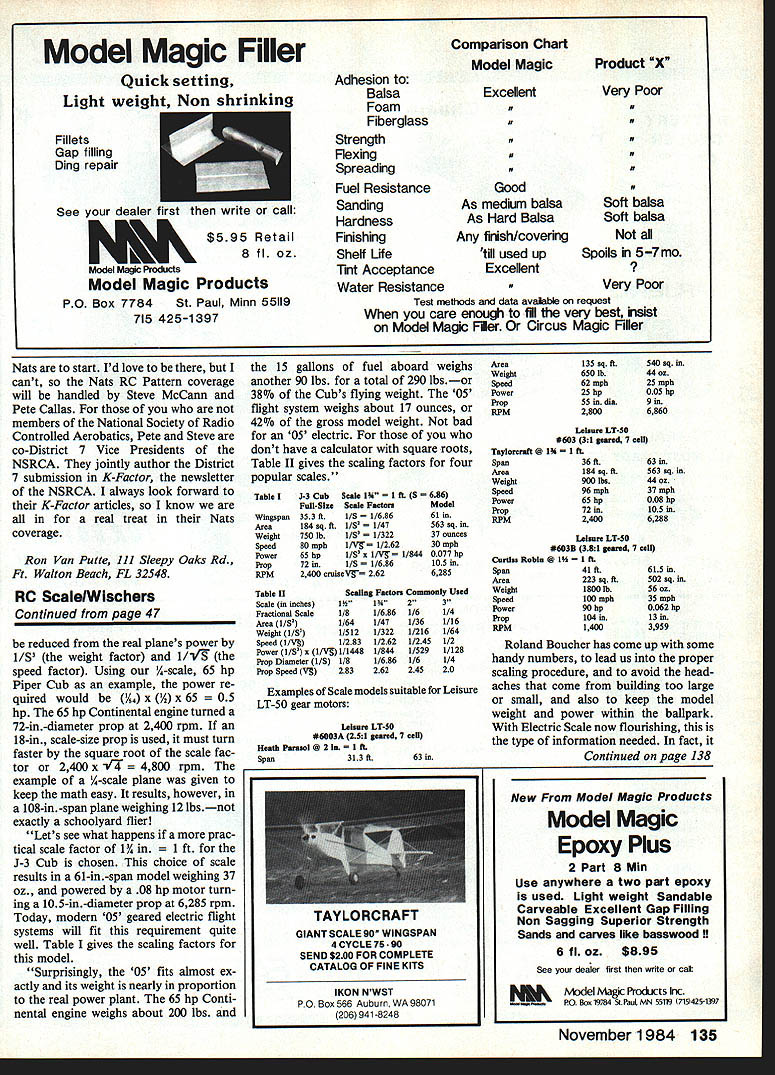
If you'd like another take, look at Figure 2. Here, the airplane starts a 180° turn when it is heading upwind. For comparison, the same turn is shown for a no-wind situation with identical control input. Again, there's no magic involved, but to a fixed observer the airplane again appears to be doing strange things. No wonder beginners often get shook when they make this kind of turn — the airplane appears to jump back at them!
Strange things happen in loops, too; I'll cover them in a later column. That's enough on the effects of wind for this month.
A costly mistake — frequency change warning
I heard about a costly crash, and I think it would be a valuable lesson to all of us who are planning to change our RC equipment to one of the new frequencies. It seems that a flier took his equipment to a repairman for routine maintenance and to have the frequency changed. When he got it back, he assumed that his equipment was in top shape and on the new frequency. The bill didn't say specifically what was done to the equipment. He went to a contest and got shot down because the repairman had never changed the frequency! Whose fault was it? I don't know, but if I have a frequency change in the future, I'll make sure that the bill indicates what was done.
Miscellaneous notes
That "mystery plane" which appeared in the September issue was not an El Gringo, but a .60-size Slicker, according to Bill Dennis (Amarillo, TX). Bill used a trike gear, .40-size Slicker to place in the 1972 Canadian Nats and the Rebel Rally in Jacksonville, FL.
By the way, Bill would like modelers who are interested in plans of the old Stoermer TV to know that the plans are available for $12 a set. Write to Sky Flite Models, 1705 Windsor, Amarillo, TX 79106.
This was written just before the '84 Nats were to start. I'd love to be there, but I can't, so the Nats RC Pattern coverage will be handled by Steve McCann and Pete Callas. For those of you who are not members of the National Society of Radio Controlled Aerobatics, Pete and Steve are co-District 7 Vice Presidents of the NSRCA. They jointly author the District 7 submission in K-Factor, the newsletter of the NSRCA. I always look forward to their K-Factor articles, so I know we are all in for a real treat in their Nats coverage.
Ron Van Putte 111 Sleepy Oaks Rd. Ft. Walton Beach, FL 32548
Transcribed from original scans by AI. Minor OCR errors may remain.

