
Radio Control Sport & Aerobatics
Ron Van Putte
New technology
A few months back I mentioned that the nasty fraying of fiberglass can be stopped by using Jet (or other similar cyanoacrylate) glue along the line where the cloth is to be cut. It works well to stop the fraying, but if too much Jet is applied along the cutting line, a stiff area in the cloth will result, making it difficult to use. I learned to apply a thin line of Jet and avoid the problem.
Then I got a telephone call from John Kenney, who operates the Square Loop Hobby Center in Greenwood, MS. John suggested spraying a product called Fray Check along the cutting line. He claimed that it worked and didn't make the fiberglass cloth stiff; he's right. I don't know if Fray Check is available in fabric stores nationwide, but it's worth looking into.
Engine storage and lubrication
Since I live in Florida, my RC flying season lasts nearly 10 months. It may surprise some of you to learn that part of Florida (the Panhandle) gets some very cold weather in the wintertime. It's not uncommon to have temperatures in the low teens on some clear, calm nights in February. Since I don't like cold weather, I often don't fly RC at all in January and February. This means that my engines can sit for a couple of months without being run.
Corrosion experts tell us about the nasty things that can happen when raw fuel is left in an engine over the winter. I ruined the bearings in several engines before learning how to treat them properly before storage. In fact, I use the same technique now every time I am finished flying for the day. It only takes five minutes, and I haven't had a bearing failure since starting to use it.
The credit belongs to Steve Rojecki. One day I watched him empty the fuel tank, open the throttle, and spray a liberal slug of WD-40 into the intake of his engine when he was finished flying for the day. Then he proceeded to attach the glow driver connector and put on the starter, and the engine fired up. It ran for a few seconds and stopped. He did it three more times with the same results. Afterward, he explained that the WD-40 propellant is combustible. As the engine runs, it carries the lubricant throughout the engine, including the bearings. When the engine stops, the propellant is gone, and all that's left is the lubricant.
I'm not above stealing a good idea, and I started using his method. However, after letting one engine sit for several months, I noticed that it was kind of stiff and hard to turn over. The WD-40 lubricant tends to thicken and get waxy after sitting for a long while. Apparently it doesn't hurt anything, but it makes an engine hard to start after a long layoff.
I started looking for a suitable replacement to WD-40 and found one. It's called Rus-Kil Formula 60, made by the Mobile Paint Manufacturing Company (Theodore, AL). They claim that it's a water-displacement lubricant which actually displaces moisture from parts. It works for me, and the engines don't get stiff from prolonged storage. I suspect that there are a lot of similar products around the country. Look for something which claims to be a water-displacement lubricant. Try it now and you may not have to replace bearings next spring.
Recommended daily post-flying routine (based on Steve Rojecki's method):
- Empty the fuel tank.
- Open the throttle.
- Spray a liberal slug of a combustible propellant-based lubricant into the intake.
- Attach the glow driver connector and use the starter to run the engine for a few seconds; repeat a few times.
- Consider using a water-displacement lubricant (e.g., Rus-Kil Formula 60) for longer-term storage to avoid waxy buildup.
New airplanes I'm building
Now that the contest season is over for me, I've started on a couple of new airplanes. The first is a T-2A MK II which I finally managed to get from Tom Atkins (Southeastern Air Crafters, Marietta, GA) after waiting (impatiently) for about a year. Tom has a funny quirk that I wish more kit manufacturers were afflicted with: he will send out a kit only if it meets his high standards. Production quality control problems on the fiberglass fuselages in the Southeast made it take so long for me to get mine. Later, when I've finished and flown it, I'll file a report with pictures and text.
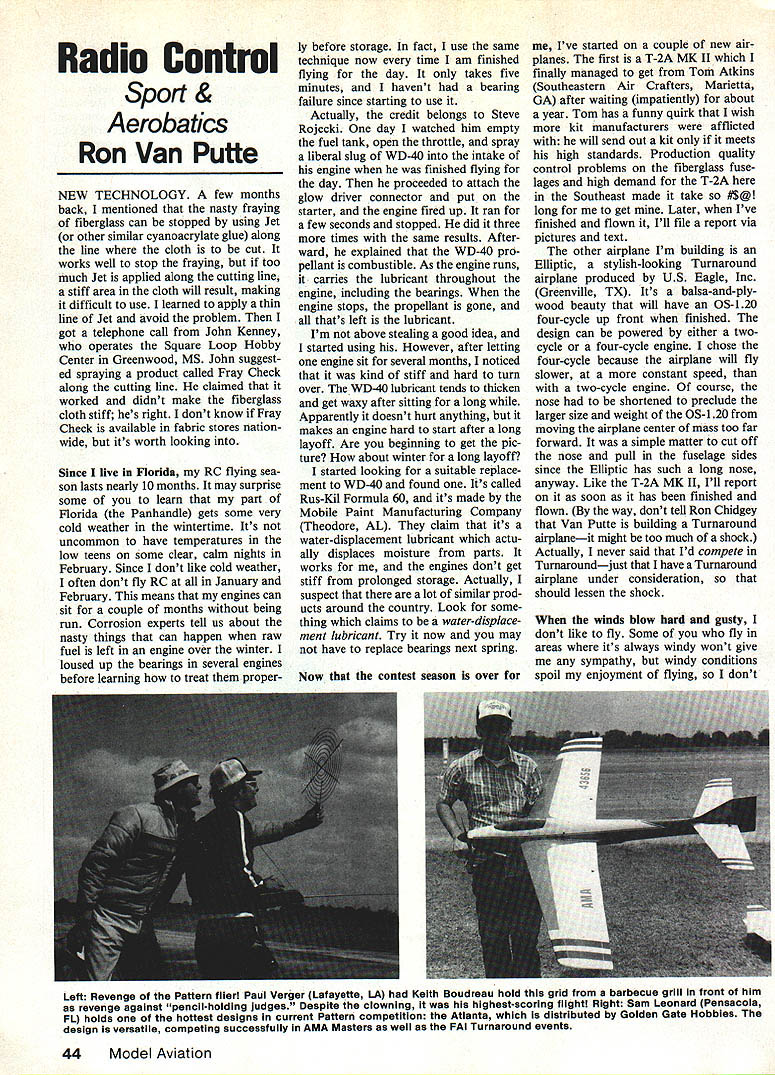
The other airplane I'm building is an Elliptic, a stylish-looking Turnaround airplane produced by U.S. Eagle, Inc. (Greenville, TX). It's a balsa-and-ply wood beauty that will have an OS-120 four-cycle up front and can be powered either by a two-cycle or four-cycle engine. I chose the four-cycle because the airplane will fly slower, at a more constant speed, than with a two-cycle engine. Of course, the nose had to be shortened to preclude the larger size and weight of the OS-120 from moving the airplane's center of mass too far forward. It was a simple matter to cut off the nose and pull in the fuselage sides since the Elliptic has such a long nose anyway. Like the T-2A MK II, I'll report on it as soon as it has been finished and flown.
(By the way, don't tell Ron Chidgey that Van Putte is building a Turnaround airplane—it might be too much of a shock.) Actually, I never said that I'd compete in Turnaround—just that I have a Turnaround airplane under consideration, so that should lessen the shock.
RC cars for windy days
When the winds blow hard and gusty, I don't like to fly. Some of you who fly in areas where it's always windy won't give me any sympathy, but windy conditions spoil my enjoyment of flying, so I don't go out. When it's warm I can go sailing, but winter's cold shoots that down. So what do you do when it's cold and windy and you don't want to watch TV? How about an RC car?
Have you seen one of the modern electric RC cars? I hadn't until recently, and they are great! They are available from many sources, with prices from around $50 to $200 and up. I bought an MRC Tamiya Grasshopper, a low-priced car with simple bearings and suspension. Even so, it really scoots, and I'm having a great time with it. It's plenty fast for me already, but shock absorbers, ball bearings and a high-current motor can be purchased for it to hop it up. Even though the Grasshopper is one of the least expensive MRC cars, I was pleasantly surprised with the quality of its design and manufacture. If you don't get an RC car for Christmas, you can always buy yourself a little after-Christmas gift to ward off post-holiday depression. Besides, they're great for maintaining your hand/eye coordination.
Importance of center of mass
Earlier in this article, when I mentioned getting the center of mass of my new Elliptic in the proper place, it occurred to me that many beginners have no idea of the importance of proper location of the airplane center of mass. It's common for many beginners to shift the center of mass of an airplane by adding weight to get rid of up- or down-elevator trim, without considering the effect of the added weight on airplane stability.
Shifting the center of mass of an airplane was first done in the late 1800s by Otto Lilienthal when he was flying gliders. Lilienthal controlled the altitude of his gliders by moving his body, which changed the location of the center of mass. What he didn't realize was that he was changing the glider's trim and stability. He killed himself doing it.
The consequences probably won't be quite so disastrous for RC fliers who thoughtlessly change their airplane's center of mass, but it could mess up a perfectly good airplane. There is a range of locations of an airplane's center of mass for which it is trimmable, controllable, and stable. The range is actually quite broad, and intentional, reasoned movement of the center of mass is often necessary to improve an airplane's flying qualities. Beginners should always make sure that the airplane's center of mass is within the range recommended on the plans.
The most dramatic consequence of an improper center of mass location is when it is behind the recommended area. An aft center of mass can bring chills to any flier because the airplane suddenly is unstable in pitch. It doesn't care whether it's pitching up or down (and it often does both—very quickly). The best thing to do in this situation is to slow the airplane down; be very gentle on the controls, and try to ease it to a landing. Unfortunately, it usually occurs on the first flight when the airplane is out of trim. Survivors of this drama seldom have to be convinced that the airplane center of mass needs to be moved forward into the proper range. The rest make sure it's right on their next airplane.
A center of mass which is too far forward doesn't cause such dramatic consequences, but a lot of airplanes have been bent because of it. The symptoms are simple:
- A lot of elevator is necessary to perform loops, rolls, and to flare the airplane for landings.
- The airplane may be dinged on landing when the pilot suddenly discovers that he has the stick all the way back and the airplane is still sinking.
Moving the center of mass back into the proper range will cure that sinking feeling and keep the landing gear on the bottom side of the wing.
Ron Van Putte 111 Sleepy Oaks Rd. Ft. Walton Beach, FL 32548
Transcribed from original scans by AI. Minor OCR errors may remain.

