
Radio Control
Sport-Aerobatics
Ron VanPutte
ONE OF THE problems associated with big contests is how to manage the several flight lines which are required because of the large number of contestants. Some clubs have the fliers use the same flight line during the contest and rotate the judges. This usually works out fine, but some contestants will always complain that they flew poorly because they were at the "bad" flight line. Unfortunately, the alternative usually requires that the judges stay at the same line and the contestants have a long walk to the several flight lines with airplanes and associated gear. So far this year I have seen two approaches which worked well and did not require a long walk for contestants.
At the Huntsville contest on May 1st and 2nd, the Rocket City Radio Control Club set up two flight lines at one circle on a runway of the old Huntsville Airport and two more flight lines at one circle on a parallel taxiway. The contestants, judges, contest administration and parking were all located in the median strip between the runway and taxiway. The judges stayed at the same flight line and contestants rotated through the flight lines. No one had to walk more than 200 feet to compete at any flight line. In addition, you were literally surrounded by the contest and could easily watch a flight from any flight line without moving from the comfort of your own tent. As a side benefit, it was relatively easy to set up the public address system and flight line communications.
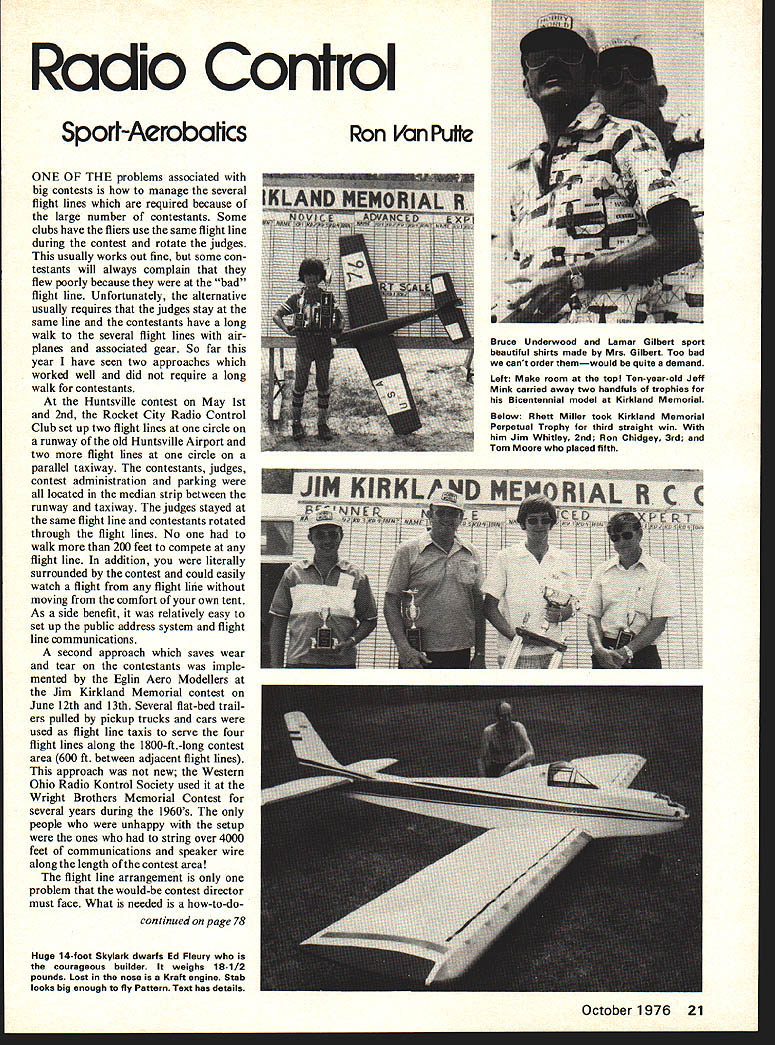
A second approach which saves wear and tear on the contestants was implemented by the Eglin Aero Modellers at the Jim Kirkland Memorial contest on June 12th and 13th. Several flat-bed trailers pulled by pickup trucks and cars were used as flight line taxis to serve the four flight lines along the 1800-ft.-long contest area (600 ft. between adjacent flight lines). This approach was not new; the Western Ohio Radio Kontrol Society used it at the Wright Brothers Memorial Contest for several years during the 1960's. The only people who were unhappy with the setup were the ones who had to string over 4000 feet of communications and speaker wire along the length of the contest area.
The flight line arrangement is only one problem that the would-be contest director must face. What is needed is a how-to-do
Radio Control: Sport-Aerobatics
book for contest directors so that new CDs can avoid the pitfalls that every contest has, no matter what the size. Are there any volunteers?
Another thing I noticed at contests so far this year is that flying quality has improved in the lower classes, especially in the Advanced class. In the old Class A, B, D Novice and D Expert setup, Class B (now called Advanced) used to be a low-population hodgepodge of fliers of widely varying ability. First there were the fliers who became impatient with earning their "graduation" from Class A (now called Novice) and promoted themselves to Class B. Then, there were the older fliers who were unwilling to compete in a group as "low" as Class A despite their lack of flying competence and they flew in Class B. Finally, there were the Class A winners who earned their way out of the class; they really tore up the competition in Class B. From what I've seen lately, those Novice class graduates are going to have a surprise coming when they get to Advanced. In each of the recent contests I competed in there were half a dozen fliers who would have won virtually any of the old Class B contests.
It's also interesting to compare the quality of maneuvers done in the various classes. A large percentage of the maneuvers in Advanced, Expert and Masters are identical and it is often nearly impossible to tell what class a flier is in by looking at a portion of a flight because the quality of flying is so good.
Perhaps one reason so many people are flying so well is that so many competitors are flying outstanding airplanes. At any given contest over half the contestants will be flying Don Lowe's Phoenix 6 or Joe Bridis' Dirty Birdy. I would imagine that the relative numbers of one airplane versus the other would vary depending on whether the contest was nearer the East coast or the West coast, but the two of them out-number all the rest combined.
FOR THOSE of you who are interested in building a Phoenix 6 and plan to install retractable landing gear, let me share a suggestion with you. One of the problems with the airplane is that the plans show the nose gear retracting into the leading edge of the wing. Doing that requires cutting the bulkhead at the front end of the RC compartment and scooping out the front of the wing. It's difficult to do properly and it weakens both the wing and the fuselage. However, you don't have to go to all that trouble because the plans are wrong; the nose of the fiberglass fuselage is longer than shown on the plans and the motor mount that is normally installed is longer than required.
When you order your kit, order it without the firewall and motor mount installed. Purchase a Fox mount to fit your engine and put the engine as far back on the mount as it will go and still leave room for the fuel tubing or fuel pump. Purchase a 2" Goldberg spinner because it has a skirt at the rear of the prop which allows the engine to be installed further forward than normal. Determine the distance from the rear of the spinner to the rear of the Fox mount; this is the distance from the nose of the airplane to the front of the firewall.
Mark the location of the firewall on the fuselage and make a cardboard template to fit the fuselage at this point. Cut the firewall from 5-ply 1/4" plywood, mark and drill the holes for the Fox mount and retract nose gear and install the firewall using polyester resin (not epoxy). If you have done everything carefully you will obtain 1 1/2" prop clearance and the nose gear will retract into the fuselage in front of the wing.
THE 1976 Jim Kirkland Memorial joined the ranks of major pattern contests by drawing 89 contestants from eight states. Over 200 enjoyed the now-famous Saturday night shrimp feast. Rhett Miller proved that he still has it all together by winning the Masters event for the third year in a row, but Rhett had all the competition that he could handle from Jim Whitley who finished in 15 points back! Jim edged out Ron Chidgey who served notice that he's back by flying better than he has in years. Ron flew the new Atlas which is now being kitted by Southern RC Products. The Atlas appears to fly slower and more stable than the Phoenix 6 or the Dirty Birdy, but it is at least as smooth and precise as either of them.
The three of them were at each other again two weeks later at the Atlanta Phoenix City contest. This time Rhett Miller won again but Ron Chidgey managed to beat Jim Whitley, partly because Jim had aileron problems due to water getting into the aileron pot in the transmitter or in the glueless assembly. This was the initial contest sponsored by the Conley Fliers, but CD Marty Farron put together a good contest. The Saturday social hour at the contest headquarters, the Admiral Benbow Inn, was free to contestants, wives and helpers. It was an enjoyable contest which pattern fliers from the Southeast should plan to attend next year.
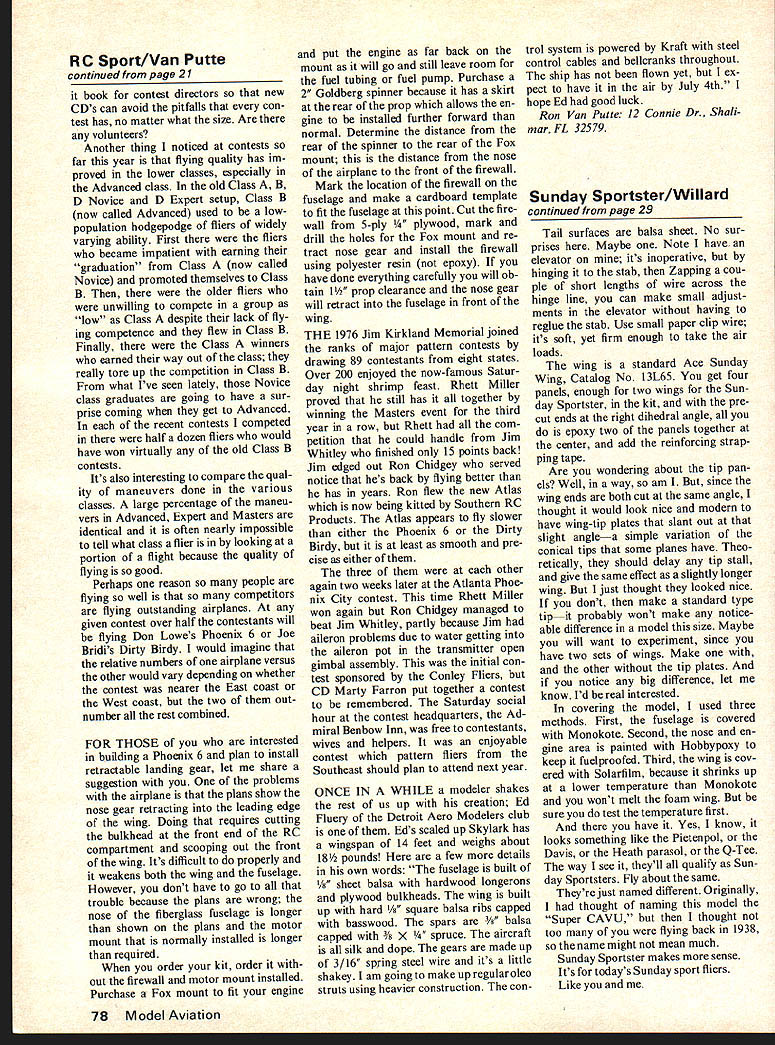
ONCE IN A WHILE a modeler shakes the rest of us up with his creations; Ed Fleury of the Detroit Aero Modelers club is one of them. Ed's scaled up Skylark has a wingspan of 14 feet and weighs about 18 1/2 pounds! Here are a few more details in his own words: "The fuselage is built up with 3/16" sheet balsa with hardwood longerons and plywood bulkheads. The wing is built up with 1/8" square balsa ribs capped with 3/32" balsa sheeting and 3/16" spruce. The aircraft is all silk and dope. The gear are made up of 3/16" spring steel wire and it's a little shaky. I am going to make up regular cable struts using heavier construction. The control system is powered by Kraft with steel control cables and bellcranks throughout. The ship has not been flown yet, but I expect to have it in the air by July 4th." I hope Ed had good luck. Ron Van Putte, 12 Connie Dr., Shalimar, FL 32579.
Transcribed from original scans by AI. Minor OCR errors may remain.

