

Radio Control: Sport & Aerobatics
Ron Van Putte
When is the last time you finished an airplane, compared the center of gravity (CG) with the one on the plans, and found they were in the same place? I've been building RC airplanes since 1954, and it only happened for me once. Usually there is only a small difference, but once in a while I got overly enthusiastic with airplane structure, primer and/or paint and had to add a lot of nose weight. In fact, the only time I've ended up with nose-heavy airplanes is when I built one of Don Lowe's Phoenix series airplanes. The swept wing shifts the wing aerodynamic center well aft and allows a CG to be further back on the fuselage than is normal with "straight-wing" airplanes.
I have built two Phoenix 3 airplanes, a Phoenix 5, two Phoenix 6s and one Phoenix 8, and I've been used to the luxury of not having to worry about having it tail-heavy. In fact, I had to add six ounces of lead to the tail of one Phoenix 6 to get the CG far enough back! There are very few straight-wing builders who have to add that much weight to the tail of an airplane. Well, I finished a straight-wing airplane a while ago which needed more than four ounces of lead to get the CG to the spot on the plans.
The airplane I'm referring to is the Elliptic, and it doesn't have what most people would call a straight wing, either, because it has an essentially elliptic wing planform (hence the name of the airplane). So why did I have to add so much lead to the tail? It's basically because I decided to use a four-cycle engine in it.
The Elliptic (U.S. Eagle, P.O. Box 1902, Greenville, TX 75401) can be flown with either a .51 to .75 two-cycle engine or a .60 to 1.20 four-cycle engine, but it's primarily set up for an OS .61. Four-cycle engines are both heavier and larger than two-cycle engines of approximately equal power, so it is risky to simply bolt on a four-cycle engine without considering the potential for a dramatic CG shift.
You'll note that a four-cycle engine is heavier and bigger than a two-cycle engine of corresponding power. Because of the way they're made, the CG of a four-cycle engine is a lot further forward on the firewall than a two-cycle engine's. So even if the engines weighed the same, the airplane CG would still shift forward because the engine CG is further forward on a four-cycle engine. That factor is compounded by the extra weight of four-cycle engines. These two facts can cause an unsuspecting builder a big problem when he tries to get the CG of his airplane in the correct place.
One obvious solution to an excessive forward CG shift when bolting on a four-cycle engine is to cut the nose off the airplane enough so that the airplane balances in the right place. Anyone who has tried this has discovered that the airplane may have almost no nose at all! For example, I calculated where the firewall should be on my Elliptic and discovered that I'd have the firewall sitting at the leading edge of the wing! (By the way, this is why many World War I airplanes had such short noses.)
There has to be a way out of most problems, and there is in this case, too. The tail is a long distance from the airplane CG, and adding a modest amount of weight to the tail has an enormous effect on shifting the airplane CG back. Most of us have discovered this fact (to our dismay) when we got too much paint on an airplane's tail. Now it can work to our advantage!
How to decide firewall location vs. tail weight
What I intend to do is present a technique to use in deciding how much to move the firewall back versus how much tail weight to add when installing a four-cycle engine. I'll follow that with a way to decide how much weight to add (and where) if any airplane has the wrong CG and you want to move it to where the plans indicate.
First, I assume that you already know where the airplane CG is supposed to be and can determine the weight and CG of a typical .60 two-cycle and a comparable four-cycle engine installation. Weighing the engines shouldn't present a problem if baby scales are available. Be sure to have the correct size propeller and spinner installed on the engine (four-cycle props are much larger than their two-cycle cousins).
Determining the CG of engines is done by finding the balance point of the engine/prop/spinner group. Granted, it is impossible to actually get an engine to balance on a sharp edge, but you can move the propeller back and forth and observe the point at which it doesn't tip badly either way. Mark the CG on the engine/prop/spinner. In the case of the engine in its normal position on the motor mount the way you're planning to use it, measure the distance between the airplane CG and the engine/prop/spinner CG. If you are planning to use a metal motor mount, also include the weight and CG of the motor-mount-and-engine group.
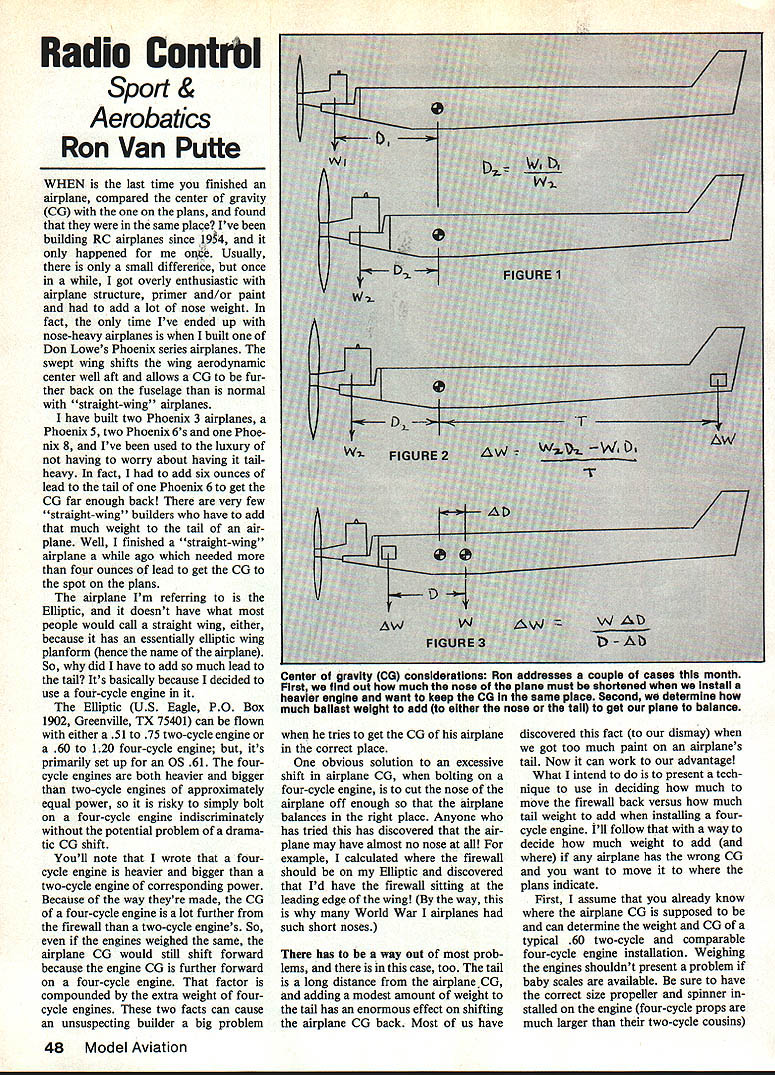
Figure 1 shows the respective weights and CG distances for a two-cycle installation and the corresponding four-cycle installation. Note W1 and D1 for the two-cycle installation, W2 and D2 for the four-cycle. The equation for D2 is:
D2 = (W1 · D1) / W2
This distance D2 is where the CG of the four-cycle engine group should be in front of the airplane CG, assuming no tail weight is added. You may need to add tail weight if this calculation leaves the airplane with an unreasonably short nose. For the first calculation, if the result is an unreasonably short length, decide what reasonable length D2 to use (Figure 2) and determine how much tail weight to add.
You'll probably want to try a few nose-length and tail-weight combinations to come up with one so that you neither have to cut off too much nose nor add too much tail weight.
Correcting a tail-heavy or nose-heavy airplane
Now, what about the builder who doesn't want to switch engines but just wants to get his new airplane to balance where it should? I'm assuming that the airplane is tail-heavy and weight must be added near the nose to get the airplane CG in the right spot. Figure 3 demonstrates this situation.
In this case:
- W is the basic weight of the airplane,
- ΔD is the distance the airplane CG must be moved forward,
- ΔX is the distance to the place where weight is to be added, and
- ΔW is the added weight.
It's not hard to see that the further forward the weight can be added, the less has to be used.
If, for some strange reason, you've built a nose-heavy airplane, the same equation can be used to determine how much tail weight is needed to get the proper airplane CG location. I doubt that many will need to do that, unless the new airplane is a Phoenix. That reminds me of the Phoenix 3 which had about 26° leading-edge sweep in the wing. I had to build a box in the fuselage back of the wing to carry the battery pack so that I could minimize the tail weight I had to add. But that's another story.
Anecdote: Reviving old glue
I recently came across a bottle of Wilhold glue which had been misplaced in the back of a cupboard and left for several years. It had separated, and the top part was dark-colored and very thin in consistency. The bottom layer appeared to be about the right color, but it was so thick I could barely get a piece of 1/32" music wire through it when I tried to stir it.
I remembered that heat makes most glues more watery, so I put the bottle (without top) in my microwave oven, ran it for 30 seconds, and stirred it. I repeated the routine several times until the glue was quite warm—and thoroughly mixed. The procedure doesn't seem to have affected its gluing ability, but I'd be interested in hearing from anyone about reasons not to do what I did (a polymer chemist, perhaps?). Meanwhile, I plan to see what happens to it by leaving it where I can see it and making trial glue joints periodically.
Newsletter items and notes
My enjoyment of RC is augmented regularly when a large envelope stuffed with RC-oriented club newsletters arrives from AMA HQ. In the last batch I came across two items of general interest.
- Center gravity (CG) considerations
- Ron addresses a couple of cases: first, find out how much nose the plane must be shortened if a heavier engine is installed and you want to keep the CG in the same place; second, determine how much ballast weight to add, either in the nose or the tail, to get the plane in balance.
- Weighing engines is done by finding the balance on a sharp edge. Move the prop back and forth and observe the point that doesn't tip badly either way; mark the CG of the engine/prop/spinner. With the engine in its normal position on the motor mount, measure the distance between the airplane CG and the engine/prop/spinner CG. If you plan to use a metal motor mount, include its weight and CG.
- Use the D2 equation above to find where the four-cycle engine group CG should be in front of the airplane CG. If that results in an unreasonably short nose, decide on a reasonable D2 and use tail weight to correct the CG.
- Noise and mufflers
- Almost every club I've been involved with in the last 15 years had at least an informal muffler rule. Nowadays almost everyone uses mufflers on their engines. In the mid‑1960s, almost nobody used them and muffler proponents argued that using mufflers would prevent the loss of flying fields due to noise.
- Early mufflers reduced noise at the expense of power. Modern mufflers do a good job of reducing noise without sacrificing as much power.
- Unless dramatic new improvements are made in mufflers for two-cycle engines, a lot of flying fields may be lost. One alternative for clubs with noise problems is to ban two-cycle engines in favor of four-cycle engines, but neighbors may eventually remember how it was before and start complaining again.
A humorous field note: "Glitchash"
The following appeared in the Mount Rainier Radio Control Society Newsletter (Tacoma, WA), attributed to "Bill D.":
"Old Threat Finally Identified by 'Field Psychologist.' Glitchash, commonly known as 'glitch,' has finally been identified after years of research. This dread malady preys upon a certain segment of the species Homo sapiens known as RC pilots.
"It is normally lurking in open fields where grown men play with model aircraft. A glitch is very dangerous when in full plumage, and the adult male should only be approached by experienced glitch hunters wielding loaded field strength meters. It has a bite which produces immediate reactions, beginning with a nervous shaking and a twitching of the thumbs.
"This sequence of symptoms is often followed by cries of, 'I don't have it!' Splintering or thudding noises occur almost immediately. At this point, the victim usually lapses into depression and may become militant if approached for the next few minutes. The glitch is invisible, but any real or imagined experience with this enemy should be reported immediately to your field psychologist."
Ron Van Putte 111 Sleepy Oaks Rd., Ft. Walton Beach, FL 32548.
Transcribed from original scans by AI. Minor OCR errors may remain.

