
Radio Control: Sport & Aerobatics
Ron Van Putte
Letters and Ken Willard
After the April column (in which I asked for revenge on Ken Willard for correcting me about the proper definition of a downwind turn), I sat back very pleased with myself. After all, I admitted that he was right and deflected the letters that he had expected would set up a "donnybrook," in which he would be the reference. That was the situation until a letter from Ken Willard arrived. Now, you must understand the way I view Ken Willard in order to get a feeling of what it was like to receive a letter from him.
Ken Willard has been writing the "Sunday Flier" column in Radio Control Modeler magazine for decades. I've been in RC for over 30 years, and I have enjoyed reading his columns for more than two-thirds of my RC experience. I have a great deal of admiration for a columnist who can write column after column of quality material for so long. Then, I get a letter from this living legend. How would you feel?
Since his writing is quality work, I decided to share excerpts from the letter. Read the first part with a chuckle in mind or you might get the wrong idea. Ken wrote, "The April issue of MA just arrived. Now I know why you didn't write me to set me straighter. Instead, since your creative juices were dry, it was good for half a column! And the other half was a donnybrook about Turnaround. As you say . . . a valid — but kind of cheap — way to get column material."
"Now don't go flying off the handle, Ron! Just joshing you a bit. Actually, I really enjoyed the roasting. Besides, it's the first time my name was in a column five times! You're gonna make me famous!"
"Sorry, though, you won't get 'revenge' in the way you suggest. I received plenty of letters, and the tabulated results were very surprising. Actually, there were four different 'definitions' submitted on what constitutes a downwind turn. Would you believe it? The results will appear in a future column. You might enjoy it."
Ken then got a bit more serious: in our column you remarked, "Who knows — and more importantly, who cares?" He reminded me that we have, whether we like it or not, a responsibility to the readers to try and present factual material. Who cares? The readers do; they look to you for answers. Sometimes the answers are not definitive, but your opinion is important. Take the word of a guy who's old enough to be your father.
How would you feel if you got that letter? It's kind of humbling. In my defense, what I meant by the "who knows and who cares" comment was that it is not important to know what the correct name is for a particular turn in windy conditions, as long as the situation is understood. You can call it what you like, but it's important to know what the airplane will do in wind when you try to fly it in a prescribed course. It's the old, "A rose by any other name would smell as sweet."
As far as the writer's responsibility to present factual material is concerned, I feel that Ken is correct about that, too. There are too many people who are willing to accept, without question, material that has been published in a newspaper, book, or magazine. In the 10 years I've written this column, I have always written what I've believed to be correct. I plan to continue doing so, but thanks for the reminder, Ken.
One interesting side note is that I got several letters agreeing with my definition of a downwind turn, even after I'd admitted that Ken was right and I was wrong!
NSRCA and Membership Reminder
Before I forget again — I received a letter from Suzi Stream, who is the Secretary/Treasurer of the National Society of Radio Controlled Aerobatics (NSRCA), over a month ago. Suzi asked me to mention that she is now the Secretary/Treasurer of the NSRCA, and I forgot to do it last month. All you Pattern fliers who haven't renewed your NSRCA membership yet (or you new prospects) can write to:
Suzi Stream 3723 Snowden Ave. Long Beach, CA 90808
Enclose $10 for 1985 NSRCA dues. The NSRCA is dedicated to improving Pattern flying and is a good partner of the AMA; besides, you get a monthly newsletter called the K-Factor as part of the annual dues.
Pattern Flying
I'm not a Pattern flyer, but I'd like to expound on one of my favorite subjects: the effects of wind on airplanes. I keep trying to get sport fliers to go in for Pattern flying. The reason I promote it is often a surprise to sport fliers. Simply said, Pattern flying improves flying skills and increases enjoyment of sport flying.
The real difference between the two types of flying is that a Pattern flier must perform particular maneuvers at specified times; a sport flier does whatever feels right, whenever he feels like it. So what's the difference? Discipline — that's what. Both types of fliers may have the same natural talent. A Pattern flier has to produce maneuvers where they're supposed to be done. Learning to fly Pattern requires the flier to concentrate on maneuvers in ways sport fliers seldom do. In the long run, the Pattern flier becomes a better flier, able to do what he wants with an airplane.
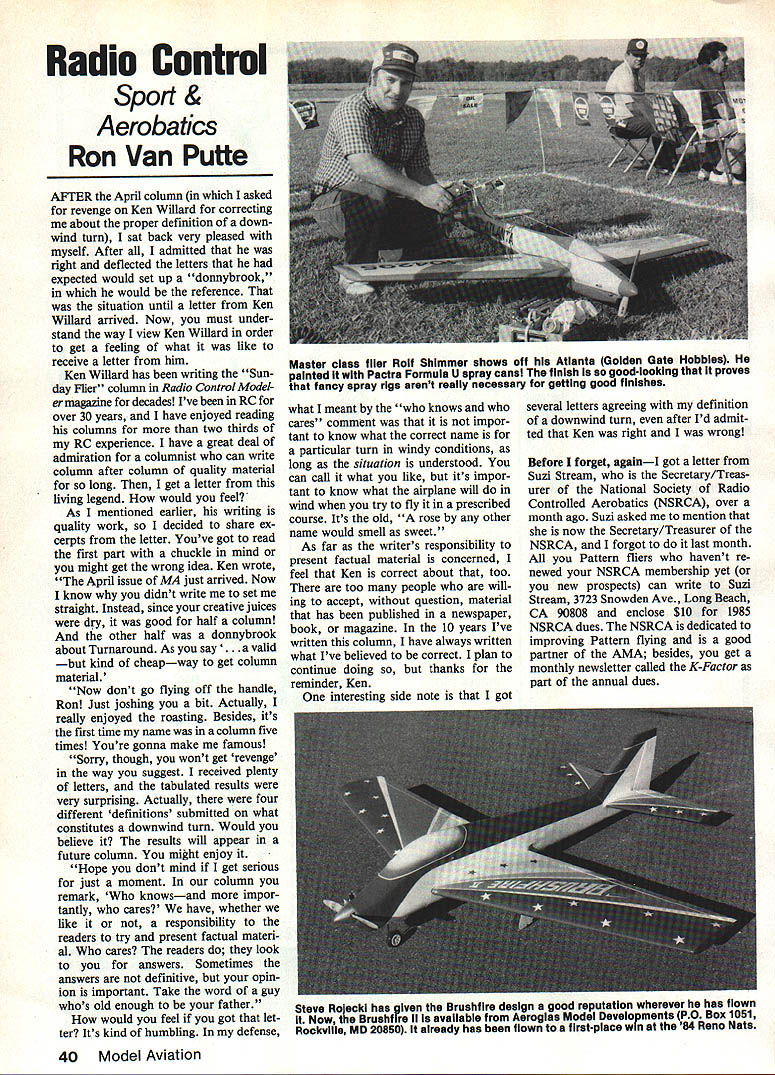
If you learn how to fly Pattern really well, you may get to be a Master class flier and receive an invitation to fly in the Masters Tournament, the RC Aerobatics Team Selection Finals. Every other year, we select a three-man team to represent the United States in the World Championships. The 1985 Masters Tournament will be held on June 20–23, 1985 at Lake Charles, LA. Lake Charles was the site of the 1974, 1975, and 1978 Nats, and it's a fine place to hold a Pattern contest of the stature of the Masters Tournament. I'm looking forward to the 1985 Masters Tournament and the 1986 Nats at Lake Charles. The Lake Area Radio Kontrol Society always hosts a great contest.
Flutter
This month the subject is flutter. Anyone who has been in the RC hobby very long has heard the dreaded sound of control-surface flutter. My first full-house RC airplane was destroyed by flutter back in 1964. It was especially embarrassing for me because, at that time, I was a flutter engineer for the U.S. Air Force. The airplane was an early generation Goldberg Senior Falcon. It turned out that the early Senior Falcons were plagued with weak wing spars, and Senior Falcon wings were infamous for failing in bending or due to flutter.
Flutter rarely involves a single control surface. In fact, purists insist that flutter involves at least two degrees of freedom. What sometimes happens is that the wing will oscillate in both bending and torsion, one literally feeding on the other. The most common case for modelers involves either wing bending and/or torsion and aileron motion.
Flutter is caused by aerodynamic forces and moments which are in phase with the motion. In other words, the aerodynamic surface is being driven in the direction it wants to go. If there's no oscillation, the phenomenon is called divergence (the wing twists off). If there is oscillation, it is called flutter.
By now, many of you are saying, "So what! Tell me how to avoid flutter without giving me a sermon on its causes!" Okay, I'll do it. For every problem there are a lot of possible solutions, and flutter is no different. All you have to do is change the aerodynamic/mechanical combination which caused the flutter in the first place. However, one thing to remember is that flutter is always out there lurking. If the airplane goes fast enough, it will flutter in one way or another. What you try to do is make the flutter speed higher than the airplane is capable of attaining.
Ways to reduce or eliminate flutter:
- Make the aileron linkage strong and rigid — the more rigid the linkage, the higher the flutter speed.
- Increase the leading-edge area of the aileron relative to the wing trailing edge.
- Seal the aileron gap to delay onset of flutter.
- Balance the ailerons so their center of gravity is on the hinge line — this is an effective way to eliminate aileron flutter.
Balancing the ailerons
- Since most ailerons are hinged at the front, make them as light as possible without sacrificing strength.
- Carefully placed small balance weights in the leading edge or just ahead of the hinge line will usually do the job. Keep the weights light.
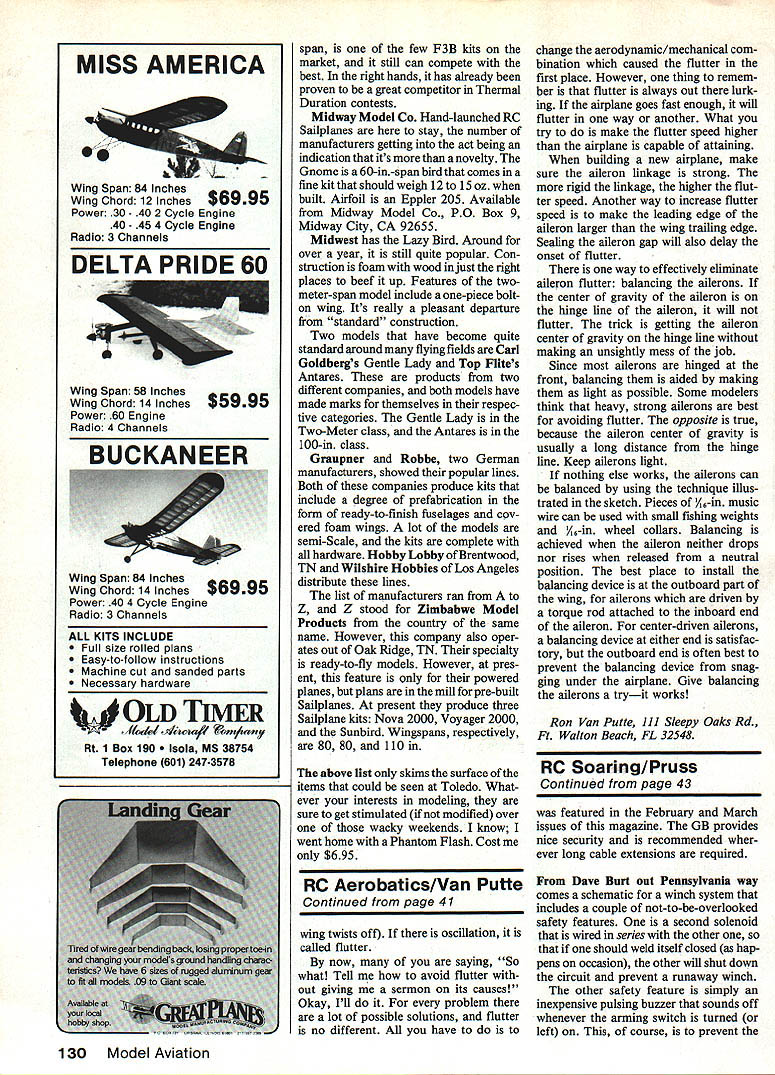
- If practical, use a mechanical balancing device: pieces of 1/4-in. music wire with small fishing swivels and 1/16-in. wheel collars can be used. Balancing is achieved when the aileron neither drops nor rises when released from neutral. The best place to install the balancing device is at the outboard part of the wing for ailerons driven by a torque rod attached to the inboard end. For center-driven ailerons, balancing at either end is satisfactory, but the outboard end often prevents the device from snagging under the airplane.
Give aileron balancing a try — it works!
Ron Van Putte 111 Sleepy Oaks Rd. Ft. Walton Beach, FL 32548.
Transcribed from original scans by AI. Minor OCR errors may remain.

