
Radio Control: Sport & Aerobatics
Ron Van Putte
NEW THINGS aren't always the best. You read about all kinds of new products and sometimes fall for the spiel — if it's new, it must be better. It's not true, but read on.
Novice model builders in my club often ask me for advice about building and finishing techniques. There are a lot of us who have made most of the mistakes that can be made in building and finishing, but we often have some good tips. Since there's no sense in forcing a novice to make the same mistakes we did, I always share my good ideas and keep the bad ones hidden away until everyone is standing around telling modeling horror stories.
Balsa filling tip
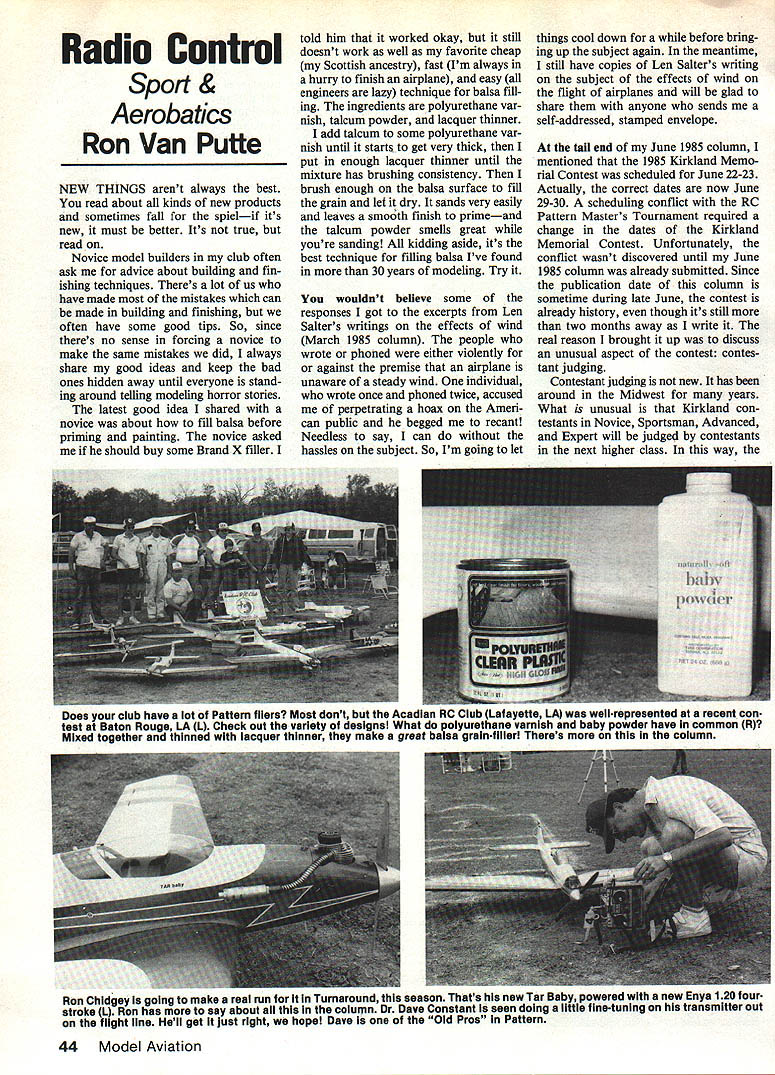
The latest good idea I shared with a novice was about how to fill balsa before priming and painting. The novice asked if he should buy some Brand X filler. I told him that it worked okay, but it still doesn't work as well as my favorite cheap (my Scottish ancestry), fast (I'm always in a hurry to finish an airplane), and easy (all engineers are lazy) technique for balsa filling. The ingredients are polyurethane varnish, talcum powder, and lacquer thinner.
I add talcum to some polyurethane varnish until it starts to get very thick, then I put in enough lacquer thinner until the mixture has brushing consistency. Then I brush enough on the balsa surface to fill the grain and let it dry. It sands very easily and leaves a smooth finish to prime — and the talcum powder smells great while you're sanding! All kidding aside, it's the best technique for filling balsa I've found in more than 30 years of modeling. Try it.
Wind effects and reader reaction
You wouldn't believe some of the responses I got to the excerpts from Len Salter's writings on the effects of wind (March 1985 column). The people who wrote or phoned were either violently for or against the premise that an airplane is unaware of a steady wind. One individual, who wrote once and phoned twice, accused me of perpetrating a hoax on the American public and begged me to recant! Needless to say, I can do without the hassles on the subject. I'm going to let things cool down for a while before bringing up the subject again. In the meantime, I still have copies of Len Salter's writing on the effects of wind on the flight of airplanes and will be glad to share them with anyone who sends a self-addressed, stamped envelope.
Kirkland Memorial Contest — contestant judging
At the tail end of my June 1985 column I mentioned that the 1985 Kirkland Memorial Contest was scheduled for June 22–23. Actually, the correct dates are now June 29–30. A scheduling conflict with the RC Pattern Master's Tournament required a change in the dates of the Kirkland Memorial Contest. Unfortunately, the conflict wasn't discovered until my June column was already submitted. Since the publication date of this column is sometime during late June, the contest will already be history by the time you read this, even though it's still more than two months away as I write it.
The real reason I brought it up was to discuss an unusual aspect of the contest: contestant judging.
Contestant judging is not new. It has been around in the Midwest for many years. What is unusual is that Kirkland contestants in Novice, Sportsman, Advanced, and Expert will be judged by contestants in the next higher class. In this way, contestant judging will eliminate, or at least reduce, the number of judges that would otherwise be provided by the host club.
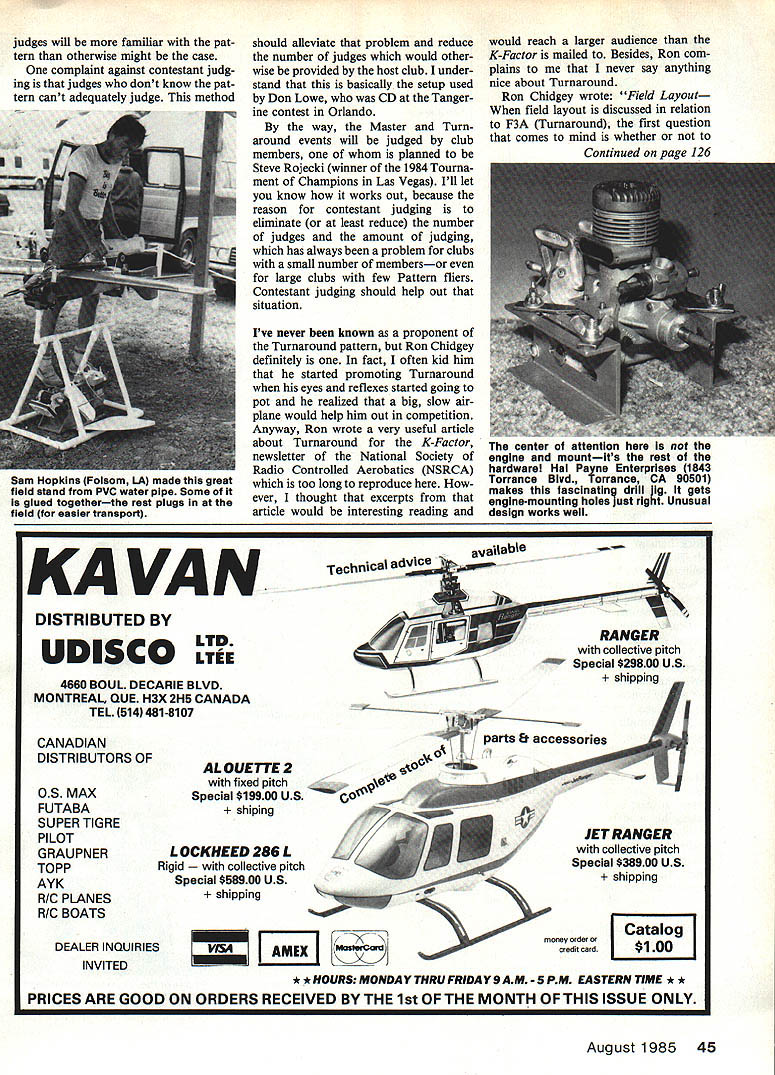
Understand, basically the setup used by Don Lowe (Contest Director, Tangerine Contest, Orlando) for Master Turnaround events — with judging provided by club members — served as the model. Steve Rojecki, winner of the 1984 Tournament of Champions in Las Vegas, planned this. I'll let you know how it works out because contestant judging is intended to reduce the judging load. The amount of judging has always been a problem — clubs with a small number of members, or large clubs with few Pattern fliers, have difficulty supplying enough judges. Contestant judging should help the situation.
Turnaround and Ron Chidgey
I've never known a stronger proponent of the Turnaround pattern than Ron Chidgey. In fact, I often kid him that he started promoting Turnaround because his eyes and reflexes started going to pot and he realized a big slow airplane would help him out in competition. Ron wrote a very useful article about Turnaround in the K‑Factor newsletter of the National Society of Radio Controlled Aerobatics (NSRCA). It was too long to reproduce here, but I thought excerpts of the article would be interesting reading and would reach a larger audience than the K‑Factor is mailed to. Besides, Ron complains to me that I never say anything nice about Turnaround.
Ron Chidgey wrote:
Field Layout — When field layout is discussed in relation to F3A (Turnaround), the first question that comes to mind is whether or not to use flags to mark the "box." In my opinion, flags should not be used, as they are not called for or specified in the FAI Sporting Code. The Sporting Code (Section 5.1.8, Marking) says this: "The maneuvers must be performed in a plane at a height which will allow them to be seen clearly by the judges. ... The non-observance of this rule will be heavily penalized by loss of points." In other words, what should be heavily penalized is placing a maneuver where it can't be clearly seen by the judge. Approximately 60° vertically and 120° horizontally is given as a reference or guideline; however, that was never intended to be taken as a rigid definition of a "box" beyond which the pilot could not fly. As a matter of fact, flying too far away from the judges (even if inside the 120° lines) should be downgraded just as harshly as flying too far past the 120° lines. Obviously, if the turnaround maneuver is flown well past the 120° line, it is placed further away from the judge than need be and should be heavily penalized. In my opinion, if the entire turnaround maneuver is outside the 120° line, it should be downgraded the four points for poor positioning. But, if only part of the maneuver is outside, it should be downgraded one, two, or three points, depending on how much of it is out.
I have been to some contests where I wish flags had been used. These were contests where the judges picked "that tall pine — two trees to the left of the oak" as a marker and downgraded three or four points if you flew past it. In those cases, I think flags would have been a better option. I can't tell you how disheartening it is to fly a whole contest only to learn you had picked out the wrong pine tree. One caution about using flags, though: If a Contest Director or chief judge feels he has just got to have flags, then for goodness' sake put them well out (at least on a line 150 yards in front of the pilot) and high enough to be seen clearly.
Use of "Out Judge" With Automatic Downgrade — This practice is definitely contrary to the rules, since automatic downgrade is in reality a penalty and would, in all probability, be on top of a downgrade already calculated into the score by the judges.
Flight Line Setup — After a season of experience and trying different approaches, the setup that seems to work best is to group the F3A competitors together, preferably on one line. An F3A pattern is compatible with any of the AMA patterns, but two F3A planes in the air at the same time is a bit too crowded. Grouping the F3A competitors on one line avoids this problem. If the F3A competitors can't be grouped on one line, then another option is to place F3A first on one line and last on the other. The point is, we have learned that you don't have to stop flying the other classes when you fly F3A. Just avoid having two F3A flights out of the same circle at the same time. The use of scribes to record scores is definitely recommended. Getting volunteers for this duty doesn't seem to be much of a problem, and it takes a big load off the judges.
Rules clarifications
Everyone should be aware of some rules clarifications that were approved at the 1984 CIAM meeting in December and became effective the first of the year:
- Hand launching of F3A models and dropping of parts (intentional or otherwise) was banned for safety reasons and will result in a zero for the flight involved.
- Unlike full-scale aerobatics, F3A aerobatics will continue to be judged on the track or flight path of the model, not the attitude. Changes in attitude of the model in order to maintain a straight track will not be a reason to downgrade a maneuver.
- The description of the Double Immelmann now reads as follows: "Model pulls up and completes a half inside loop, immediately half-rolls to upright, flies straight and level for a distance equal to half the diameter of the half loop, does a half outside loop and immediately half-rolls to level flight."
Individual maneuver clarifications
The following points regarding the listed maneuvers were discussed at the judging school, where a consensus was reached:
- Avalanche — Watch for the "break" from the line of flight, indicating a stall has occurred. No break, no stall, no snap! A fast barrel roll is not a snap.
- Half Roll Into Half Square Loop — The half roll is part of the turnaround maneuver and is not the exit of the Three Outside Loops. The pause following the half roll should be relatively short so that the half roll and half square loop appear as one maneuver, not two separate maneuvers.
- Top Hat — It is now a square maneuver as opposed to tall, i.e., the vertical and horizontal legs are equal in length.
- Top Hat With ½ Rolls — Since this is a wind-correction maneuver, the length of the top (horizontal) leg is the pilot's option; however, the model should fly horizontally at least long enough to establish a definite heading.
- Six-Sided Loop — Just a caution to watch that the angles are 60°, not 45°.
- Reverse Rolls — The pause between the rolls should be very short, only long enough for the judge to see that the model has stopped with the wings level.
- Inverted Spin — Two cautions should be observed: first, the half rolls are part of the maneuver (don't sluff off the exit half roll); second, a definite downline should be established following the spin.
See what I mean about it being interesting reading? Thanks, Ron.
Next month there will be no discussion of the effects of wind on airplanes. Other than that, your guess is as good as mine.
Ron Van Putte 111 Sleepy Oaks Rd. Ft. Walton Beach, FL 32548
Transcribed from original scans by AI. Minor OCR errors may remain.

