
Radio Control: Sport Aerobatics
Ron Van Putte
111 Sleepy Oaks Rd. Ft. Walton Beach, FL 32548
PICTURE this scene: A Pattern contest has been conducted for four rounds with the Contest Director being sure that contestants were equally exposed to the judges. Then, just before the fifth round starts, a contestant discovers that during the fifth and sixth rounds the judging arrangement will not provide equal exposure to the judges. The contestant can demand that either the judging arrangement be changed to guarantee equal exposure, or that the contest be decided based on the four rounds with equal exposure. Right?
You must realize that I wouldn't have set it up the way I did if the answer were "Yes." Actually, the answer is no — contestants do not have the right to equal exposure to the judges. Before you begin to howl, let's check out the 1988/89 AMA Competition Regulations (the rule book).
Equal Exposure and the Rules
The official part of the rules for RC Aerobatics is contained in paragraphs 1 through 20 (pages 54–57). Nowhere in this part of the rules is equal exposure mentioned. However, in paragraph 21 (page 57), "Suggested Field Procedure" (my emphasis—RVP), subparagraph 21.7 contains these sentences: "Sets judges shall judge contestants on the Flight List an equal number of times. If different judges are used during the contest, all contestants shall have an equal opportunity to fly before all judges."
Surprised? I was. When I first read those two sentences I forgot that they were in the "Suggested Field Procedure" paragraph. In addition, the use of "shall" in both sentences misled me. I am an aeronautical engineer, but have dealt with enough contracts to know that the word "shall" is a very strong legal word. Ask any lawyer what it means, and he'll probably tell you that if you don't do what follows "shall" in a contract, you've broken the contract.
Is it really too late to submit a rule-change proposal for the 1990/91 competition regulations to move subparagraph 21.7 out of the "Suggested Field Procedure" paragraph and into the official rules? Yes — unless it's an emergency proposal or a request for a rules interpretation (RMC). By the way, how many competitors' "rights" are there in the "Suggested Field Procedure" that you thought were part of the official rules? How about subparagraphs 21.3 and 21.5? I thought they were part of the official rules, too. Check them out.
I suggest that Contest Directors notify contestants prior to a contest via contest flyers and ads in the "Competition Newsletter" that equal exposure to judges is guaranteed. Many of us have come to expect equal exposure, and I don't plan to drive 300 miles to a contest which doesn't guarantee it.
New Airplanes — Two Goldberg Kits
Seen any new airplanes lately? I have. Carl Goldberg Models sent two kits to the Model Aviation editorial offices for review and comment. MA's publisher sent them to me.
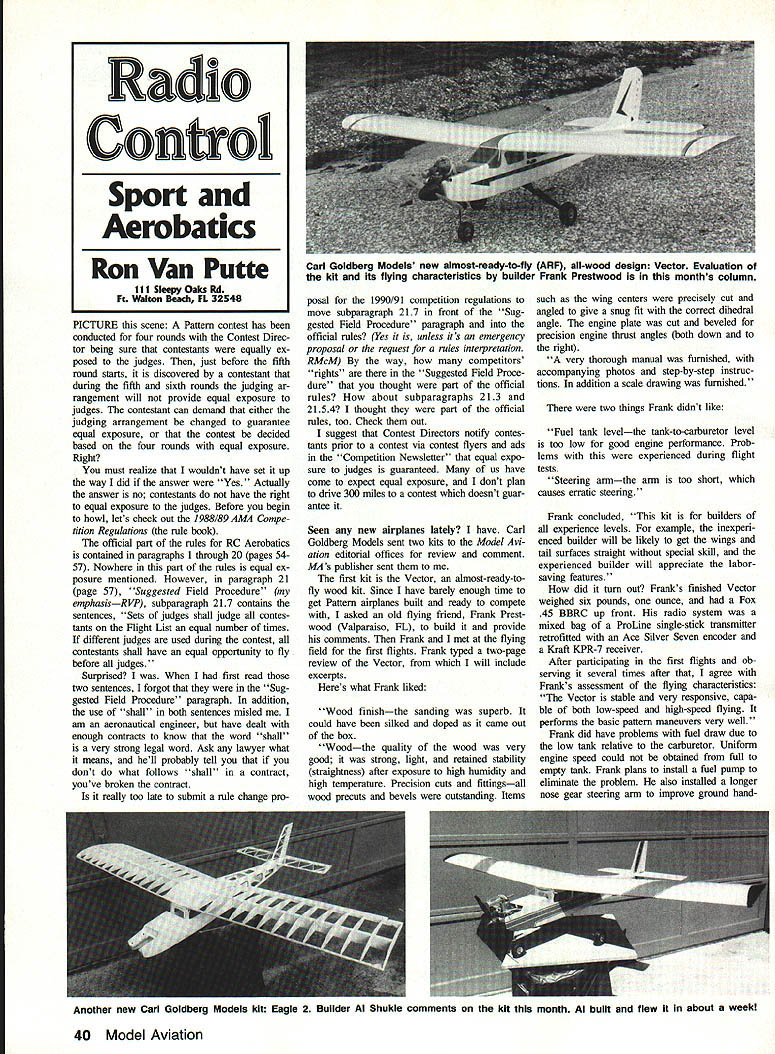
#### Vector — review by Frank Prestwood
Carl Goldberg's Vector is an almost-ready-to-fly wood kit. Since I have barely enough time to get Pattern airplanes built and ready to compete, I asked an old flying friend, Frank Prestwood (Valparaiso, FL), to build it and do the flying tests for me. Frank typed a two-page review of the Vector; here are excerpts and summarized impressions.
What Frank liked:
- Wood finish — the sanding was superb; it could have been silked and doped as it came out of the box.
- Wood quality — strong, light, and retained straightness after exposure to high humidity and temperature.
- Precision cuts and fittings — precut wood and bevels were outstanding. Wing centers were precisely cut and angled for a snug fit and correct dihedral. The engine plate was cut and beveled for precision thrust angles (both down and to the right).
- Documentation — a very thorough manual with photos and step-by-step instructions, plus a scale drawing.
Two things Frank didn't like:
- Fuel tank level — the tank-to-carburetor level was too low for good engine performance; problems were experienced during flight tests.
- Steering arm — the nose-gear steering arm was too short, causing erratic steering.
Frank concluded: "This kit is for builders of all experience levels. The inexperienced builder will likely get the wings and tail surfaces straight without special skill, and the experienced builder will appreciate the labor-saving features."
Frank's finished Vector weighed 6 lb 1 oz and had a Fox .45 BBRC engine up front. The radio system was a mixed bag: a ProLine single-stick transmitter retrofitted with an Ace Silver Seven encoder and a Kraft KPR-7 receiver. After participating in the first flights and observing it several times afterwards, I agree with Frank's assessment of the flying characteristics: the Vector is stable and very responsive, capable of both low-speed and high-speed flying. It performs the basic pattern maneuvers very well.
Frank did have problems with fuel draw due to the low tank relative to the carburetor. Uniform engine speed could not be obtained from full to empty tank; Frank plans to install a fuel pump to eliminate the problem. He also installed a longer nose-gear steering arm to improve ground handling.
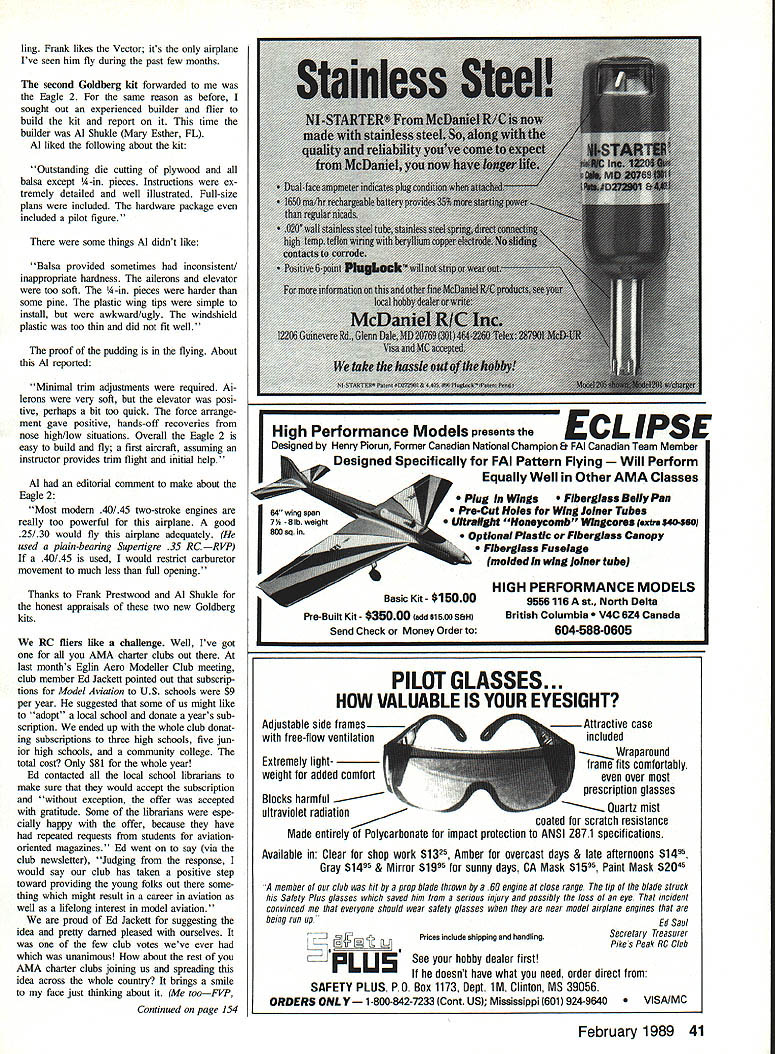
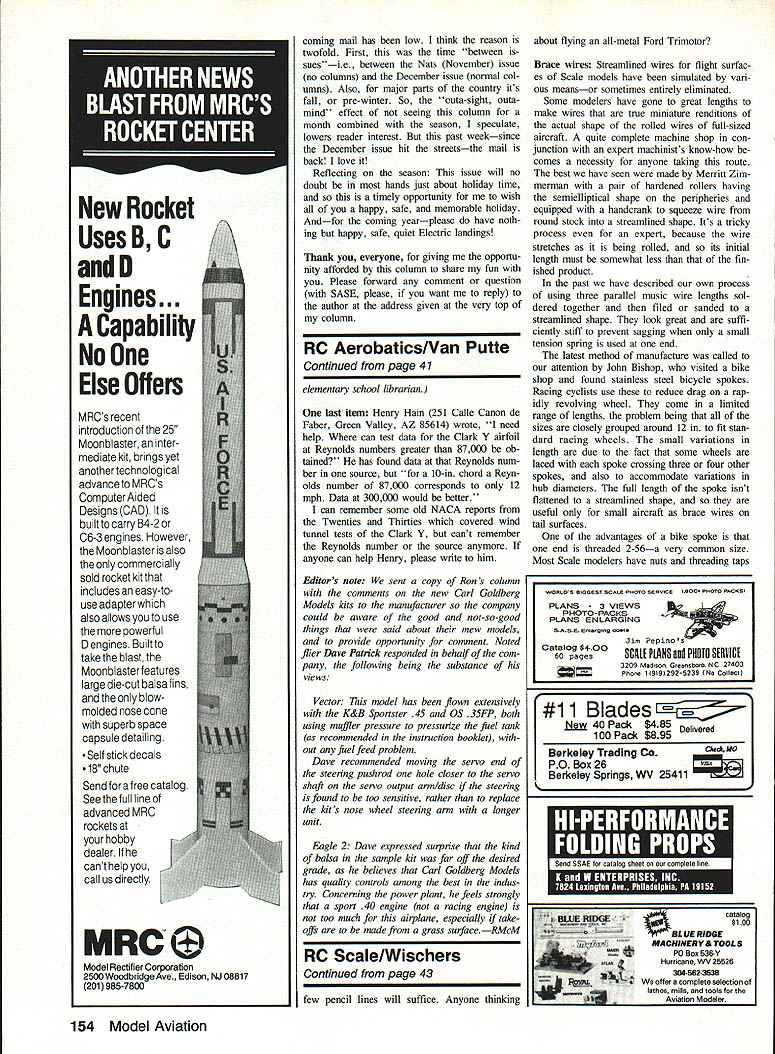
#### Eagle 2 — review by Al Shukie
The second Goldberg kit forwarded to me was the Eagle 2. I asked experienced builder and flier Al Shukie (Mary Esther, FL) to build the kit and report on it.
What Al liked:
- Outstanding die-cutting of plywood and all balsa except some 1/4-in. pieces.
- Extremely detailed and well-illustrated instructions.
- Full-size plans included.
- The hardware package even included a pilot figure.
What Al didn't like:
- Balsa hardness inconsistent; some pieces were too soft (ailerons and elevator) while some 1/4-in. pieces were harder than expected.
- Plastic wing tips were simple to install but awkward.
- Windshield plastic was too thin and did not fit well.
Flying impressions:
- Minimal trim adjustments were required.
- Ailerons were very soft; elevator was positive and perhaps a bit too quick.
- Fore-and-aft arrangement gave positive, hands-off recoveries from nose-high/low situations.
- Overall, the Eagle 2 is easy to build and fly — a good first aircraft, assuming an instructor provides trim advice and initial help.
Al's editorial comment: "Most modern .40/.45 two-stroke engines are really too powerful for this airplane. A good .25/.30 would fly this airplane adequately. If a .40/.45 is used, I would restrict carburetor movement to much less than full opening." (Al used a plain-bearing SuperTigre .35 RC.)
Thanks to Frank Prestwood and Al Shukie for their honest appraisals of these two new Goldberg kits.
Club Project — School Subscriptions
We RC fliers like a challenge. Well, I've got one for all you AMA charter clubs out there. At last month's Eglin Aero Modeller Club meeting, club member Ed Jackett pointed out that subscriptions for Model Aviation to U.S. schools were $9 per year. He suggested that some of us might like to "adopt" a local school and donate a year's subscription.
We ended up with the club donating subscriptions to three high schools, five junior high schools, and a community college. The total cost? Only $81 for the whole year.
Ed contacted the local school librarians to make sure that they would accept the subscription — and, without exception, the offer was accepted with gratitude. Some librarians were especially happy because they had repeated requests from students for aviation-oriented magazines. Ed commented, "Judging from the response, I would say our club has taken a positive step toward providing the young folks out there something which might result in a career in aviation as well as a lifelong interest in model aviation."
We are proud of Ed Jackett for suggesting the idea and pretty darned pleased with ourselves. It was one of the few club votes we've ever had which was unanimous! How about the rest of you AMA charter clubs joining in and spreading the idea across the whole country? It brings a smile to my face just thinking about it. [RVP]
Transcribed from original scans by AI. Minor OCR errors may remain.

