
Radio Control: Sport-Aerobatics
Ron VanPutte
LAST MONTH I announced a new section on how to make airplanes perform maneuvers properly. This column will begin what I hope to be a continuing series toward that end. My intent is not to confuse and confound anyone by long technical discussions on aerodynamics and flight dynamics, but rather to suggest aircraft construction techniques, control surface rigging and pilot control inputs to accomplish certain flight maneuvers.
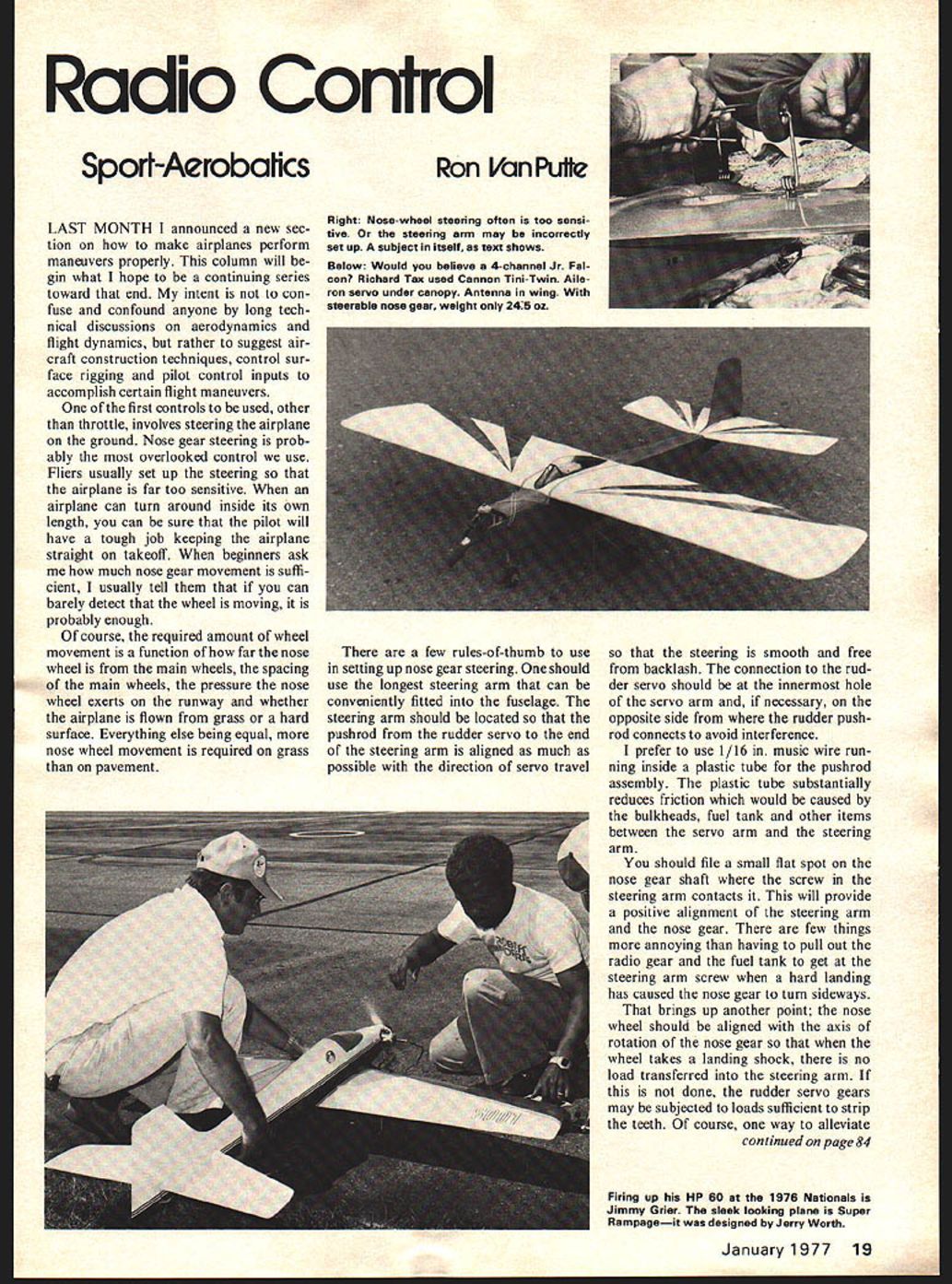
One of the first controls to be used, other than throttle, involves steering the airplane on the ground. Nose gear steering is probably the most overlooked control we use. Fliers usually set up the steering so that the airplane is far too sensitive. When an airplane can turn around inside its own length, you can be sure that the pilot will have a tough job keeping the airplane straight on takeoff. When beginners ask me how much nose gear movement is sufficient, I usually tell them that if you can barely detect that the wheel is moving, it is probably enough.
Of course, the required amount of wheel movement is a function of how far the nose wheel is from the main wheels, the spacing of the main wheels, the pressure the nose wheel exerts on the runway and whether the airplane is flown from grass or a hard surface. Everything else being equal, more nose wheel movement is required on grass than on pavement.
There are a few rules-of-thumb to use in setting up nose gear steering. One should use the longest steering arm that can be conveniently fitted into the fuselage. The steering arm should be located so that the pushrod from the rudder servo to the end of the steering arm is aligned as much as possible with the direction of servo travel so that the steering is smooth and free from backlash. The connection to the rudder servo should be at the innermost hole of the servo arm and, if necessary, on the opposite side from where the rudder pushrod connects to avoid interference.
I prefer to use 1/16 in. music wire running inside a plastic tube for the pushrod assembly. The plastic tube substantially reduces friction which would be caused by the bulkheads, fuel tank and other items between the servo arm and the steering arm.
You should file a small flat spot on the nose gear shaft where the screw in the steering arm contacts it. This will provide a positive alignment of the steering arm and the nose gear. There are few things more annoying than having to pull out the radio gear and the fuel tank to get at the steering arm screw when a hard landing has caused the nose gear to turn sideways.
That brings up another point; the nose wheel should be aligned with the axis of rotation of the nose gear so that when the wheel takes a landing shock, there is no load transferred into the steering arm. If this is not done, the rudder servo gears may be subjected to loads sufficient to strip the teeth. Of course, one way to alleviate the problem, if it can't be avoided, is to install an override device on the servo arm.
After everything mentioned above has been accomplished, the nose gear should be adjusted so that the airplane tracks straight when the rudder control is neutralized. It is often a pain in the neck to take off the wing several times to get the steering just right, but it is worth it. A properly adjusted airplane is a pleasure to take off and pattern judges reward people who take the time to do it.
Next month I intend to discuss how to properly set up the ailerons. If you have any suggestions on what to include in other discussions, please let me know.
Have you ever had your retractable landing gear fail for no apparent reason? I have; just before the 1975 Nats my Phoenix 6 had the very uncomfortable experience of periodically sliding in on the belly instead of on the wheels. The failures continued through the Nats despite my efforts at reworking the retract mechanism and completely overhauling the retract servo. When I discovered the cause of the problem, it was so obvious that I was disgusted with myself.
It turned out that a small amount of oil had gotten on the retract servo plug and socket assembly preventing a solid electrical contact. The servo "thought" the landing gear was down, but it wasn't down quite far enough to lock the mechanism. Now I use tuner cleaner, an aileron extension cord and a clean rag to clean the contacts about once a month. The appropriate end of the aileron extension cord is partially mated with either the plug or the socket, tuner cleaner is sprayed on the exposed contacts, the assembly worked in and out a few times and the excess tuner cleaner is wiped off with a clean rag. My retracts have performed faultlessly since using this technique. By the way, I do the same thing on my aileron connector assembly because it is exposed to the same environment as the retract gear connector assembly.
Recently, when I was up at Wright-Patterson AFB, Ohio, on official business, I had an opportunity to visit an old friend, alleged charter member of the "over-the-hill" gang, Don Lowe. By the way, Don showed a lot of people that he is definitely not "over-the-hill," but is better than ever by finishing third in the 1976 Nats. Anyway, Don and I went flying after work had finished one day. Don was flying as I critiqued his performance of many maneuvers which will be part of the pattern for the Tournament of Champions in Las Vegas during November. The pattern is very demanding on both airplane and pilot and I could see the need for dual-rate functions on all control surfaces because of the wide range of control inputs required for the pattern.
The single most-difficult maneuver seems to be the Rolling Circle. It involves rolling the airplane continuously while performing a horizontal circle. If that wasn't difficult enough, the airplane must roll exactly four times as it goes around the circle! Makes you almost glad that you aren't good enough to be invited to that contest, doesn't it?
From the monthly deluge of club newsletters, I have selected excerpts from two which may be interesting to you. The first is from the Monmouth (N.J.) Model Airplane Club Newsletter, edited by Joe Friend, and is as follows:
Four Bones: Someone has said that membership in every association is made up of four kinds of bones:
There are the "Wish" bones who spend their time wishing someone else would do the work. There are the "Jaw" bones who do all the talking but very little else. Next there are the "Knuckle" bones who knock everything that anyone ever tries to do. And finally there are the "Back" bones who get under the load and do the work. (Anonymous.)
The second excerpt is from Airflow, newsletter of the Radio Control Club of Rochester, N.Y., edited by William Wegman. It brings a warm glow to me, be- cause I watched the man in action when I started in radio control more than 22 years ago — in Rochester. It goes as follows:
Reflections on a Competitor — Hal deBolt: First to do an outside loop with an RC model. First to use strip ailerons on an RC model. First to use retracts on RC airplanes. First with laminar flow sections on RC planes. Produces RC kits longer than any other U.S. manufacturer. Competing actively in modeling since 1932. Has won top honors in Indoor, Scale, Free Flight, U Control (Speed, Stunt and Sport), and RC (Pylon, Sport and Stunt). These are some of the facts on Harold deBolt.
To have watched him shake a takeoff dolly loose from a screaming U-Control Speed job through a cloud of methanol, castor oil and dust was enough to surge adrenalin in the veins of even the disinterested. The name deBolt has always meant a guy to try everything and every way in modeling.
To watch him handle a long butcher knife (his favorite tool when building) as deftly as a surgeon, must be amazing. To have watched him stomp on a side-winder to stop a prop-sheared engine from exploding, and then just as casually go on to the next plane and fly an all-black sleek scale Hellcat as though nothing at all had preceded the flight was a sight to a 12-year-old that meant, "That guy has got to be cooler than icebergs." To watch him in person and on film at club meetings is to know that Harold has lots of tricks, and wastes little time getting a race started. Harold usually starts his engines before anyone else when flying pylon. This gets everybody cranked up sooner, and moves the race to a higher pitch, a higher pressure.
He is someone to watch, someone to compete with, someone to learn from. He competes like a true contender, with determination, cunning, and an endless zest. Harold means business, he flies his own race. He does not pass out ice cream cones to the kiddies. He is frank and to the point. Harold is Pappy.
Pappy deBolt! If you fly models and you haven't heard of him, you have probably missed a large chunk of modeling history. (By Dick Smith, Don Steeb, Ed Keck, and Bill Wegman.)
I can think of no better way to bring this month's column to a close. (Editor's Note: See Hall of Fame selections elsewhere in this issue.)
Ron Van Putte: 12 Connie Dr., Shalimar, Fla. 32579.
Transcribed from original scans by AI. Minor OCR errors may remain.

