
Sport-Aerobatics
Ron Van Putte
SINCE YOU will be receiving this just after Christmas, the following slightly edited contribution from Plane Prop Wash, newsletter of the Syracuse Thunderbirds Aero Radio Society, should be very appropriate. "Dear Mr. Modeler: We received your letter and we found it a bit confusing at times, but we did our best and hope that we've made you happy. The Spinners were unavailable, so we have sent you a small local group. The Monokote was a mystery to all of us: we sent a mohair coat instead. We didn't send the Monokote iron because the coat can only be dry cleaned. Hope size 20 is alright on the Super Shoe; of course we sent two. We didn't have green Solarfilm, but did have Kodachrome II color film. We sent you the largest Super Chipmunk available and have included a cage, although we realize you didn't request it. The Kwik Link entitles you to one free call on the "hot line," certificate enclosed. However, regarding the request for Hot Stuff: that is not in our line. Merry Christmas, S. Claus."
Last month I promised to discuss how to rig the ailerons. The discussion will cover how I do it based on my pattern flying philosophy; however, most pattern fliers will agree on the basic principles.
One should never have more aileron throw than is required. If full stick deflection causes too much aileron throw, the ailerons will probably be overly sensitive about neutral and make it difficult to trim the airplane in roll.
I generally rig the aileron throw to obtain three rolls in five seconds with full stick deflection. In addition, I adjust my low rate aileron to give one roll in five seconds for doing slow rolls. In this way I can hold full stick control for both maneuvers and not worry about doing them in the proper time.
The concept of aileron differential (when ailerons move up more than they move down) is often poorly understood, even by some experienced pattern fliers. They just know that the airplane rolls much more axially with aileron differential. I will attempt to describe what happens when the ailerons are deflected so that the concept will be better understood and more easily implemented.
Deflection of the ailerons usually alters both the lift and drag distributions across the wing. The modified lift distribution causes a net rolling moment and the changed drag distribution causes a net yawing moment. If an aileron system is rigged so that the ailerons move up the same amount as they move down, the wing will tend to roll about an axis which is displaced from the center of the fuselage and the airplane will yaw while it is rolling. This situation makes a corkscrewing, generally sloppy, roll. Conversely, an aileron system with proper differential will cause the airplane to roll about the fuselage axis with no yawing tendency.
The reason aileron differential works is that the downward moving aileron is more effective in changing both lift and drag than an upward moving aileron. For example, suppose that the ailerons are deflected an equal amount for a clockwise roll as viewed from behind the airplane (i.e., the airplane will tend to roll to the right). This means that the left aileron moves down and the right aileron moves up.
The left aileron will cause an increase in both the lift and drag on the left wing. The right aileron will cause a decrease in the lift and an increase in the drag on the right wing. The effect of the lift changes will result in a clockwise rolling moment. Since the downward moving (left) aileron causes a larger drag increase than the upward moving (right) aileron, the effect of the drag changes will be a nose-left yawing moment. So, we have an airplane which is rolling to the right and yawing to the left at the same time. The combination of the two motions makes the resulting rolls look bad.
Aileron differential is used to adjust the drag changes on the wing so that moving the ailerons causes little or no yawing moment to be generated because of aileron motion. Of less importance, but a factor which also improves rolling motion, is that the lift changes on each side of the wing will even out. Consequently, the airplane will tend to roll about an axis which is closer to the fuselage centerline. The combination of both effects is to substantially improve the appearance of axial rolls. The trick comes in determining how much aileron differential to use. To determine how much aileron differential is required and how to arrange the linkages to obtain it, unfortunately, the best method is trial-and-error. If you have patience, you can get it just right, but even the wrong aileron differential is better than none at all.
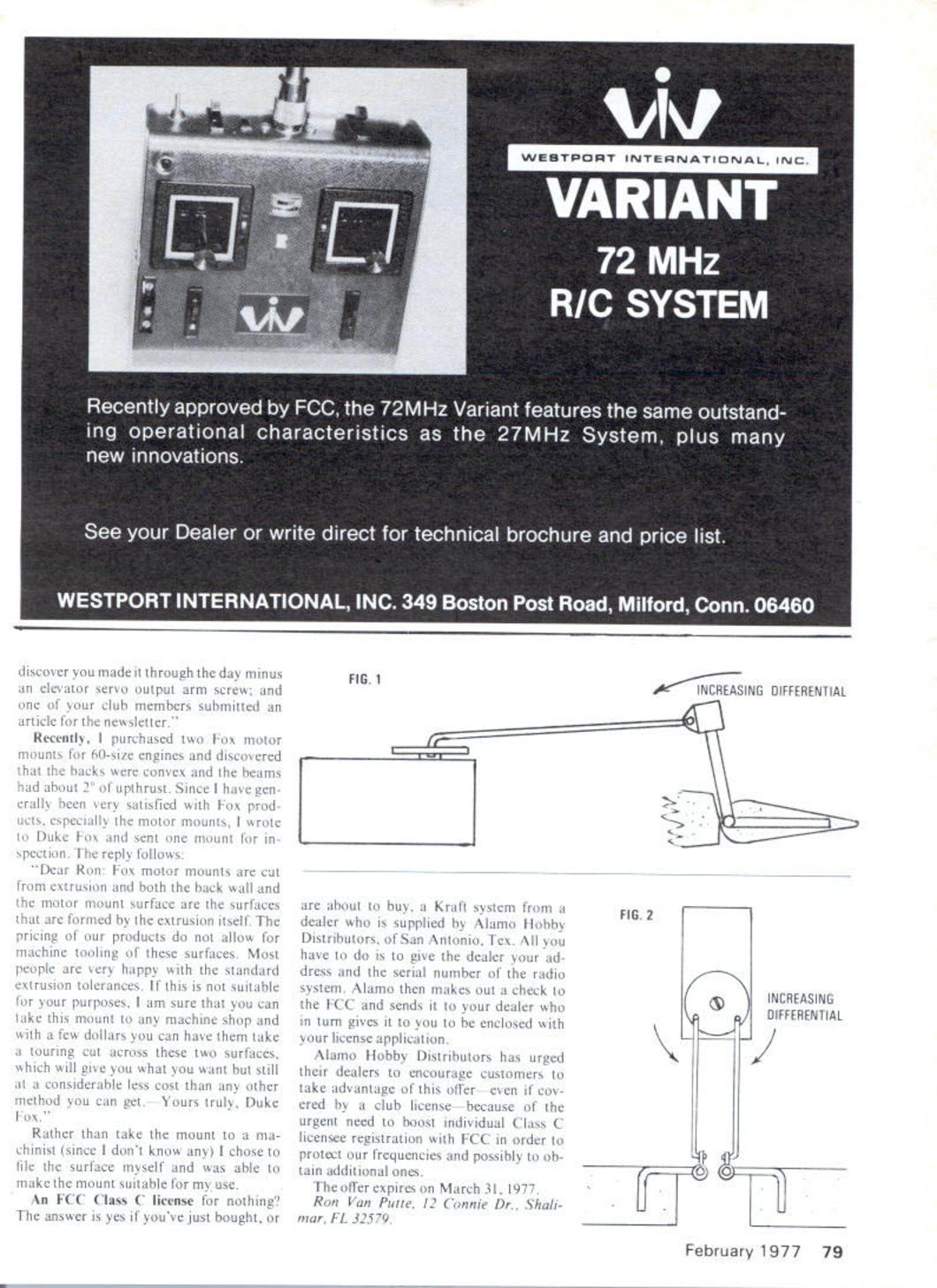
Figs. 1 and 2 show two ways to obtain aileron differential with low-wing airplanes. Since virtually all pattern airplanes have low wings and most sport fliers with high-wing airplanes aren't really concerned with perfect axial rolls, this shouldn't cause anyone any problems. Of course, you can combine both techniques to provide more differential than is possible by using either technique by itself. Try it. It is very easy, and it works.
That reminds me of a construction technique that I just discovered and would like to share. Like many modelers I often use vinyl spackling in basic construction and repair jobs. Spackling is great to use because it fills small holes so well and is easy to sand. It is easy to sand because it is so soft and relatively porous; both these characteristics can be problems when you paint over it because paint is absorbed more into the spackling and the finish is duller there than on adjacent areas.
After sanding down a spackled area I give it a shot of Hot Stuff or Zap and another light sanding. The paint goes on much more uniformly.
From The TAC Times, newsletter of the Temple (Texas) Aero Modelers Model Airplane Club, edited by Dan Amburn, comes a gem worth sharing. 'Happiness Is: Finding out your new next door neighbor is Jersey Jim Martin; landing ten seconds before your receiver battery dies; finding out that the loud crunch you heard while backing your car out of the pit area was only a rotten board; accidentally flying through a tree without touching a limb; while cleaning your plane, you suddenly Last month I promised to discuss rigging ailerons. This discussion will be based on a pattern-flying philosophy; however, pattern fliers will agree the basic principles apply to sport-aerobatic ships as well. You should never have aileron throw that requires full stick deflection — full stick deflection causes too much aileron movement; the ailerons will probably be overly sensitive about neutral and make it difficult to trim the airplane for a steady roll. Generally rig aileron throw to obtain three rolls in five seconds at full stick deflection. In addition, adjust the low-rate aileron so it will give a roll in five seconds when doing slow rolls. That way you can hold full stick for control in both maneuvers and not worry about proper timing.
The concept of aileron differential — ailerons moving up and down by unequal amounts — is often poorly understood. Some experienced pattern fliers just know the airplane rolls more axially with differential. I will attempt to describe what happens when ailerons are deflected so the concept will be better understood and easily implemented.
Deflection of ailerons usually alters both the lift and drag distributions across the wing. The modified lift distribution causes a net rolling moment; the changed drag distribution causes a net yawing moment. If an aileron system is rigged so the ailerons move up the same amount as they move down, the wing will tend to roll about an axis displaced from the center of the fuselage and the airplane will yaw in the rolling situation. This makes corkscrewing — generally a sloppy roll.
Conversely, an aileron system with proper differential will cause the airplane to roll about the fuselage axis with no yawing tendency. The reason aileron differential works is that the downward-moving aileron is effective at changing both lift and drag, while the upward-moving aileron mostly changes lift.
For example, suppose ailerons are deflected an equal amount for a clockwise roll (viewed from behind the airplane), i.e., the airplane will tend to roll right which means the left aileron moves down and the right aileron moves up. The left aileron will cause an increase in both lift and drag on the left wing; the right aileron will cause a decrease in lift and an increase in drag on the right wing. The effect of the lift changes will result in a clockwise rolling moment. Since the downward-moving left aileron causes a larger drag increase than the upward-moving right aileron affects drag, there will be a nose-left yawing moment. So you have an airplane rolling right and yawing left at the same time. The combination of the two motions makes the resulting rolls look bad.
Aileron differential is used to adjust the drag changes caused by the moving ailerons so little or no yawing moment is generated because the aileron motion that produces the excessive drag is reduced in magnitude. It also improves the rolling motion because the lift changes on each side are more balanced. Consequently, the airplane will tend to roll about an axis closer to the fuselage centerline. This combination of both effects substantially improves the appearance of axial rolls.
The trick comes in determining how much aileron differential to use.
Transcribed from original scans by AI. Minor OCR errors may remain.

