
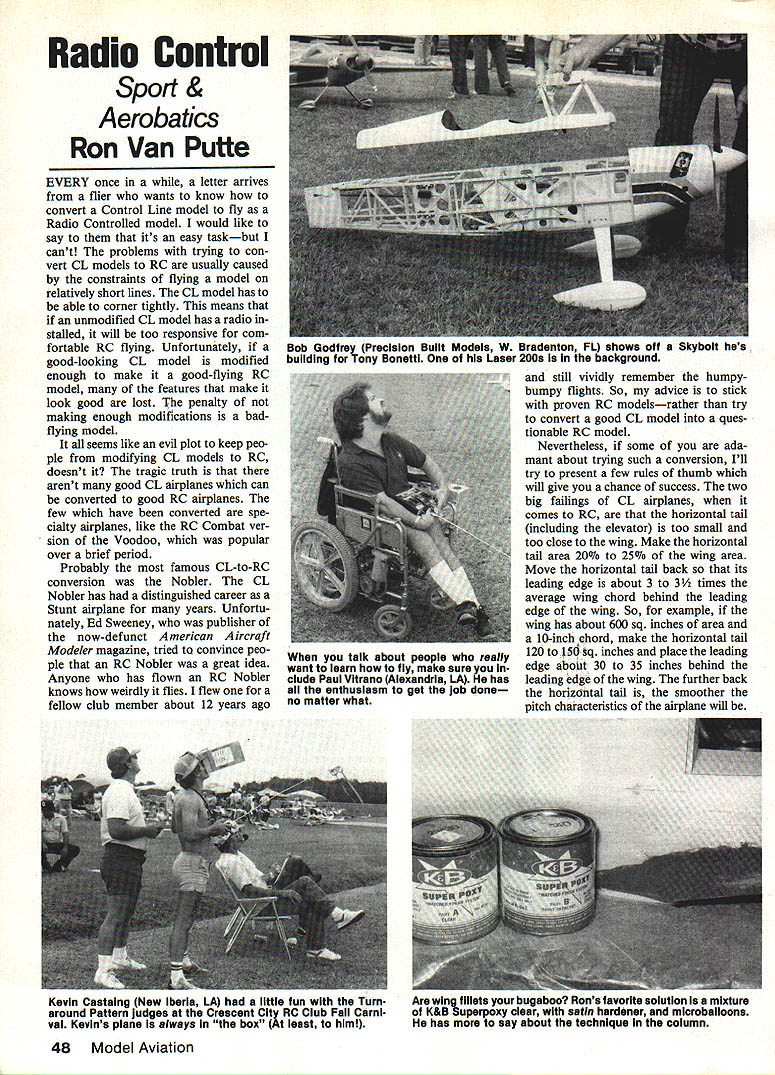
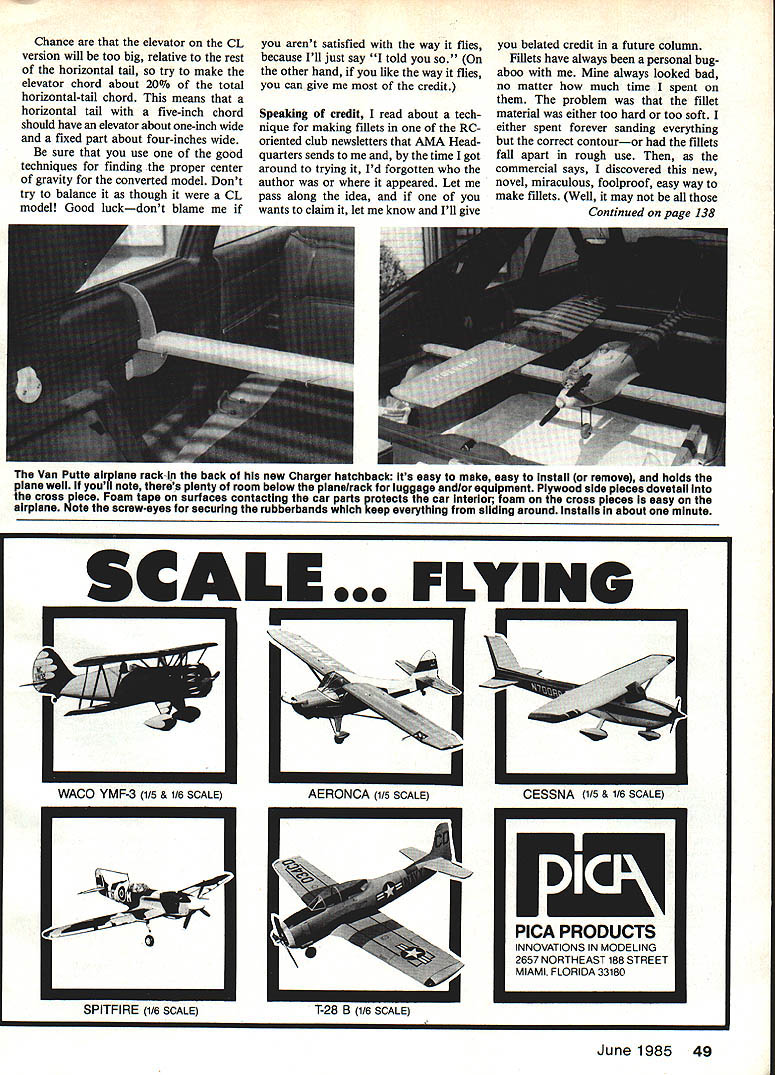
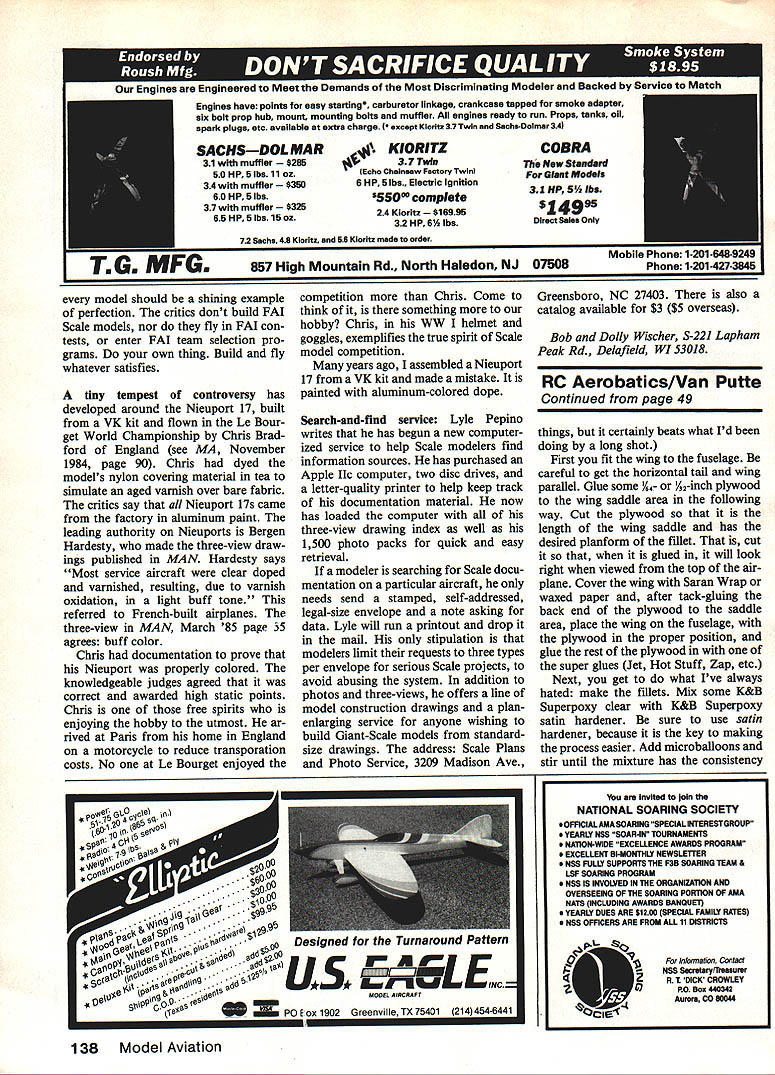
Radio Control
Sport & Aerobatics
Ron Van Putte
Every once in a while a letter arrives from a flier who wants to know how to convert a Control-Line (CL) model to fly as a Radio-Controlled (RC) model. I'd like to say it's an easy task—but I can't. The problems with trying to convert CL models to RC are usually caused by the constraints of flying a model on relatively short lines. A CL model has to be able to corner tightly; this means an unmodified CL model will usually be too responsive or unstable for comfortable RC flying. Unfortunately, if a good-looking CL model is modified enough to make it a good-flying RC model, many of the features that make it look good are lost. The penalty of not making enough modifications is a bad-flying model.
The tragic truth is that there aren't many CL airplanes that can be converted into good RC airplanes. A few specialty airplanes have been converted (for example, the RC Combat version of the Voodoo), and probably the most famous CL-to-RC conversion was the Nobler. The CL Nobler has had a distinguished career as a stunt airplane for many years, but the RC Nobler flies oddly; anyone who has flown one knows how humpy-bumpy it can be. My advice is to stick with proven RC models rather than try to convert a good-looking CL model into a questionable RC model.
Nevertheless, if you are adamant about trying such a conversion, here are some rules of thumb that will give you a chance of success.
- Make the horizontal tail area about 20%–25% of the wing area.
- Move the horizontal tail back so its leading edge is about 3–3.5 times the average wing chord behind the wing leading edge. For example, if the wing has about 600 sq. in. area and a 10 in. chord, make the horizontal tail 120–150 sq. in. and place the tail leading edge about 30–35 in. behind the wing leading edge. The further back the horizontal tail is, the smoother the pitch characteristics will be.
- The elevator on the CL version will usually be too large relative to the rest of the horizontal tail. Try to make the elevator chord about 20% of the total horizontal-tail chord. For instance, a horizontal tail with a 5 in. chord should have an elevator about 1 in. wide and a fixed part about 4 in. wide.
- Use good techniques to find the proper center of gravity for the converted model. Do not try to balance it as if it were still a CL model—the RC equipment and configuration change the balance point.
Good luck—don't blame me if you're not satisfied with the way it flies, because I'll just say I told you. On the other hand, if you like the way it flies, you can give me credit.
Fillet Technique (an easy, strong, sandable fillet)
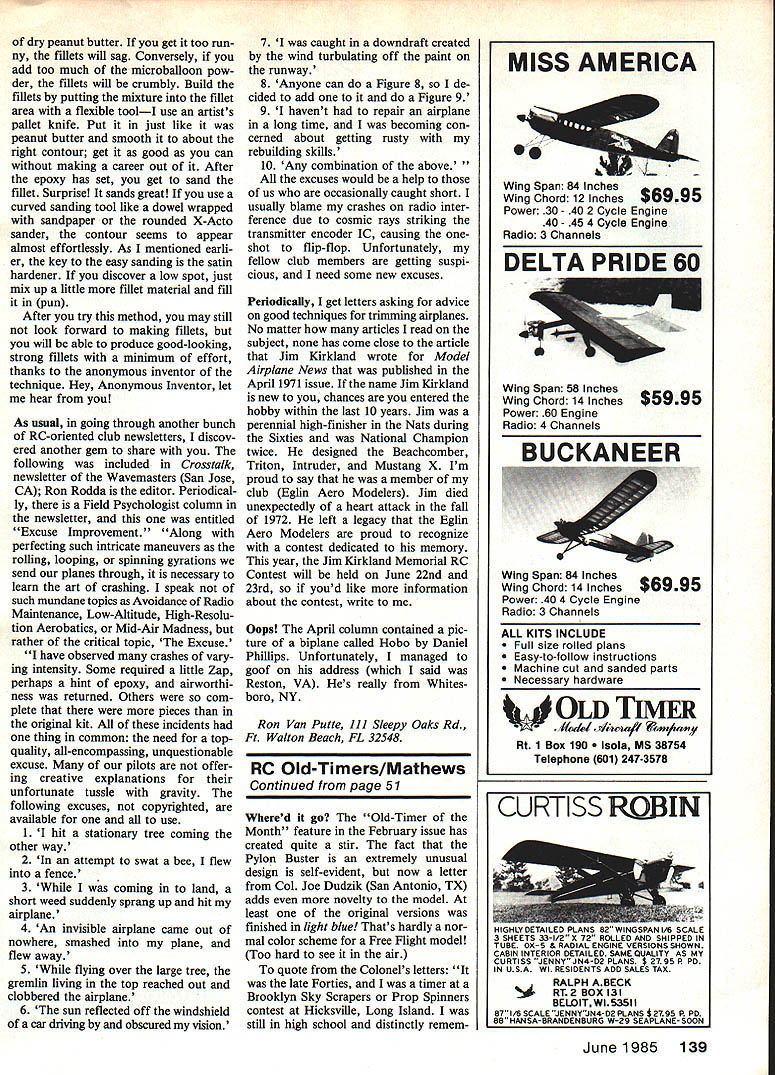
I read about a technique in club newsletters and, after experimenting, found a reliable method for making fillets using K&B Superpoxy (clear), satin hardener, and microballoons. The satin hardener is key to making the process easy and the result sandable.
Steps:
- Fit the wing to the fuselage and make sure the horizontal tail and wing are parallel.
- Cut a strip of 1/4- or 1/2-inch plywood the length of the wing saddle to form a platform for the fillet. Shape it so it looks right from above.
- Cover the mating surfaces of the wing with Saran Wrap or waxed paper to prevent permanent adhesion.
- Tack-glue the wing and the plywood to the fuselage. Then tack-glue the plywood to the fuselage using a cyanoacrylate (super glue) such as Jet, Hot Stuff, or Zap to hold everything in position.
- Mix K&B Superpoxy (clear) with the K&B Superpoxy satin hardener. Add microballoons and stir until the mixture reaches the consistency of toothpaste or thick peanut butter. If it gets too runny the fillets will sag; if you add too much microballoon powder the fillets will be crumbly.
- Apply the mixture into the fillet area with a flexible tool (an artist's palette knife works well). Shape the fillet to about the correct contour without obsessing over perfection.
- After the epoxy has set, sand the fillet. A curved sanding tool (a dowel wrapped with sandpaper or a rounded X-Acto sander) helps bring out a smooth contour. If you find low spots, mix a little more fillet material and fill them in, then sand again and apply a final skim coat to finish.
The result is a strong, sandable fillet that doesn't fall apart and that sands nicely thanks to the satin hardener. If the anonymous originator of this technique wants to claim credit, let me know and I'll give belated acknowledgment.
Field Humor: "Excuse Improvement"
While going through RC-oriented club newsletters, I found a Field Psychologist column in Crosstalk (Wavemasters, San Jose, CA; editor Ron Rodda) titled "Excuse Improvement." It noted that along with perfecting intricate maneuvers, it is necessary to learn the art of crashing—not the techniques of avoidance, but the art of creating a top-quality excuse. The following excuses are offered for general use:
- "I hit a stationary tree coming the other way."
- "In an attempt to swat a bee, I flew into a fence."
- "While I was coming in to land, a short weed suddenly sprang up and hit my airplane."
- "An invisible airplane came out of nowhere, thrashed into my plane, and flew away."
- "While flying over the large tree, the gremlin living in the top reached out and clobbered the airplane."
- "The sun reflected off the windshield of a car driving by and obscured my vision."
- "I was caught in a downdraft created by the wind turbulence off the paint on the runway."
- "Anyone can do a Figure 8, so I decided to add one to it and do a Figure 9."
- "I haven't had to repair an airplane in a long time, and I was becoming concerned about getting rusty with my rebuilding skills."
- "Any combination of the above."
I usually blame my crashes on radio interference caused by cosmic rays striking the transmitter encoder IC, causing the one-shot to flip-flop. Unfortunately, my fellow club members are getting suspicious, so I need some new excuses.
Trimming and Tribute
Periodically I get letters asking for trimming techniques. Many excellent articles exist, but one I found outstanding was by Jim Kirkland in Model Airplane News (April 1971). If Jim Kirkland's name is new to you, he was a perennial high-finisher in the Nats during the 1960s and twice National Champion. He designed the Beachcomber, Triton, Intruder, and Mustang X. Jim was a member of my club (Eglin Aero Modelers) and died unexpectedly of a heart attack in the fall of 1972. He left a legacy honored by the Jim Kirkland Memorial RC Contest. This year's contest will be held on June 22–23; write to me if you'd like more information.
Oops—an earlier column contained a picture of a biplane called Hobo by Daniel Phillips. I goofed on his address (I said Reston, VA). He is actually from Whitesboro, NY.
Ron Van Putte 111 Sleepy Oaks Rd. Ft. Walton Beach, FL 32548
Transcribed from original scans by AI. Minor OCR errors may remain.

