
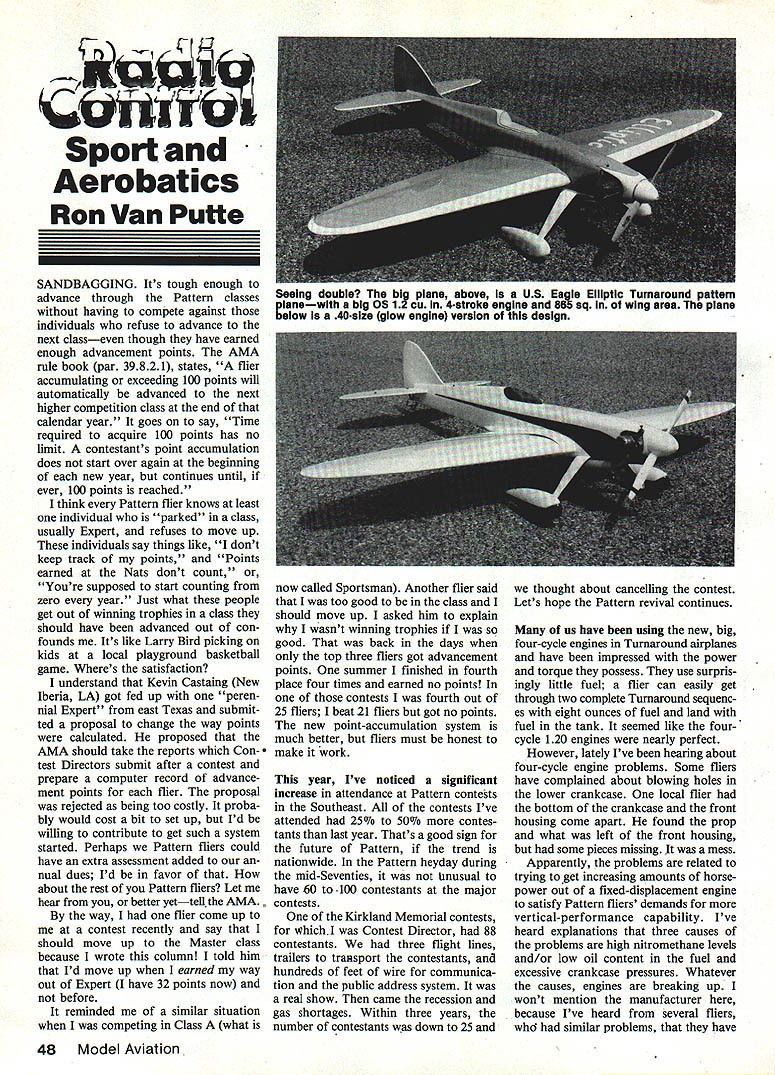
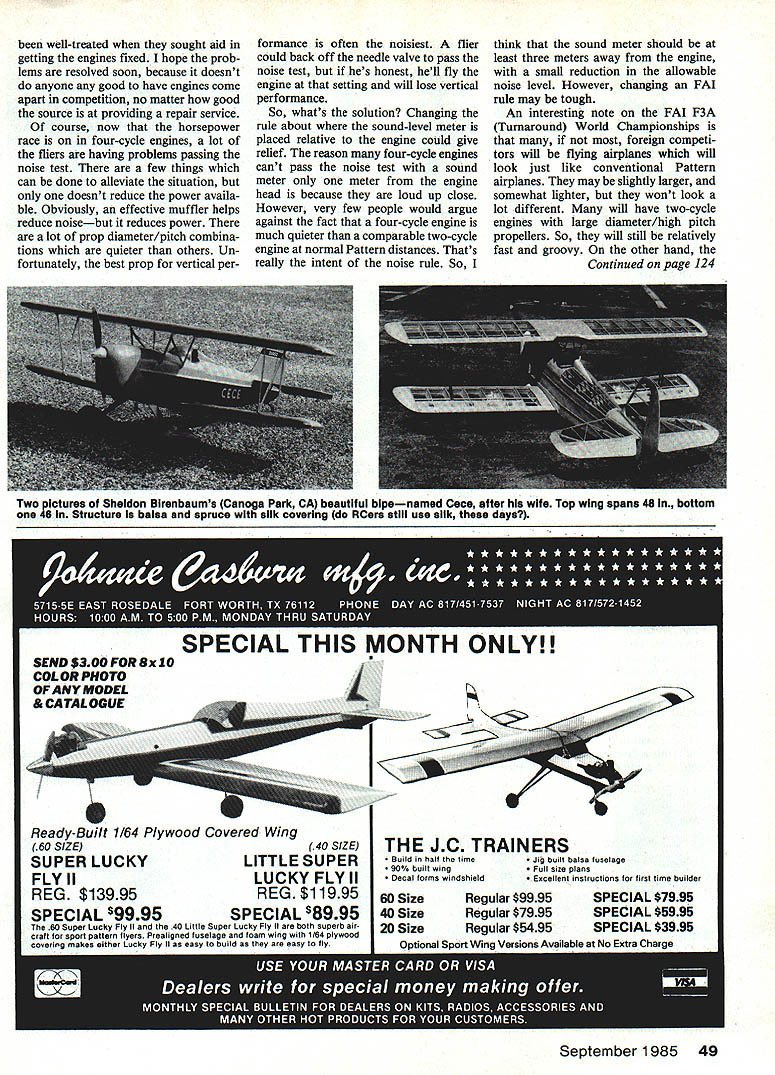
Radio Control: Sport and Aerobatics
Ron Van Putte
Sandbagging
SANDBAGGING. It's tough enough to advance through the Pattern classes without having to compete against those individuals who refuse to advance to the next class—even though they have earned enough advancement points. The AMA rule book (par. 39.8.2.1) states, "A flier accumulating or exceeding 100 points will automatically be advanced to the next higher competition class at the end of that calendar year." It goes on to say, "Time required to acquire 100 points has no limit. A contestant's point accumulation does not start over again at the beginning of each new year, but continues until, if ever, 100 points is reached."
I think every Pattern flier knows at least one individual who is "parked" in a class, usually Expert, and refuses to move up. These individuals say things like, "I don't keep track of my points," "Points earned at the Nats don't count," or "You're supposed to start counting from zero every year." Just what these people get out of winning trophies in a class they should have been advanced out of confounds me. It's like Larry Bird picking on kids at a local playground basketball game. Where's the satisfaction?
I understand that Kevin Castaing (New Iberia, LA) got fed up with one "perennial Expert" from east Texas and submitted a proposal to change the way points were calculated. He proposed that the AMA should take the reports which Contest Directors submit after a contest and prepare a computer record of advancement points for each flier. The proposal was rejected as being too costly. It probably would cost a bit to set up, but I'd be willing to contribute to get such a system started. Perhaps we Pattern fliers could have an extra assessment added to our annual dues; I'd be in favor of that. How about the rest of you Pattern fliers? Let me hear from you, or better yet—tell the AMA.
By the way, I had one flier come up to me at a contest recently and say that I should move up to the Master class because I wrote this column! I told him that I'd move up when I earned my way out of Expert (I have 32 points now) and not before.
It reminded me of a similar situation when I was competing in Class A (what is now called Sportsman). Another flier said that I was too good to be in the class and I should move up. I asked him to explain why I wasn't winning trophies if I was so good. That was back in the days when only the top three fliers got advancement points. One summer I finished in fourth place four times and earned no points! In two of those contests I was fourth out of 25 fliers; I beat 21 fliers but got no points. The new point-accumulation system is much better, but fliers must be honest to make it work.
Pattern Contest Attendance
This year, I've noticed a significant increase in attendance at Pattern contests in the Southeast. All of the contests I've attended had 25% to 50% more contestants than last year. That's a good sign for the future of Pattern, if the trend is nationwide. In the Pattern heyday during the mid-Seventies, it was not unusual to have 60 to 100 contestants at the major contests.
One of the Kirkland Memorial contests, for which I was Contest Director, had 88 contestants. We had three flight lines, trailers to transport the contestants, and hundreds of feet of wire for communication and the public address system. It was a real show. Then came the recession and gas shortages. Within three years, the number of contestants was down to 25 and we thought about canceling the contest. Let's hope the Pattern revival continues.
Four-Cycle Engines and Reliability Issues
Many of us have been using the new, big, four-cycle engines in Turnaround airplanes and have been impressed with the power and torque they possess. They use surprisingly little fuel; a flier can easily get through two complete Turnaround sequences with eight ounces of fuel and land with fuel in the tank. It seemed like the four-cycle .120 engines were nearly perfect.
However, lately I've been hearing about four-cycle engine problems. Some fliers have complained about blowing holes in the lower crankcase. One local flier had the bottom of the crankcase and the front housing come apart and found the prop and what was left of the front housing, with some pieces missing. It was a mess.
Apparently, the problems are related to trying to get increasing amounts of horsepower out of a fixed-displacement engine to satisfy Pattern fliers' demands for more vertical-performance capability. I've heard explanations that three causes of the problems are:
- high nitromethane levels in the fuel,
- low oil content in the fuel, and/or
- excessive crankcase pressures.
Whatever the causes, engines are breaking up. I won't mention the manufacturer here, because I've heard from several fliers who had similar problems.
There are a few things that can be done to alleviate the situation without reducing available power. Obviously, an effective muffler helps reduce noise—but it reduces power. There are a lot of prop diameter/pitch combinations that are quieter than others. Unfortunately, the best prop for vertical performance is often the noisiest. A flier could back off the needle valve to pass the noise test, but if he's honest, he'll fly the engine at that setting and will lose vertical performance.
Noise Rules and a Possible Solution
So, what's the solution? Changing the rule about where the sound-level meter is placed relative to the engine could give relief. The reason many four-cycle engines can't pass the noise test with a sound meter only one meter from the engine head is because they are loud up close. However, very few people would argue against the fact that a four-cycle engine is much quieter than a comparable two-cycle engine at normal Pattern distances. That's really the intent of the noise rule.
I think that the sound meter should be at least three meters away from the engine, with a small reduction in the allowable noise level. However, changing an FAI rule may be tough.
FAI F3A (Turnaround) World Championships
An interesting note on the FAI F3A (Turnaround) World Championships is that many, if not most, foreign competitors will be flying airplanes which look just like conventional Pattern airplanes. They may be slightly larger and somewhat lighter, but they won't look a lot different. Many will have two-cycle engines with large-diameter, high-pitch propellers. So, they will still be relatively fast and groovy.
On the other hand, the U.S. team is likely to have airplanes like the Laser 200, Frackowalc's Challenger II, Chidgey's Tar Baby, Circus Hobbies' Stevens Akromaster, or any of the other large, slow airplanes powered by four-cycle 1.20 engines.
Is that a problem? Well, it could be for the U.S. team. Suppose I am a foreign judge who is used to seeing fast, groovy airplanes perform the Turnaround pattern, and I am a judge in the World Championships. How would I judge the U.S. team entries? The rule book says that a maneuver is graded on "smoothness" or gracefulness. Those slow, four-cycle-powered airplanes will not look as smooth or graceful as their two-cycle-powered cousins. The U.S. team could really get clobbered by foreign judges.
The only saving feature of the U.S. team entries will be that they will be able to stay in the "box" much more easily than the two-cycle-engine-powered entries and make up some ground by keeping their maneuvers "in a plane and at a height which will allow them to be seen clearly by the judges, approximately 60° vertically and 120° horizontally." It will be an interesting World Championships.
Letter from Doug Dahlke
Doug Dahlke (Oshkosh, WI) — he calls it "EAA-ville" — wrote to help me out (I think). His letter, in part, said:
"A few quick comments on your column of June 1985. First of all, on your comments about late conversions (to RC, RPV), it sounds like you are talking about built CL stuff of 20 years ago — which may be the intent. You suggested '...make the horizontal tail area 20% to 25% of the wing area...'. If you will refer to page 70 of the June 1985 issue, Ted Fancher's column, you will see the area of the stab and elevator should normally be between 20% and 25% of the wing area."
This has been pretty much standard for a decade or more in stunt ships. True, the elevator should be reduced for RC. Also, there is a clear trend towards longer aft moment arms in CL stunter designs. Perhaps not quite the full 3 to 3.5 times my earlier suggestion, but new designs are much better in this respect.
Well, what can I say? Perhaps I can hedge by saying that my first powered airplane was an RC (a deBolt Kitten), which flew in 1954 — I never flew a CL airplane in my life! By the way, what's a "ukie"? (Just kidding.)
Closing
In the meantime, may all your landings be "wheels down."
Ron Van Putte 111 Sleepy Oaks Rd. Ft. Walton Beach, FL 32548
Transcribed from original scans by AI. Minor OCR errors may remain.

