
Radio Control: Sport and Aerobatics
Ron Van Putte
Standing corrected. I received a long-distance call from Bob Hunt of Flying Models magazine who pointed out a couple of errors in the caption to the picture of Dean Pappas' Maya aircraft which was in the May column. The first error was identifying the Maya as having all-balsa construction. Bob claims that major parts of the airplane are cored styrofoam which was covered with balsa. He should know because he did the styrofoam work for Dean! The second error was identifying the radio as a Futaba PCM, when actually he flies a JR PCM. Now that I look more closely at the picture, he's right: the Futaba PCM won't lie flat on the pavement the way Dean's radio does. Sorry.
I've had quite a few requests lately from fliers who were interested in how to get started in Pattern competition. Since I started this column in 1975 (Yikes! Has it been that long?), I've discussed my philosophy of Pattern flying several times, but apparently it's time to do it again.
Three areas of Pattern flying
Pattern flying discussion can be broken down into three areas:
- Tools — the airplane, engine, radio and accessories; the things you need to get the job of Pattern flying done.
- Techniques — the way the aircraft is built and set up.
- Practice — how you go about refining the flying skills.
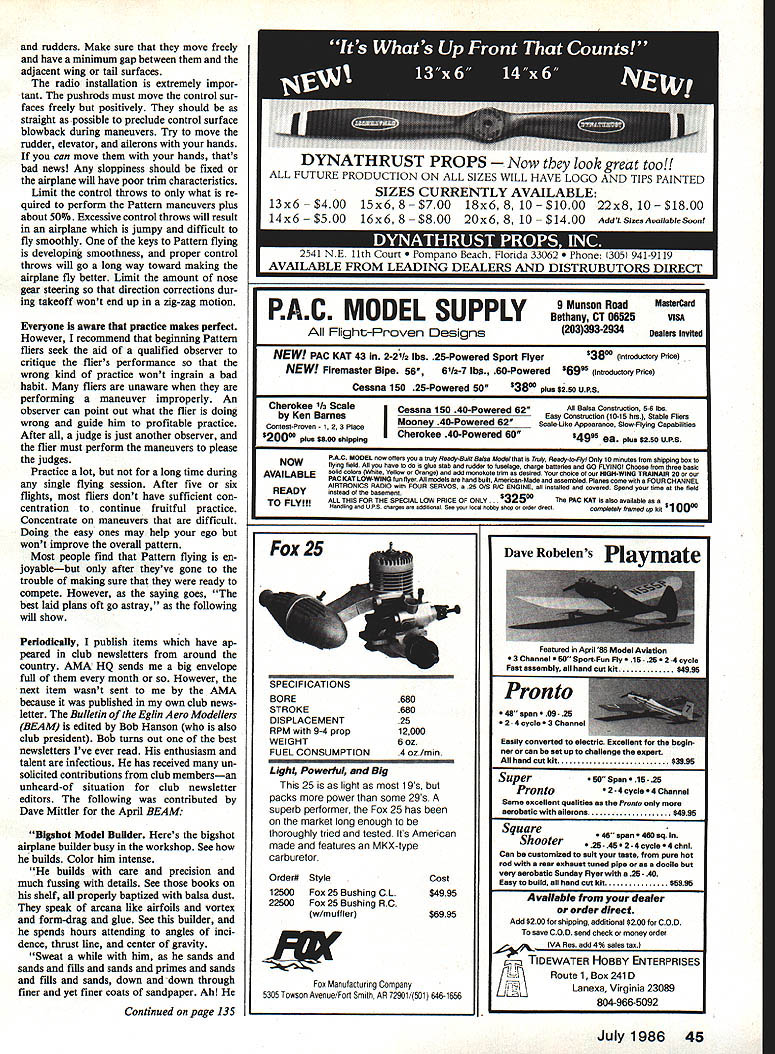
Many times in the past, I've told Pattern beginners at the field and by way of this column that they don't need the latest in Pattern-plane design to get started. In fact, the most sophisticated designs around are probably not good aircraft to choose. Sophistication often means complication, which does not have a payoff for beginning Pattern fliers.
What is needed is an aircraft which is capable of performing the Novice and Sportsman class maneuvers well in the hands of a competent flier. It must be a .60-size airplane because they fly the pattern better than their smaller cousins.
Tools: airplane, engine, retracts, radio
What do I recommend?
- Airplane: A Super Kaos .60. The design has been around for a long time and has proven its ability to fly the Novice and Sportsman patterns well. It's not cheap, but it is uncomplicated, and the Great Planes people have maintained Joe Bridi's high standards of quality control. It's a fine product.
- Engine: Get a good engine, but don't break the bank to get a top-of-the-line engine. The super engines are fine; fliers need substantial vertical performance. The Novice and Sportsman classes don't require that extreme performance. Get an engine with a reputation for good power and reliability.
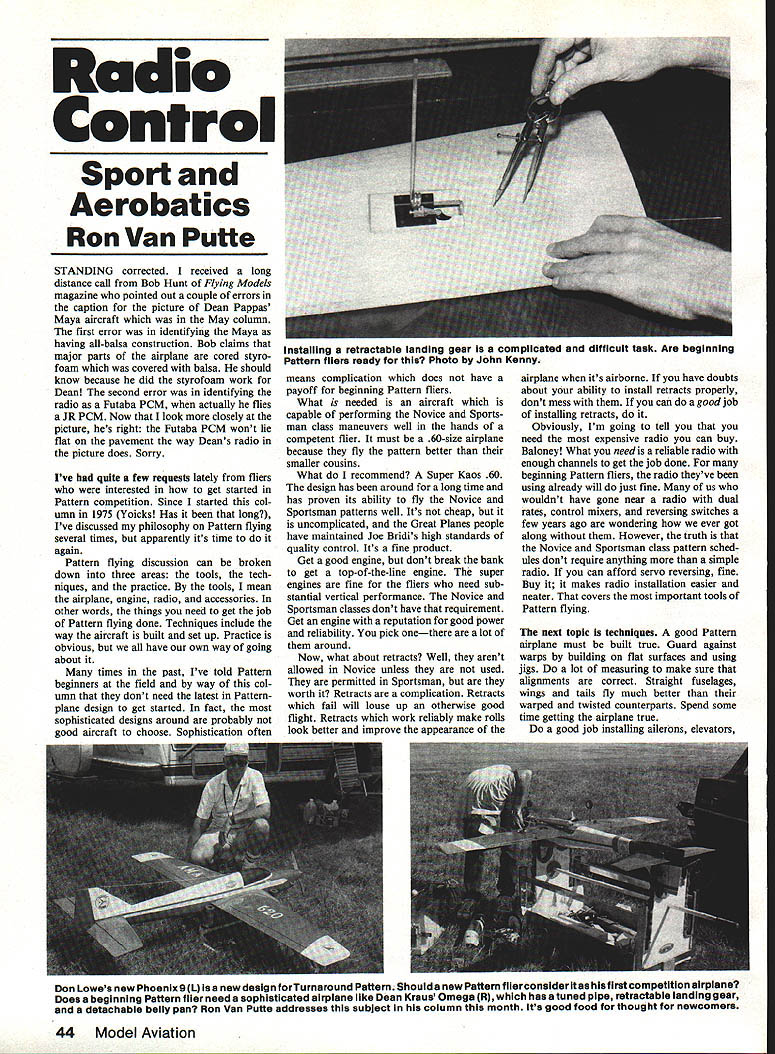
- Retracts: They aren't allowed in Novice unless they are not used. They are permitted in Sportsman, but are they worth it? Retracts are a complication. Retracts which fail will louse up an otherwise good flight. Retracts which work reliably make rolls look better and improve the appearance of the airplane. If you have doubts about your ability to install retracts properly, don't mess with them. If you can do a good job of installing retracts, do it.
- Radio: You do not need the most expensive radio you can buy. What you need is a reliable radio with enough channels to get the job done. For many beginning Pattern fliers, the radio they've been using already will do just fine. Many of us who wouldn't have gone near a radio with such rates, control mixers, and reversing switches a few years ago are wondering how we ever got along without them. However, the truth is the Novice and Sportsman classes don't require anything more than a simple radio. If you can afford servo reversing, fine — buy it; it makes radio installation easier and neater.
That covers the most important tools of Pattern flying.
Techniques
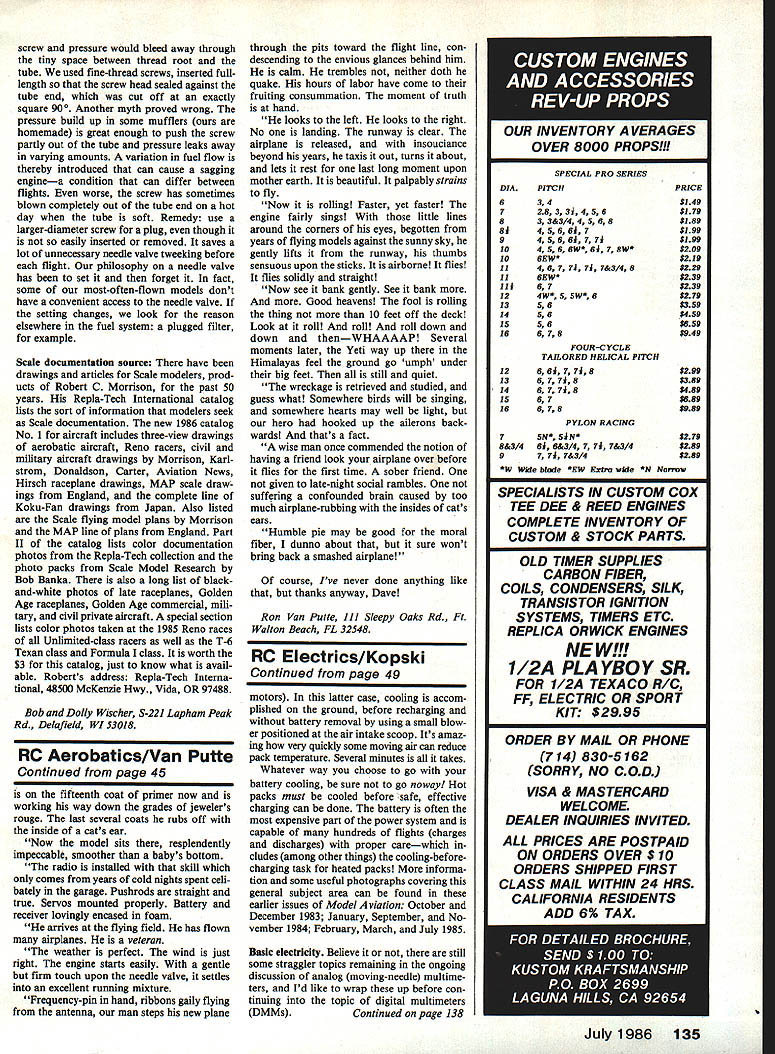
A good Pattern airplane must be built true. Guard against warps by building on flat surfaces and using jigs. Do a lot of measuring to make sure that alignments are correct. Straight fuselages, wings and tails fly much better than their warped and twisted counterparts. Spend some time getting the airplane true.
Do a good job installing ailerons, elevators and rudders. Make sure they move freely and have minimum gap between adjacent wing and tail surfaces. Radio installation is extremely important: pushrods must move control surfaces freely and positively and should be as straight as possible to preclude control surface blowback during maneuvers. Try to move rudder, elevator and ailerons by hand; if they can move by hand, that's bad news. Any sloppiness should be fixed or the airplane will have poor trim characteristics. Limit control throws to what is required to perform Pattern maneuvers.
Practice
Everyone is aware that practice makes perfect. However, I recommend that beginning Pattern fliers seek the aid of a qualified observer to critique the flier's performance so that the wrong kind of practice won't ingrain a bad habit. Many fliers are unaware when they are performing a maneuver improperly. An observer can point out what the flier is doing wrong and guide him to profitable practice. After all, a judge is just another observer, and the flier must perform the maneuvers to please the judges.
Practice a lot, but not for a long time during any single flying session. After five or six flights, most fliers don't have sufficient concentration to continue fruitful practice. Concentrate on maneuvers that are difficult. Doing the easy ones will only help your ego but won't improve the overall pattern.
Most people find that Pattern flying is enjoyable — but only after they've gone to the trouble of making sure that they were ready to compete. However, as the saying goes, "The best laid plans oft go astray," as the following will show.
Bigshot Model Builder (anecdote from BEAM)
Periodically, I publish items which have appeared in club newsletters from around the country. AMA HQ sends me a big envelope full of them every month or so. However, the next item wasn't sent to me by the AMA because it was published in my own club newsletter. The Bulletin of the Eglin Aero Modelers (BEAM) is edited by Bob Pannous (who is also club president). Bob turns out one of the best newsletters I've ever read. His enthusiasm and talent are infectious. He has received many unsolicited contributions from club members—an unheard-of situation for club newsletter editors. The following was contributed by Dave Miller for the April BEAM:
"Bigshot Model Builder. Here's the bigshot airplane builder busy in the workshop. See how he builds. Color him intense.
He builds with care and precision and much fussy buildup with dabs and globs of glue and he fusses with details. He keeps everything neat on his shelf, all properly bagged and dusted. They speak of arcana like airfoils and vortex and form-drag and glue. See this builder, and he spends hours attending to angles of incidence, thrust lines, and center of gravity.
Sweat a while with him, as he sands and sands and sands and fills and sands and primes and sands and sands and sands and sands and yet finer coats of sandpaper. Ah! He is on the fifteenth coat of primer now and is working his way down the grades of jeweler's rouge. The last several coats have rubbed off with the inside of a cat's ear.
Now the model sits there, resplendently impeccable, smoother than a baby's bottom. The radio is installed with that skill which only comes from years of cold nights spent in the garage. Pushrods are straight and true. Servos mounted properly. Battery and receiver lovingly encased in foam.
He arrives at the flying field. He has flown many airplanes. He is a veteran.
The weather is perfect. The wind is just right. The engine starts easily. With a gentle but firm touch upon the needle valve, it settles into an excellent running mixture.
Frequency-pin in hand, ribbons gaily flying from the antenna, our man steps his new plane through the pits toward the flight line, descending to the envious glances behind him. He is calm. He trembles not, neither doth he quake. His hours of labor have come to their fruiting consummation. The moment of truth is at hand.
He looks to the left. He looks to the right. No one is landing. The runway is clear. The airplane is released, and with insouciance beyond his years, he taxis it out, turns it about, and lets it rest for one last long moment upon mother earth. It is beautiful. It palpably strains to fly.
Now it is rolling! Faster, yet faster! The engine fairly sings! With those little lines around the corners of his eyes, begotten from years of flying models against the sunny sky, he gently lifts it from the runway, his thumbs sensuous upon the sticks. It is airborne! It flies! It flies solidly and straight!
Now see it bank gently. See it bank more. And more. Good heavens! The fool is rolling the thing not more than 10 feet off the deck! Look at it roll! And roll! And roll down and down and then—WHAAAAP!! Several moments later, the Yetis way up there in the Himalayas feel the ground go 'umph' under their big feet. Then all is still and quiet.
The wreckage is retrieved and studied, and a hush! Somewhere birds will be singing, and somewhere hearts may well be light, but our hero had hooked up the ailerons backwards! And that's a fact.
A wise man once commended the notion of having a friend look your airplane over before it flies for the first time. A sober friend. One not given to late-night social rambles. One not amplifying a confounded brain caused by too much airplane-rubbing with the insides of cat's ears.
Humble pie may be good for the moral fiber, I dunno about that, but it sure won't bring back a smashed airplane!"
Of course, I've never done anything like that, but thanks anyway, Dave!
Ron Van Putte 111 Sleepy Oaks Rd. Ft. Walton Beach, FL 32548.
Transcribed from original scans by AI. Minor OCR errors may remain.

