
Radio Control: Sport and Aerobatics
Ron Van Putte
Update on Sears Filled Epoxy
Greg Bartling (New Martinsville, WV) wrote to Sears headquarters in Chicago asking about the chances of having their Filled Epoxy sold again and about who manufactured it for Sears. He received the following reply from the Merchandising Group:
"I'm responding to your March 9, 1986 letter to Mr. Brennan (Sears president, RVP) and Sears. Thank you for writing and expressing an interest in Filled Epoxy, an adhesive we had to discontinue in 1983. This decision resulted from extremely poor sales performance. Sears' source could no longer afford to manufacture the product. In fact, the product is no longer produced at all. Therefore, providing a manufacturer's name would be to no avail. I'm sorry Sears cannot satisfy your request in this area." — D. E. Alcox, Buyer, Hardware Department
Scribbled across the bottom of the letter Greg noted, "So much for Sears! The last statement is not accurate, however. The filled epoxy cement is available from McMaster-Carr Supply Co., Box 440, New Brunswick, NJ 08903 as Catalog No. 92 at $8.36 for 11 oz. The company's 2,250-page catalog is a real source of goodies for modelers."
I then got a letter from Model Aviation Associate Editor Ross McMullen, who wrote: "How come you have never tried Model Magic Products' epoxy for your fiberglass repairs (instead of Sears Filled Epoxy)? It is a strong, easily-sandable material." Thanks, Ross. It is a good product, but I still wish that good old Sears Filled Epoxy was still around.
Model Magic Products response and proposed tests
I also received a telephone call, followed by a letter, from Vern Wald, president of Model Magic Products, who took me to task about the "apparent conspiracy" that appeared in the May issue. On page 46 I reported that Bud Wolfe (Scottsdale, AZ) thought Red Devil One Time Spackling was almost identical to Model Magic Filler and cost one-quarter as much. On the facing page was an ad for Model Magic Products which included Model Magic Filler (MMF). To all but the very naive, it appeared that I had done a job on Model Magic Filler.
After I convinced Vern that I had no control over the ads or their placement, I offered to print any reasonable rebuttal he submitted. He sent a friendly, humorous letter which included the following points:
- Model Magic tested Red Devil in 1983. They could buy it repacked for less than raw materials for MMF, but it lacked the strength, adhesion and versatility required for broad use on model aircraft and boats.
- Red Devil is fine for patching walls and small nicks, but they hesitate to recommend it for fine models.
- At a retail price of $5.95, a tub of Model Magic Filler will last for five to six .40 to .60 size planes, including fillet work. That works out to about $1 per plane for a product they claim is many times stronger and more versatile.
Vern included a comparison paper describing three simple tests you can try yourself:
- Build a T from two pieces of basswood, 1/4 x 1 x 2 in., using only fillets of MMF or brand X. After 24 hours, try to pry them apart. Vern claims a strength factor of at least six in favor of MMF.
- Cut 3/16 x 1/2-in. V-grooves in 1/8-in. basswood and fill them with MMF and brand X. After 24 hours, attempt to push and tug the filler loose from the V-grooves. Vern claims a strength factor of about 25 to 1 in favor of MMF.
- Coat a tongue depressor with 1/32-in. of filler. After 24 hours flex the tongue depressor. Vern claims brand X will crack and flake off while MMF will not.
OK, gang — let's find out if he's right.
Turnaround pattern controversy
Back about two years ago, the subject of the Turnaround pattern divided people into two groups: For or Against. A lot of bad feeling developed because the For people seemed to be trying to push Turnaround on everyone. The attitude seemed to be that "real pilots" flew Turnaround while the rest flew the old style of Pattern.
The Against people resented the pressure to conform to the new style — and especially the implication that they were lesser pilots for preferring the old style of Pattern. There was a lot of misunderstanding and name-calling. After a while, it died away and both factions began to live together in reasonable harmony.
Now it seems headed toward another confrontation — within Turnaround itself. I feel that if the Turnaround box should be enforced, it should be enforced. Depending on who you talk to and what you say, you could be in for a large "discussion."
In the June column I published a letter from Jim Ewing, Charlottetown, Prince Edward Island, Canada. In response I received a letter from Mike Harrison (Hot Springs, AR), which said in part:
"I'm glad to see someone out there studying the FAI Turnaround box. However, there needs to be a great deal more data for Jim before any of his proposals can be considered valid. First of all, the designated distance from pilot to flight path is 150 meters (amended FAI standards), making the flight path distance across the box approximately 520 meters. Next, no Turnaround aircraft go 70 mph. Most are around 90–100 mph, making straight flight across the box occupy from 10.5 to approximately 13 seconds. However, the time statement is very misleading. Most of the path is used up in the maneuvers or turnaround, so the setup time for each maneuver is very short: one to three seconds, usually. Add to that crosswinds (or any kind of wind), and the problem is compounded.
"Being in or out of the box is part of the judging of the Turnaround maneuver itself. Line judges are too much. Emphasis is placed on flying — with overall distance a part of the overall pattern."
"I appreciate Mr. Ewing's comments, but he needs to get in the trenches with us to learn what's going on."
I know Mike Harrison, and he's never been one to mince words. However, despite the apparent error in the prescribed distance from the pilot to the flight path, many Turnaround pilots I've talked to agree with Ewing's idea of having two "walls" out there. It would encourage pilots to fly much closer to the judges where the maneuvers could be seen better. It would also negate most of the reasons for having the box at all.
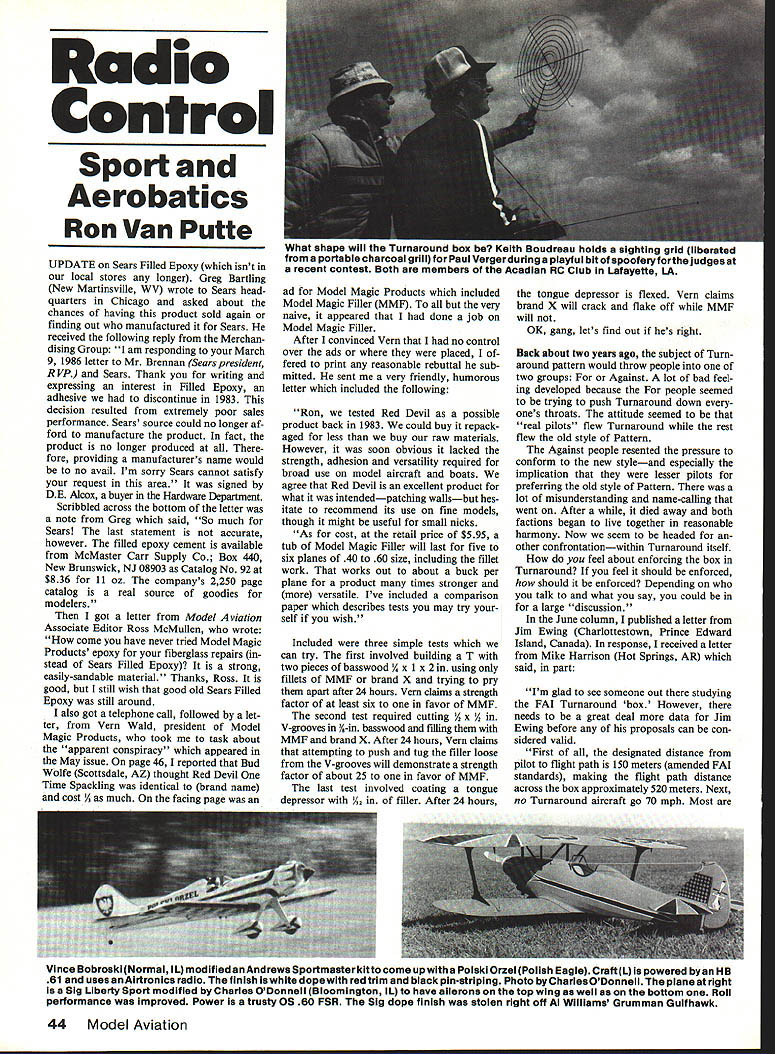
One topic that has been with us ever since Turnaround arrived is the use of devices to mark the box. Many don't want them used at all, claiming judges should recognize the boundaries without marker devices. Most Turnaround marker advocates insist that if markers are used, they should be prominent enough for both the judges and the pilot to see. If markers are that prominent, the pilot is attempting to measure up against a standard he can't see. We've all been to contests where the boundaries of the box were two short poles (maybe with a small flag on top). That's unfair.
I certainly hope we can get some resolution of the box and marker device issues soon so competitors can concentrate on competition rather than arguing with one another.
Contact
Ron Van Putte 111 Sleepy Oaks Rd. Ft. Walton Beach, FL 32548
Transcribed from original scans by AI. Minor OCR errors may remain.

