
Radio Control: Sport and Aerobatics
Ron Van Putte
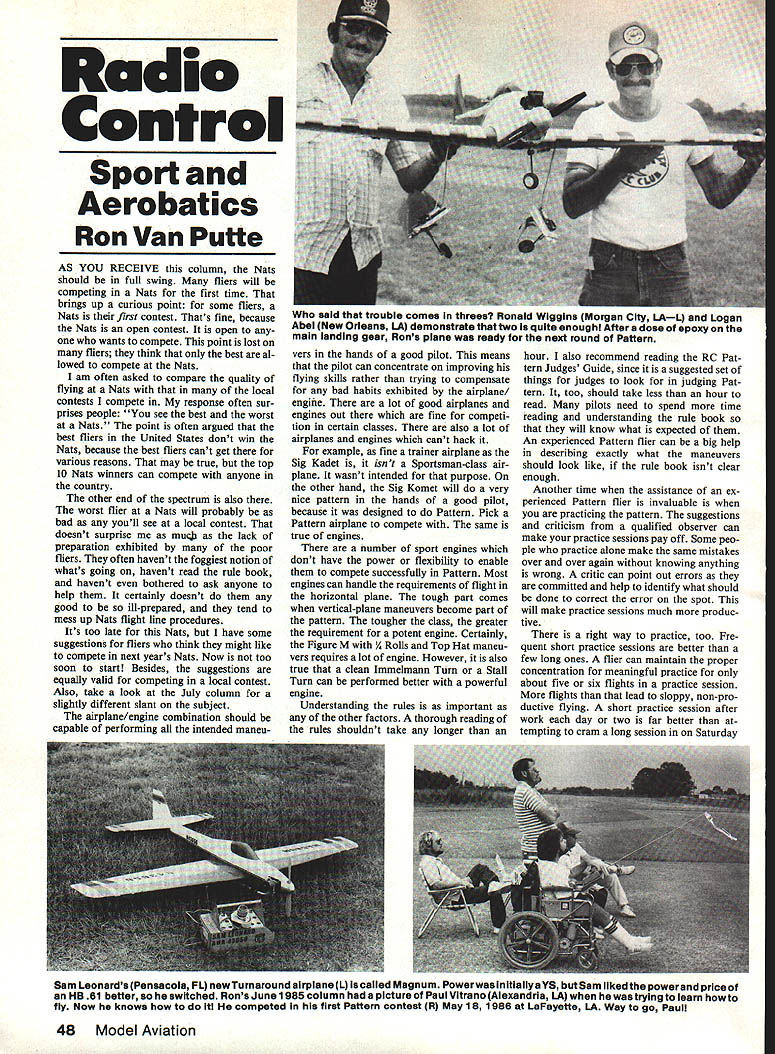
As you receive this column the Nats should be in full swing. Fliers will be competing in the Nats for the first time, which brings up a curious point: some fliers enter the Nats as their first contest. That's fine because the Nats are an open contest—anyone who wants to compete may. The point some fliers miss is that the Nats are not restricted to only the best.
I am often asked to compare the quality of flying at the Nats to local contests. My response surprises people: you see the best and the worst at the Nats. It is argued that the best fliers in the United States don't always win the Nats because they can't always attend for various reasons. That may be true, but the top 10 Nats winners can compete with anyone in the country.
At the other end of the spectrum, the worst flier at the Nats will probably be as bad as any you'll see locally. What surprises me more is the lack of preparation exhibited by many poor fliers. They often haven't the foggiest notion of what's going on, haven't read the rule book, and haven't bothered to ask anyone for help. That certainly doesn't help—ill-prepared pilots tend to mess up Nats flight-line procedures.
It's too late for this year's Nats, but I have suggestions for fliers who might like to compete next year. Now is not too soon to start. These suggestions are equally valid for local contests. Also see my July column for a slightly different slant.
Equipment: airplane and engine
An airplane/engine combination should be capable of performing all intended maneuvers. In the hands of a competent pilot, this means the pilot can concentrate on improving flying skills rather than compensating for bad habits of the airplane or engine.
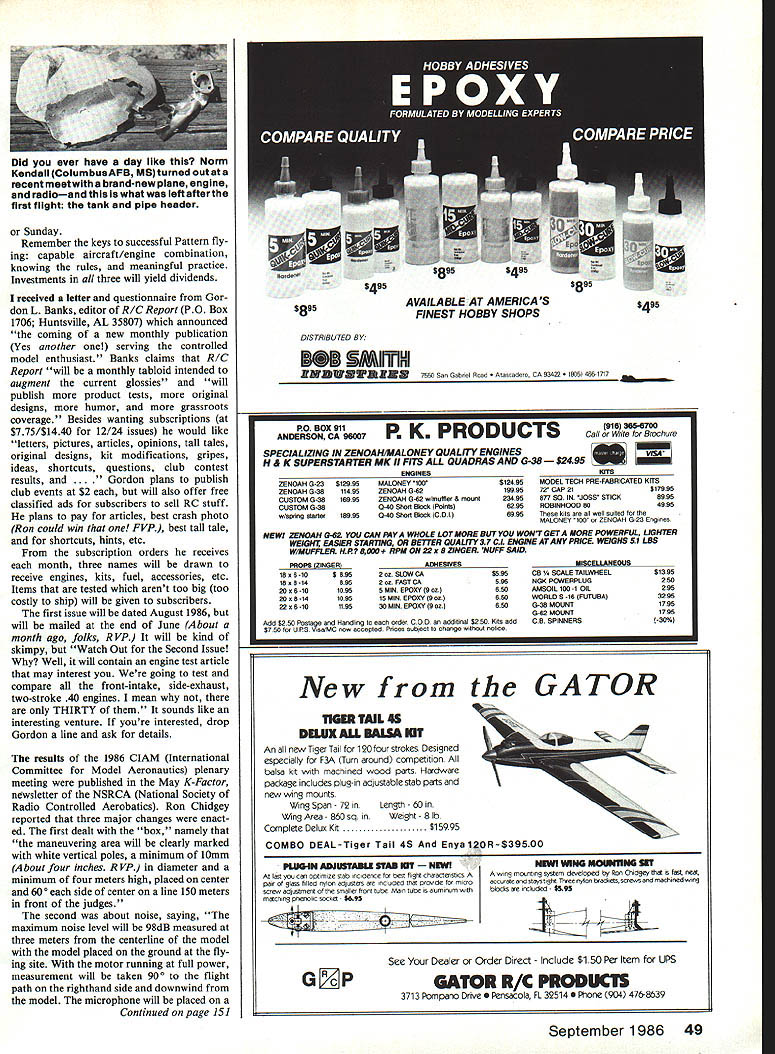
- Pick an airplane designed for the class you intend to fly. A fine trainer like the Sig Kadet isn't a Sportsman-class airplane; the Sig Komet, designed for pattern, will do a very nice pattern in the hands of a good pilot.
- Choose an engine with adequate power and flexibility. Many sport engines lack the power needed for higher-level Pattern; most engines can handle horizontal-flight requirements, but vertical-plane maneuvers demand more. Tougher classes require more potent engines—maneuvers such as Fig. 8s, rolls, and the Top Hat need significant power. Even a clean Immelmann or stall turn benefits from a powerful engine.
Understanding the rules
Understanding the rules is as important as equipment. A thorough reading of the rules shouldn't take longer than an hour. I also recommend reading the R/C Pattern Judges' Guide, since it outlines what judges look for; it too should take less than an hour.
- Spend time reading and understanding the rule book so you know what is expected.
- Consult an experienced Pattern flier to clarify how maneuvers should look when the rule book is unclear.
- Use an experienced observer while practicing—qualified suggestions and criticism make practice sessions pay off.
Some pilots practice alone and repeat the same mistakes without realizing it. A critic can point out errors as they occur and help identify corrections on the spot, making practice sessions much more productive.
Practice
There is a right way to practice. Frequent short practice sessions are better than a few long ones.
- A flier can maintain proper concentration for meaningful practice for about five to six flights in one session.
- More flights lead to sloppy, nonproductive flying.
- Short practice sessions after work every day or two are far better than trying to cram a long session into one day.
Remember, keys to successful pattern flying include:
- a capable aircraft/engine combination
- knowing the rules
- meaningful, focused practice
Investments in these three areas will pay dividends.
R/C Report (Gordon L. Banks)
I received a letter and questionnaire from Gordon L. Banks, editor of R/C Report (P.O. Box 1706; Huntsville, AL 35807), announcing the coming of a new monthly publication serving controlled-model enthusiasts. Banks says R/C Report "will be a monthly tabloid intended to augment the current glossies" and "will publish more product tests, more original designs, more humor, and more grassroots coverage."
He is seeking subscriptions ($7.75 for 12 issues; $14.40 for 24 issues) and contributions: letters, pictures, articles, opinions, tall tales, original designs, kit modifications, gripes, ideas, short-cuts, queries, club contest results, and sketches. Gordon plans to publish club events at $2 each and will offer free classified ads for subscribers to sell R/C items. He plans to pay for articles, best crash photo, best tall tale, and for short-cuts and hints.
From the subscription orders received each month, three names will be drawn to receive engines, kits, fuel, accessories, etc. Items tested that aren't too large will be given to subscribers. The first issue was dated August 1986 and mailed at the end of June. It was expected to be slim, but the second issue was promised to be more substantial—containing, among other things, an engine test article comparing all front-mounted, side-exhaust, two-stroke .40 engines: "I mean why not, there are only THIRTY of them."
If you're interested, drop Gordon a line and ask for details.
CIAM (International Committee for Aeronautics) plenary meeting results
The results of the 1986 CIAM plenary meeting were published in the May K-Factor, newsletter of the NSRCA (National Society of Radio Controlled Aerobatics). Ron Chidgey reported that the major proposed changes were enacted.
Two notable changes were:
- Changes concerning the "box" (competition flying area).
- New noise regulations: the maximum noise level will be 98 dB measured at three meters from the centerline of the model with the model placed on the ground at the flying site. With the motor running at full power, measurement will be taken 90° to the flight path on the right-hand side and downwind from the model. (Original text was cut off in the source.)
Remember to consult the official CIAM/NSRCA publications for full details and exact measurement procedures.
Ron Van Putte 111 Sleepy Oaks Rd. Fort Walton Beach, FL 32548
Transcribed from original scans by AI. Minor OCR errors may remain.

