
Radio Control: Sport and Aerobatics
Ron Van Putte
Square One
When beginning, Pattern fliers often ask for advice. One point I always emphasize is the importance of reading and understanding the AMA rule book. After all, the only way to do well at anything is to know what is expected of you. Pattern flying is no different. The rule book tells us what to do and what not to do. Part of the rule book includes the section entitled "AMA RC Pattern Judges' Guide." The Guide describes how each maneuver is to be done and the infractions which should result in downgrades.
One of my pet peeves is the judging of the Cuban Eight. Many, if not most, fliers do not fly 45° downlegs. Most downlegs are only 25° to 30° from the horizontal. Inexperienced and experienced judges give good scores for fliers who fly maneuvers with such shallow downlegs, probably because so many fliers do the Cuban Eight that way.
To make matters worse, fliers who do perform 45° downlegs are downgraded because their maneuvers don't look like those of the majority of the remaining fliers! Even so, I still maintain that sooner or later the judges will get wise to the situation and reward the flier who does the Cuban Eight properly. I hope that it's sooner.
At several recent contests, a Sportsman-class competitor named Mark Bowie (Greenwood, MS) pointed out another judging problem. He asked me why the judges didn't downgrade improperly framed maneuvers. I said I thought they did. He asked me to watch flights by several high-scoring fliers from a position directly behind the judges.
I watched as entire maneuvers were offset on one side or the other of the judges. For example, three loops with no part of the loops presented in front of the judges, or three rolls which weren't started until the airplane was directly in front of the judges. Cause for downgrade? What does the Judges' Guide say? Were the fliers downgraded?
On page 47 of the 1986-87 edition of the AMA rule book, under the heading of "Suggested Downgrades... Maneuvers Off-Center," it states: "Deduct 2 points for each quarter of the total maneuver's length that is offset. Examples: (assuming no offset with judges' permission due to sun) loops offset so that edge of loop just reaches judges—deduct 4 points because maneuver is off center one-half diameter; 2 of 3 axial rolls offset—deduct about 1 1/2 points because maneuver is off center by 1/4 diameter." Pretty specific, isn't it?
The judges must have downgraded those poorly centered loops and rolls, right? Wrong! Those fliers scored eights and nines, even though the Judges' Guide said that the best they should have gotten for their loops and rolls was a six. Fair? No.
It's tougher to properly center a maneuver while doing it well. Fliers who can should get a higher score than those who cannot. Come on, judges—shape up!
While I'm on the soapbox about proper presentation of maneuvers, I feel the need to point out that all maneuvers should have a level entry and exit of "at least 15 meters" (page 47 of the rule book, again). Fifteen meters is about 50 feet. Most airplanes fly 90 to 110 miles per hour — it equates to a bit less than a half second of level entry and exit. I know a lot of fliers who say, "Three wifferdills starting now" — and immediately yank the stick. Then they wonder why the score was bad. Give the judges at least half a second of level entry and exit, and the ones who know what they're doing will reward it.
Doc Edwards: Box Suggestions
I just got a letter from Jim "Doc" Edwards that I'd like to share. For those who have been in an isolated retreat for the last 25 years, Doc is one of the real Masters of our sport. He won the 1967 Masters' Tournament and has been a competitor and judge in numerous national and international events. He likes to come across as "a good ole country boy," but when he talks, people listen. He has earned the respect that other competitors give to his opinions.
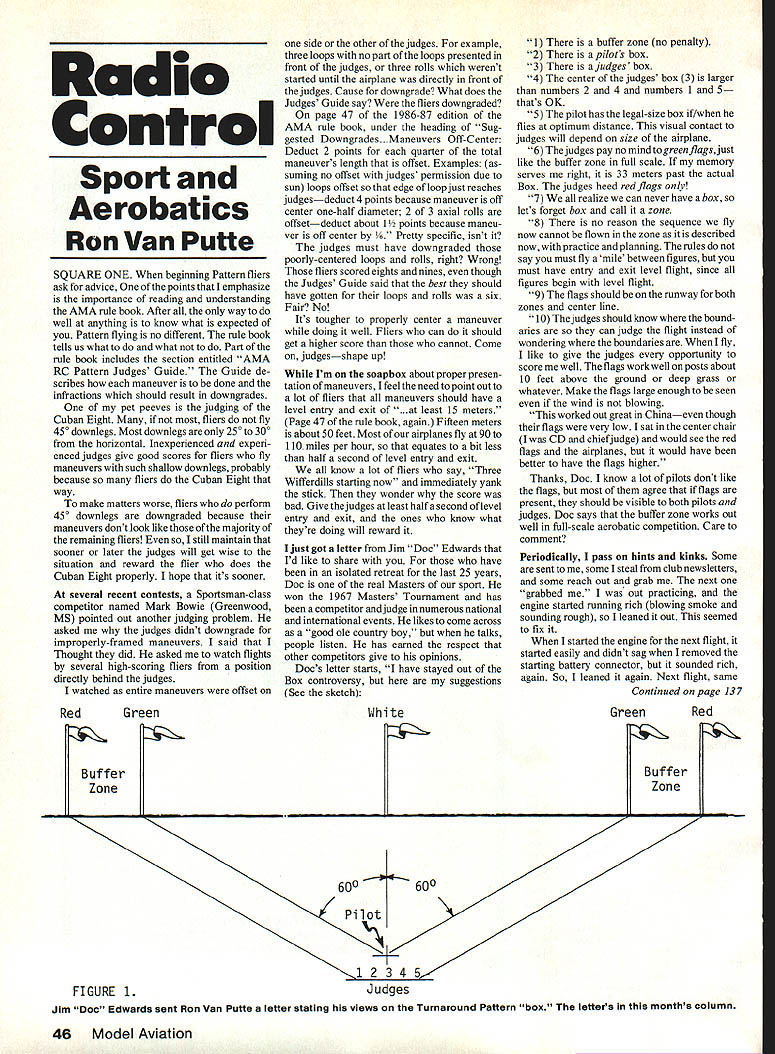
Doc's letter starts, "I have stayed out of the Box controversy, but here are my suggestions (see the sketch):
- There is a buffer zone (no penalty).
- There is a pilot's box.
- There is a judges' box.
- The center of the judges' box (3) is larger than numbers 2 and 4 and numbers 1 and 5 — that's OK.
- The pilot has the legal-size box if/when he flies at optimum distance. This visual contact to judges will depend on size of the airplane.
- The judges pay no mind to green flags, just like the buffer zone in full scale. If my memory serves me right, it is 33 meters past the actual Box. The judges heed red flags only!
- We all realize we can never have a box, so let's forget box and call it a zone.
- There is a reason the sequence we fly now cannot be flown in the zone as it is described now, with practice and planning. The rules do not say you must fly a mile between figures, but you must have entry and exit level flight, since all figures begin with level flight.
- The flags should be on the runway for both zones and center line.
- The judges should know boundaries and can judge flight instead of wondering where the boundaries are. When I fly, I like to give the judges every opportunity to score me well. Fletch works well on posts about 10 feet above the ground — make flags large enough to be seen if the wind is not blowing."
"This worked great in China — even though their flags were very low, I sat center chair (I was CD and chief judge) and would see the red flags and the airplanes, but it would have been better to have the flags higher."
Thanks, Doc. I know a lot of pilots don't like the flags, but most agree that if flags are present, they should be visible to both pilots and judges. Doc says that the buffer zone works out well in full-scale aerobatic competition.
Hints and Kinks
Periodically, I pass on hints and kinks. Some are sent to me, some I steal from club newsletters, and some reach out and grab me. The next one "grabbed me." I was out practicing; the engine started running rich (blowing smoke and sucking around), so I leaned it out. This seemed to fix it.
When I started the engine for the next flight, it started easily and didn't sag when I removed the starting battery connector, but it sounded rich again. So, I leaned it again. Next flight, same thing. Now, this is very unusual for a Rossi. Since the engine didn't sag when the battery connector was removed, it couldn't be a bad glow plug, right? Wrong! It was a bad glow plug. The plug, when on a normally reliable engine, can get balky — check the glow plug. I knew that — I just forgot.
Ron Van Putte 111 Sleepy Oaks Rd. Ft. Walton Beach, FL 32548
Transcribed from original scans by AI. Minor OCR errors may remain.

