
Radio Control: Sport and Aerobatics
Ron Van Putte
What is normalizing?
What's all this fuss about normalizing? In case you haven't heard, the current argument in Pattern is whether or not to normalize the scores to determine the winner of contests in the U.S.A.
Basically, normalizing means dividing each flier's score in front of a particular set of judges by the best score given by that set, then multiplying the result by 1000. The top flier for a round in front of any particular judging set receives 1000 points and everyone else gets a proportionally lower score.
After the contest is over there are two common ways to determine the winner:
- Count all rounds and total the scores; the highest total wins.
- Use "throwaway" flights and count only the best three or four flights — for example, best three of five, four of six, etc. Most contests use best four of six. In many contests with two flight lines, four rounds will give equal exposure for normalizing.
Won't results be the same either way? Not necessarily. The difference can be substantial.
Example from the Nats
Thanks to Nats Pattern Chief Tabulator Mike Lauman, who calculated the final standings both ways, the Expert class at the Nats provides a clear example of what normalizing can do.
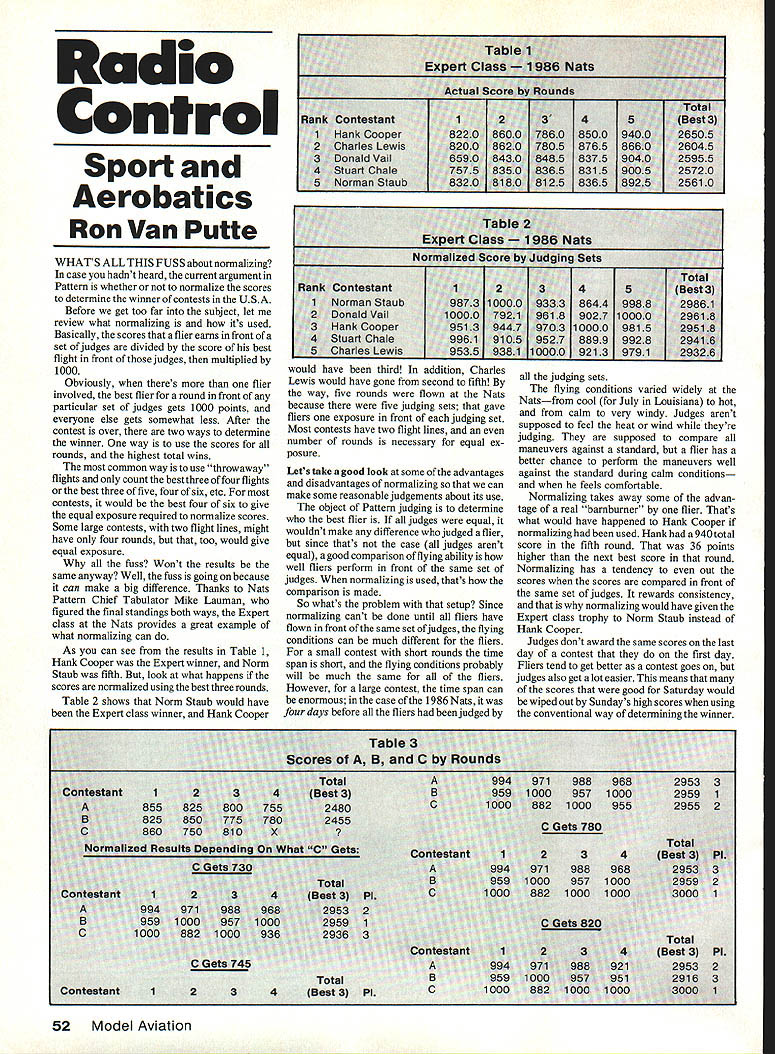
- Using conventional scoring, Hank Cooper was the Expert winner and Norm Staub placed fifth (see Table 1).
- If scores are normalized using the best three rounds, Norm Staub would have been the Expert winner and Hank Cooper would have placed third (see Table 2). Charles Lewis would have moved up as well.
The five rounds flown at the Nats exposed fliers to five different judging sets. Most contests have two flight lines; the number of rounds necessary to give equal exposure depends on the number of judging sets.
Advantages of normalizing
The object of Pattern judging is to determine who the best flier is. Normalizing attempts to make a fair comparison by measuring how well fliers perform in front of the same set of judges. Advantages include:
- Reduces judge-to-judge variability by comparing flights judged by the same panel.
- Rewards consistent performance across different judging sets.
- Helps equalize the value of flying on different days or in different rounds when judges may be stricter or easier.
- Prevents late inflated judging from overpowering earlier high scores if rounds are staged to give equal exposure (for example, two rounds judged by each set).
A smart Contest Director can stage rounds so scores can be normalized separately for groups of rounds (e.g., twice on Saturday, once on Sunday) to limit the effect of judging drift.
Disadvantages and potential for abuse
Normalizing can't be done until all fliers have flown in front of the same set of judges, so flying conditions can differ considerably between fliers. At a small contest with short rounds the time span is short and conditions are similar for everyone. At a large contest, judging may be spread over days and conditions can vary widely, as they did at the 1986 Nats — from cool to hot and from calm to very windy. A flier may have a substantial advantage if he happens to fly during calm, comfortable conditions; normalizing can reduce or remove that advantage.
Normalizing also tends to reward consistency and can penalize one spectacular outlying score. For example, Hank Cooper's high fifth-round score at the Nats (a 940 total that was 36 points higher than his next best round) would have been diminished by normalizing, costing him the title.
There is also a vulnerability to collusion. Dave Brown illustrated a potential cheating scenario (Table 3) for a four-round contest with three contestants — A, B, and C — when normalizing is used. Suppose before C flies the last round B offers C a reward to fly poorly. Depending on C's score in the fourth round the final order can change:
- If C scores below a certain threshold (e.g., less than 730), final order: B, A, C.
- If C scores around 745, final order: B, C, A.
- If C scores around 780, final order: C, B, A.
- If C scores around 820, final order: C, A, B.
By contrast, under conventional scoring in Brown's example, A would always beat B regardless of what C does. So normalizing can allow one contestant to influence others' relative standings, which opens a path for dishonesty.
Summary and invitation for comment
Normalizing can't eliminate all problems in determining who really flew better. It reduces judge-panel variability and rewards consistency, but it can penalize high outlying scores and creates potential avenues for strategic manipulation. I encourage letters from anyone who has comments on the use of normalizing; I'm not firmly on either side of the issue, so both pro and con arguments are welcome.
Other notes from the Nats
- Have you heard about the 1987 Nats? Informed sources say Lincoln, NE is the front-running choice. Chicopee, MA was 1,430 miles from Ft. Walton Beach, FL — I wonder how far Lincoln is? (If I go to the 1987 Nats, I'll learn the answer — that's where the Nats will be.) — RVM.
- Ed Izzo was passing out flyers during the Nats for the Third Annual RC World Flying Festival on November 27–30, 1986. It's billed as a manufacturer's exhibition, auction, fly-in, and fun-fly rather than a contest. It will be held at the RC World flying field southwest of Orlando. If you're interested, write to RC World Fliers, Inc., 2219 Mo-Ho Dr., Orlando, FL 32807 for a flyer.
- Ed thanked me for mentioning that he "invented" the foam wing. I don't really know who cut the first foam wing, but I cut my first one in 1966, so he must have done it more than 20 years ago.
- For the first time ever, all contestants at the Nats this year had their engine noise level measured just before every flight. I feared it would take too long, but it only added about 10 seconds to each flight.
My own engine test results were confusing: I was told my engine noise level varied during the five rounds from 94 dB to 101 dB. What did I do different? Almost nothing — I'm kidding; I don't remember touching the needle valve more than once. You may say that 94 dB isn't really much different from 101 dB, but it is: a difference of about 6 dB corresponds roughly to a doubling or halving of sound intensity, depending on direction.
Transcribed from original scans by AI. Minor OCR errors may remain.

