
Radio Control: Sport and Aerobatics
Ron Van Putte
Smooth
Do you admire the flier who can perform maneuvers smoothly and gracefully? Me too. There are three ways to achieve this:
- Natural ability
- One name that always comes to mind is Don Lowe. He's had that ability since I first watched him fly reed equipment way back in 1962.
- Another is Steve Rojecki. Steve's radio setup allows the airplane to perform extreme control without the appearance of harsh inputs. He doesn't use dual-rate controls, yet his airplanes fly as if he does.
- Massive practice
- Practice is the chief ingredient for most successful fliers. It requires some natural ability, but repetition and time on the sticks produce smoothness.
- Cheating (using radio features)
- For those with some natural talent but limited practice time, a feature-rich radio can create smooth, graceful flying. I fall into this category.
Cheating with radio features
Using a radio with helpful features makes many maneuvers look smoother:
- Dual-rates:
- If your loops look jerky because of stick input, use the lowest elevator rate that still allows the loop with nearly full stick throw. Small stick inputs then won't make the airplane jump.
- Use a very low aileron rate so roll corrections are subtle and largely undetectable.
- Roll buttons and multi-position aileron rates:
- Slow rolls look best with minimal stick hold. Less-skilled fliers can use roll buttons or very slow aileron dual-rates to imitate this.
- Automatic rudder dual-rate:
- Some systems (e.g., Futaba PCM) drop rudder rate automatically above a selected throttle setting, allowing large stick inputs to translate into the correct small rudder response.
- Variable Trace Ratio (VTR):
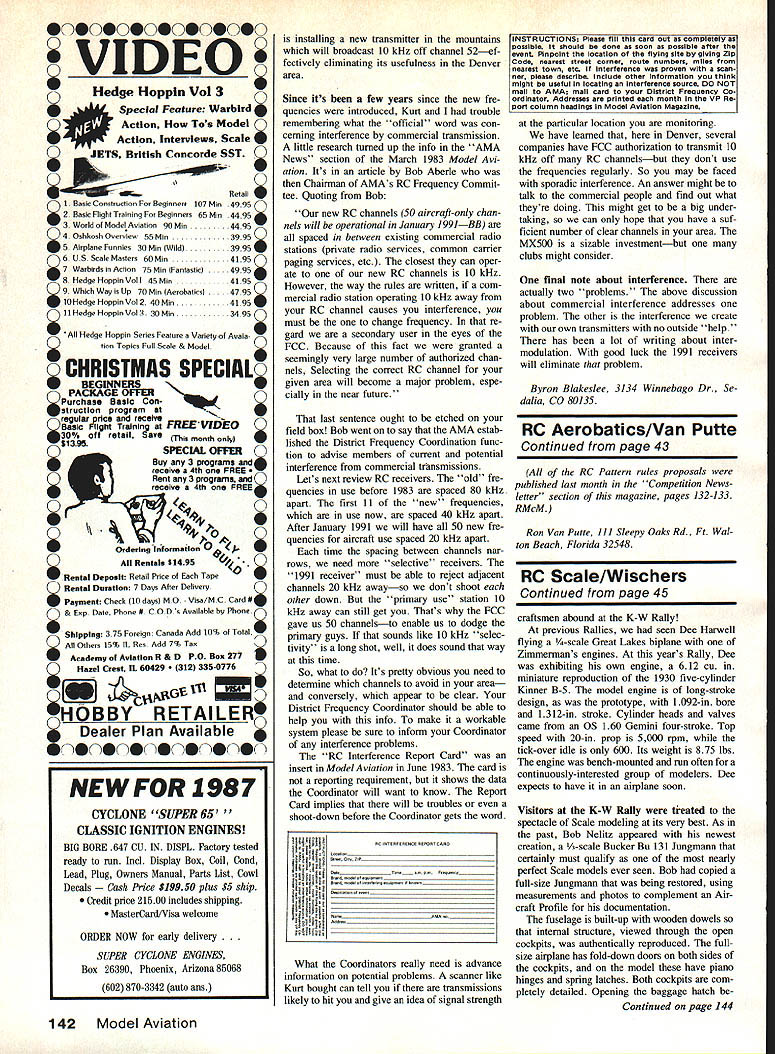
- VTR provides a shallow servo response near neutral stick and a steep response beyond roughly 80% stick movement. This yields smooth responses around neutral while still allowing full control when needed. (As shown in the drawing, the elevator response curve changes with stick travel.)
Specific maneuvers and settings
Certain maneuvers benefit greatly from tailored control rates:
- Slow roll: Pros hold just enough stick for a smooth roll; others use low aileron rate or roll buttons. I prefer the lowest aileron rate my Futaba PCM offers and hold partial stick for the desired roll rate.
- Four Point and Eight Point Rolls:
- I used to fly these at the same aileron rate I used for three horizontal rolls. Using a medium aileron rate (my PCM has three positions) lets the airplane roll slowly to the points, pausing only momentarily. The result looks better and appears more difficult, while it is actually easier.
- Maneuvers requiring variable elevator input:
- Top Hat, Square Loop (with or without half rolls), and Triangular Rolling Loop need heavy elevator input during corners and light input elsewhere. VTR helps by providing rapid cornering when the stick is yanked and gentle responses near neutral.
Using radio features in sport flying
Purists may claim a truly good flier doesn't need extra radio features. That's true, but until rules prohibit dual-rates and features like VTR, fliers who don't use them risk a competitive disadvantage. For sport flying, take full advantage of modern radio features—they add enjoyment and make it easier to fly better.
Futaba PCM systems feature a form of dual-rate response called Variable Trace Ratio (VTR). The graph (in the original article) shows servo response to stick movement; it is user-adjustable at the transmitter.
FCC proposal affecting the 50 MHz band
I received a letter from Dr. Michael Shabot (Rolling Hills Estates, CA) about a disturbing report in the August 18 issue of InfoWorld: the Federal Communications Commission is considering permitting a digital data network to use 52–54 MHz, part of the amateur radio band. This includes frequencies used by ham RC fliers (commonly 53.1, 53.2, 53.3, 53.4 and 53.5 MHz).
The proposal cited a perceived lack of interest in the band for ham transmissions and claimed ham operators would not experience interference from VHF signals. The FCC may publish a formal rule for public comment, likely in November; a key issue will be whether the frequencies would be protected or unlicensed.
Dr. Shabot sent a copy of his letter to Raymond Kowalski, Chief of Special Services, Federal Communications Commission, Washington, DC 20554, strongly opposing the 52–54 MHz Public Digital Radio Service because of its potential disastrous effect on RC modelers. If you want to oppose this proposal, write your objections to the FCC at the above address. Thanks to Dr. Shabot for bringing this potential problem to light.
RC Pattern rule change proposals
There is a large number of RC Pattern rule-change proposals currently under consideration by the Contest Board. Some are minor; others could seriously change the character of RC Pattern. Examples include:
- RC-88 and RC-89: Change Expert and Advanced class patterns, respectively, to Turnaround style.
- RC-88: Would outlaw retracts from Sportsman class.
- RC-88-2: Would combine Expert and Master classes into a new, fixed pattern called Open.
- RC-88-4: Would require Advanced, Expert, and Master class engines to pass a 105 dB sound level test or lose 10 points per judge.
All of the RC Pattern rule proposals were published last month in the "Competition Newsletter" section of this magazine (pages 132–133).
RC Aerobatics / Van Putte
Ron Van Putte 111 Sleepy Oaks Rd. Ft. Walton Beach, Fla. 32548
Transcribed from original scans by AI. Minor OCR errors may remain.

