
Radio Control: Sport and Aerobatics
Ron Van Putte
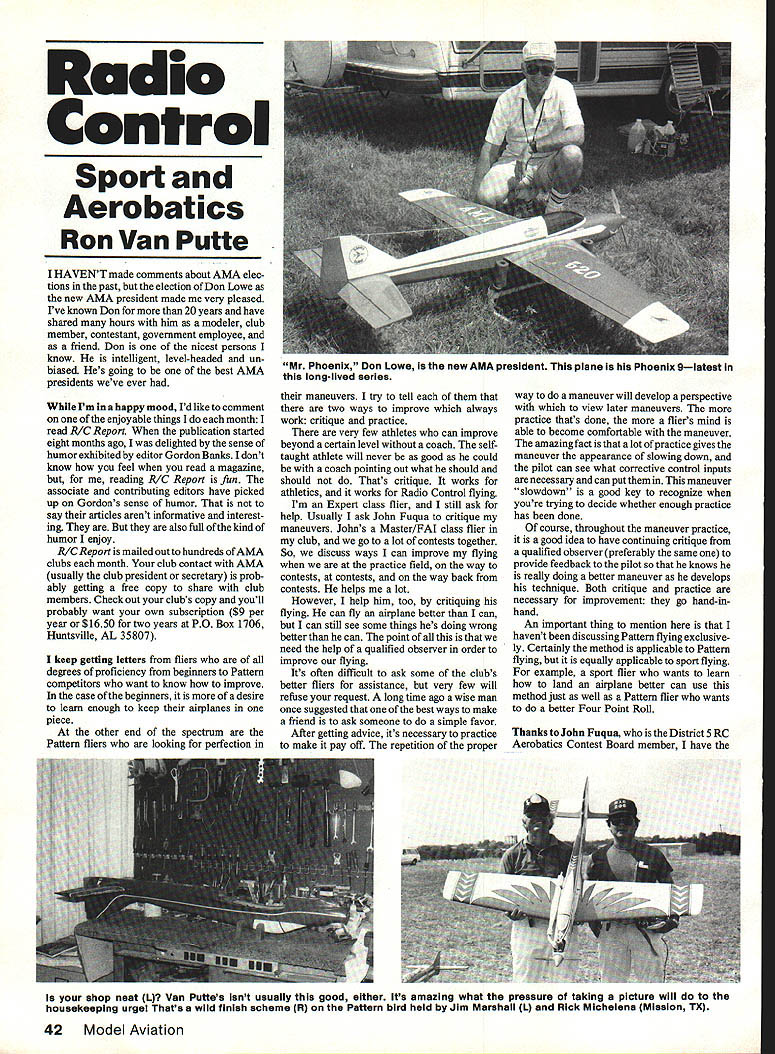
I haven't commented on AMA elections in the past, but the election of Don Lowe as the new AMA president pleased me. I've known Don for more than 20 years and have shared many hours with him as a modeler, club member, contestant, government employee, and friend. Don is one of the nicest people I know: intelligent, level-headed, and unbiased. He's going to be one of the best AMA presidents we've ever had.
R/C Report
One of the enjoyable things I do each month is read R/C Report. When the publication started eight months ago I was delighted by the sense of humor exhibited by editor Gordon Banks. Reading R/C Report is fun. The associate and contributing editors have picked up Gordon's sense of humor while still producing informative and interesting articles.
R/C Report is mailed to hundreds of AMA clubs each month. Your club contact with AMA (usually the club president or secretary) is probably getting a free copy to share with club members. Check your club's copy — you'll probably want your own subscription ($9 per year or $16.50 for two years; P.O. Box 1706, Huntsville, AL 35807).
Critique and Practice
I keep getting letters from fliers of all proficiency levels — beginners who want to learn enough to keep their airplanes in one piece, and Pattern competitors who are looking for perfection in their maneuvers. I tell each of them there are two ways to improve that always work: critique and practice.
Very few athletes can improve beyond a certain level without a coach. The self-taught athlete will never be as good as he could be with a coach pointing out what he should and should not do. That's critique. It works for athletics, and it works for radio control flying.
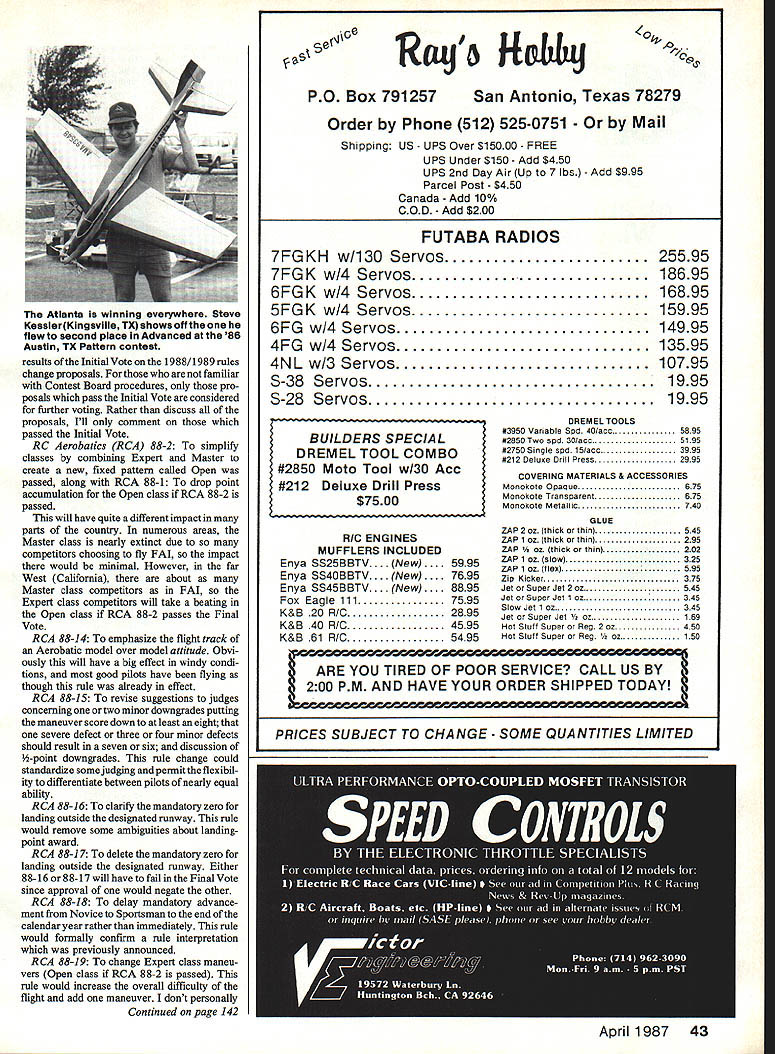
I'm an Expert-class flier and I still ask for help. Usually I ask John Fuqua to critique my maneuvers. John is a Master/FAI-class flier in my club and we attend many contests together. We discuss ways I can improve at the practice field, on the way to contests, at contests, and on the way back. He helps me a lot.
I help him, too, by critiquing his flying. He can fly an airplane better than I can, but I can still see some things he's doing wrong better than he can. The point is we need the help of qualified observers in order to improve our flying.
It's often difficult to ask some of the club's better fliers for assistance, but very few will refuse your request. A long time ago a wise man suggested that one of the best ways to make a friend is to ask someone to do a simple favor.
After getting advice, practice is necessary to make it pay off. Repetition of the proper way to do a maneuver develops a perspective for later maneuvers. The more practice you do, the more your mind becomes comfortable with the maneuver. A lot of practice often makes the maneuver appear to slow down, allowing the pilot to see what corrective control inputs are necessary and to apply them. This "slowdown" is a good indicator that sufficient practice has been done.
Throughout maneuver practice it's a good idea to have continuing critique from a qualified observer (preferably the same one) to provide feedback so the pilot knows he is really improving. Critique and practice go hand-in-hand.
This method is not limited to Pattern flying; it's equally applicable to sport flying. For example, a sport flier who wants to improve landings can use the same critique-and-practice approach as a Pattern flier working on a Four-Point Roll.
Contest Board: Initial Vote Results (1988/1989 proposals)
Thanks to John Fuqua, District 5 RC Aerobatics Contest Board member, I have the results of the Initial Vote on the 1988/1989 rules change proposals. For those not familiar with Contest Board procedures, only proposals that pass the Initial Vote are considered for further voting. Rather than discuss all proposals, I’ll comment on those that passed the Initial Vote.
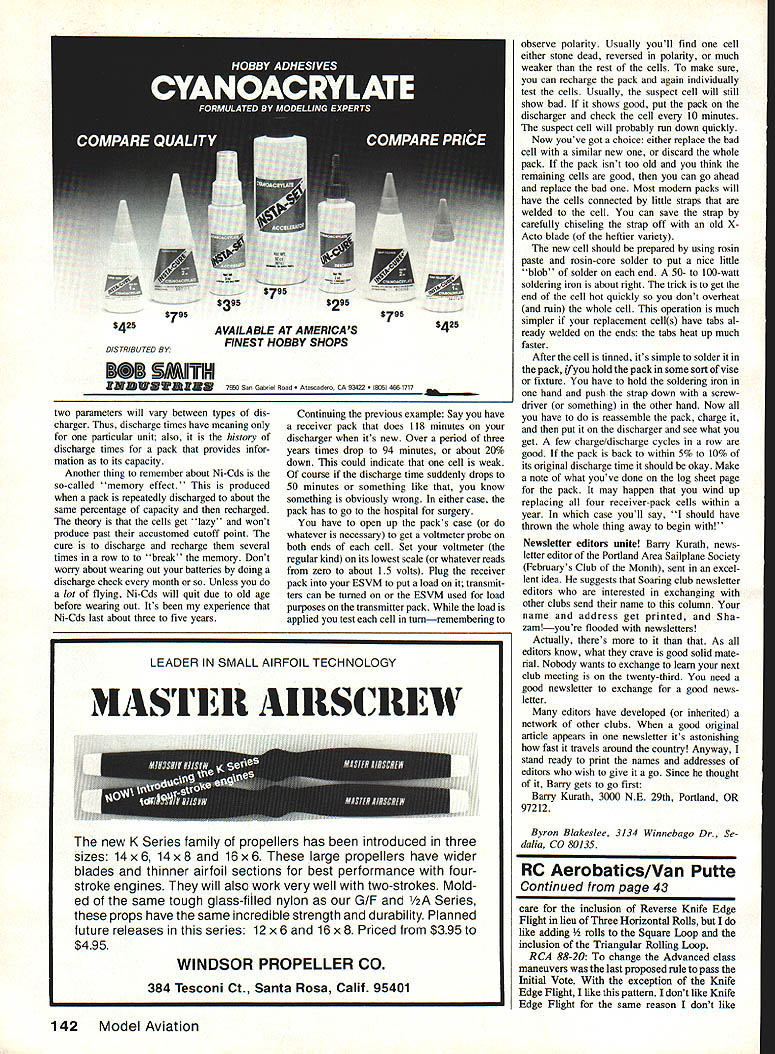
- RCA 88-2: Combine Expert and Master classes to create a new fixed pattern called Open — passed.
- RCA 88-1 (to drop point accumulation for the Open class if RCA 88-2 is passed) also passed.
- Comment: This will affect regions differently. In many areas Master is nearly extinct (many competitors choose FAI), so impact is minimal. In places like California, where Master is strong, Expert fliers could be at a disadvantage in the new Open class.
- RCA 88-4: Emphasize the flight track of the aerobatic model over model attitude — passed.
- Comment: This will affect judging and may alter how certain maneuvers are scored.
- RCA 88-15: Revise suggestions to judges concerning one- or two-point downgrades for certain line deviations — passed.
- Comment: This will standardize some judging and permit flexibility to differentiate between pilots of nearly equal ability.
- RCA 88-16: Clarify the mandatory zero for landing outside the designated runway — passed.
- RCA 88-17: Delete the mandatory zero for landing outside the designated runway — also passed.
- Comment: 88-16 and 88-17 are mutually exclusive; approval of one would negate the other, so one will have to fail in the Final Vote.
- RCA 88-18: Delay mandatory advancement from Novice to Sportsman until the end of the calendar year rather than immediate — passed.
- Comment: This formally confirms a previously announced rule interpretation.
- RCA 88-19: Change Expert-class maneuvers (or Open class if RCA 88-2 is passed) — passed.
- Comment: This would increase overall difficulty and add one maneuver. I don't feel this should be done unless the Contest Board provides a sound justification.
- RCA 88-20: Change the Advanced-class maneuvers — passed.
- Comment: With the exception of the Knife Edge Flight, I like this pattern. I dislike Knife Edge Flight because it tends to penalize aircraft that do not have neutral wing incidence or that do not knife well. The rest of the pattern is an improvement and adds interest to the Advanced flight.
Final note
A caption on a picture of Paul Verger (Lafayette, LA) in the February issue said that the aileron servo in Paul's airplane "quit in the vertical-downward part of the Square Loop with 1/2 rolls." Have you ever seen one of those maneuvers? The 1/2 rolls would be a real challenge. It was just a typo — it should have read "1/2 Rolls."
Ron Van Putte 111 Sleepy Oaks Rd. Ft. Walton Beach, FL 32548
When responding to advertisers, mention that you read about them in Model Aviation.
Transcribed from original scans by AI. Minor OCR errors may remain.

