
Radio Control: Sport and Aerobatics
Ron Van Putte
The BRUSHFIRE is a very capable Pattern design from the hand of Ken Bonnema. Steve Rojecki has campaigned this design for the past few years with great success, and the model has become very popular. Since publishing the photo of the Brushfire II model in the July column, it has been brought to my attention that neither Ken Bonnema nor Steve Rojecki has any association with its manufacturer, Aeroglas Model Developments.
On the lighter side of the Brushfire story, Steve Rojecki plans to fly a new Brushfire II in the Turnaround event at the 1985 Nats. As this is written, he's in the final stages of finishing it. Like all Brushfires, it will probably weigh much less than eight pounds. Someday I hope he writes an article on how to keep weight out of an airplane.
By the way, the aircraft shown is a modified Sig Kougar, as you have no doubt guessed.
Letter: After-muffler experiment (Bud Wolfe)
An interesting letter arrived from Bud Wolfe (Scottsdale, AZ), who wrote in part:
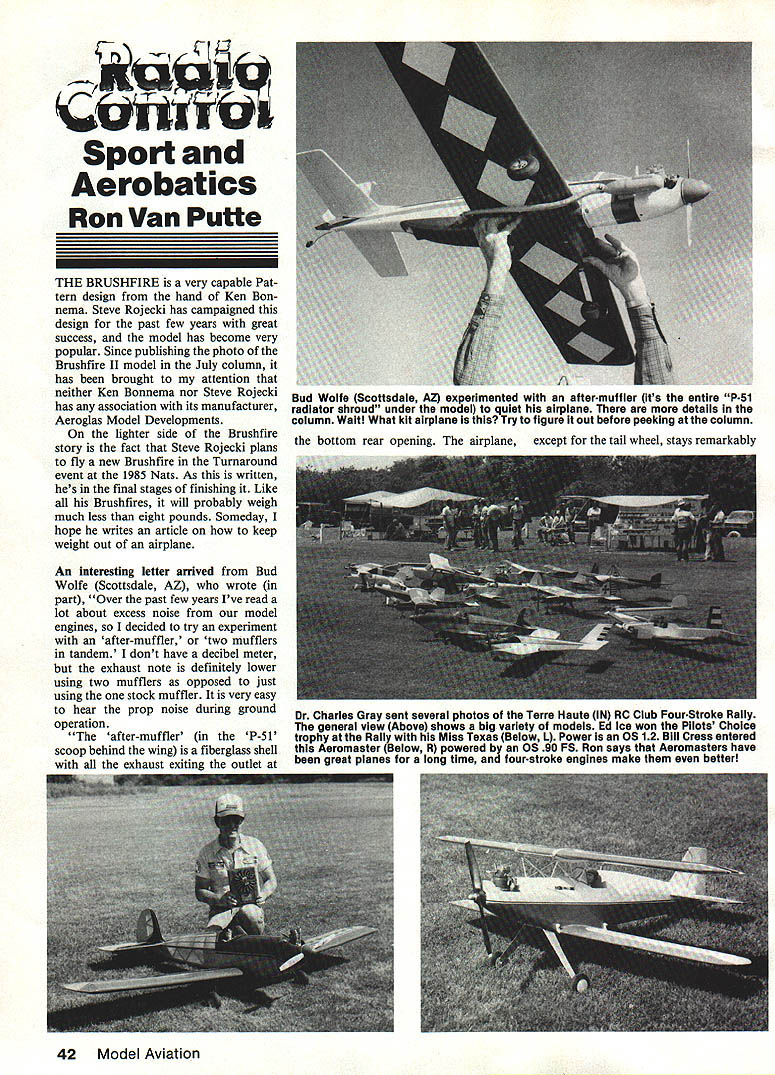
"Over the past few years I've read a lot about excess noise from our model engines, so I decided to try an experiment with an 'after-muffler,' or 'two mufflers in tandem.' I don't have a decibel meter, but the exhaust note is definitely lower using two mufflers as opposed to just using the one stock muffler. It is very easy to hear the prop noise during ground operation.
"The 'after-muffler' in the P-51-style scoop behind the wing is a fiberglass shell with all the exhaust exiting the outlet at the bottom rear opening. The airplane, except for the tail wheel, stays remarkably quiet.
"I had expected at least a 500 rpm loss in exchange for less noise, but was pleasantly surprised to find a 100 to 300 rpm gain at full throttle. The rpm gain varied with the prop size. Maybe one of your readers could explain exactly why. What I don't know is whether my setup is a fluke or not. Would a longer or shorter pipe, a larger or smaller or a differently shaped 'after-muffler' work better or worse? I don't know."
For readers who would like to correspond: Bud Wolfe, 8724 E. Weldon Ave., Scottsdale, AZ 85251.
Starting in Pattern flying
Response to the July column encouraged sport fliers to go into Pattern flying in order to improve flying skills. I received several letters asking how to get started in Pattern flying. People who have been reading this column have good memories and will realize I've covered the subject several times in the past 10 years. However, it's probably at least a couple of years since I last brought it up. I'll have another try for people who didn't read earlier columns.
The purpose of this month's column is to plan an approach to Pattern flying from the viewpoint of helping the sport flier who wants to improve flying skills, rather than to train a novice Pattern flier to do well on the contest circuit.
Aircraft and engine considerations
The first thing to consider is the aircraft/engine combination. Most Pattern maneuvers require some vertical performance. Certainly maneuvers like Straight Flight, Out Back Procedure Turn, Three Rolls, and Straight Vertical Flight don't really become fun unless the airplane has vertical performance. Consequently, the airplane should be able to loop comfortably from a level entry. Some three-channel airplanes will do remarkably well.
The airplane under discussion should have rudder, elevator, aileron, and throttle control. To get out and learn to fly Pattern maneuvers, the airplane should be able to perform an axial roll in the hands of an experienced pilot. Some airplanes' ailerons have much effective dihedral; it's tough to get a good roll. The airplane/engine combination must be capable of performing the maneuvers in the hands of a good pilot.
Next consideration is the amount of control authority which is available. Many sport fliers have airplanes that are very sensitive because the control surfaces move too much.
Control setup and tuning
- Aileron throw: When the aileron control is held full over, the airplane should roll three times in about five seconds. I'd be willing to bet that two-thirds of sport fliers have their airplanes set up to perform three rolls in three seconds or less. Too fast — slow down the roll rate by cutting back on aileron throw.
- Elevator throw: A comfortable-size loop should require half to two-thirds of the available stick throw. All that's needed is a little margin of control to get out of a sticky situation. The resulting pitch control should be positive and smooth.
- Nose gear steering: Most sport fliers' airplanes can turn around inside a phone booth! If you can see the nose wheel move, it's probably too sensitive. I usually put the longest steering arm that I can find on the nose gear and attach the pushrod from the outside of it to the most-inside hole on the rudder servo arm. In fact, I usually drill a hole further inside than the ones already on most servo arms to achieve minimum throw. It makes those takeoff rolls nice and smooth.
You probably noticed that I've used the word "smooth" a couple of times already. That's for a good reason—Pattern flying is smooth and graceful. The proper attitude to develop for Pattern flying is to think about working toward smoothness and gracefulness. It's hard at first because learning new maneuvers is sometimes scary and that tends to make you yank the controls around. However, if you continue to work toward smoothness and gracefulness, it becomes second nature.
Practice, discipline, and positioning
Most sport fliers only fly according to a random routine. One of the keys to learning how to fly better is to develop discipline. This means that a pilot learning to fly Pattern should practice maneuvers when and where they should be done:
- Loops should be performed directly in front of the pilot.
- Rolls should be done parallel to the flight line and centered on the pilot.
It's not easy, but continued practice pays off.
Try the easy maneuvers first. Once the airplane is properly trimmed, it should be capable of doing Straight Flight Out all by itself once the pilot puts it in the correct position. Read the rule book to find out the correct position for starting the maneuver. Straight Flight Back can't be all that tough, can it? Well, it depends on how good a job the pilot did on the Procedure Turn.
The Procedure Turn is one of the maneuvers that pilots constantly do poorly. It's supposed to be a 90° turn linked with a 270° turn in the opposite direction. Watch someone try it, and I'll bet that the first turn is 75° at the most. An observer can usually tell, much better than a pilot, what the airplane is really doing. Ask someone to coach you until you can recognize a true 90° turn. The 270° turn is actually quite easy if the wind isn't blowing too hard and the pilot remembers to maintain altitude by keeping the turn smooth and graceful.
How to improve — a three-step plan
I'm not going to describe what should be done to perform each Pattern maneuver in the rule book. What I suggest to a pilot who wants to improve his flying ability can be covered in three steps:
- Start with the easier maneuvers to build ability and confidence.
- Read the rule book to find out what the maneuvers are supposed to look like.
- Practice with an observer to tell you what you're doing right and wrong.
That third step is a tough one for a lot of sport fliers, to whom practice is an ugly word, but it's really the only way to make everything else pay off.
Ron Van Putte 111 Sleepy Oaks Rd. Ft. Walton Beach, FL 32548.
Transcribed from original scans by AI. Minor OCR errors may remain.

