
Radio Control: Sport and Aerobatics
Ron Van Putte
Turnaround and the visibility problem
Here's a scenario: contestants are to run from one end of a hallway to the other and are penalized each time they touch a wall. Sound reasonable? Oh — almost forgot — they're blindfolded and can't see the walls. Does it still sound reasonable? Should a contestant be penalized for touching a wall he can't see? That's the rule.
Now consider an RC Pattern event called Turnaround. Contestants are penalized whenever their airplane flies outside the box limits. The box limits are marked so the judges can see them, but the pilots often cannot. Being penalized for flying out of a box you can't see is just as unreasonable as penalizing a blindfolded runner for touching an unseen wall.
At a recent contest I witnessed exactly this problem. The out-of-box markers were very small and were placed against a backdrop of small trees. Pilots could not see them unless they took their eyes off their airplanes. The "box" judge — whose sole job it was to determine if an airplane left the box — was sitting behind the pilot. Consequently an airplane could appear to be "in" from the pilot's view but "out" from the judge's view. Add to that the practice of judging a close approach to the box limits as "out," and you have many frustrated pilots.
I support enforcing the box in Turnaround competition, but the limits must be marked so that both pilots and judges can see them. A marginal approach to the box limit should be called "in" by a judge positioned in front of the pilot.
Combining Expert and Master classes
A rules proposal to combine the Expert and Master classes into an Open class has generated debate. Representatives from areas with a high concentration of Master-class competitors tend to oppose the proposal. Their arguments were summarized by Peter Callas and Steve McCann (NSRCA District 7 co-vice-presidents) in the K-Factor newsletter. Key points include:
- The current class progression is important for improving flying skills. Jumping from Advanced to Master is too large a step for many fliers.
- Expert class is typically where a flier learns to properly trim and fly an airplane.
- The quality and dedication of Master-class fliers (especially on the West Coast) are very high.
- Master-class experience prepares fliers for FAI team selection; many top FAI fliers came up through Expert and Master classes.
- Some proponents of all-FAI-class Pattern think FAI quality would improve if fliers came up through FAI-style classes, but none of the top fliers came from IMAC or FAI-only backgrounds.
- Eliminating AMA-type Pattern or combining Expert and Master is seen by these authors as a step backwards for the sport.
A clarification: the "AMA magazine" referred to is Model Aviation. The rules proposals were published and discussed in recent back issues (see December 1986 and January–February 1987).
My view: I don't believe combining Expert and Master would be the end of the world. As an Expert competitor I might not relish facing Master pilots, but I could live with it. What would make combining classes more acceptable to me is creating a "Beginner's FAI" transition class to ease the move between AMA and FAI styles. Such a transition class would provide real competition for those new to Turnaround without the embarrassment of being initially outclassed by FAI pros.
If a transition class is not a viable option in the current rules cycle, that highlights a broader concern about the lack of flexibility allowed to Contest Board members. John Fuqua, District 5 RC Aerobatics Contest Board member, has been perplexed by the apathy surrounding these proposals — he has received no letters favoring the combination, and little feedback from District 5 members. If you have an opinion on this or any other rule-change proposal, please take five minutes to write to your district Contest Board member (names and addresses are listed in Model Aviation).
A proposed identical-airplane competition
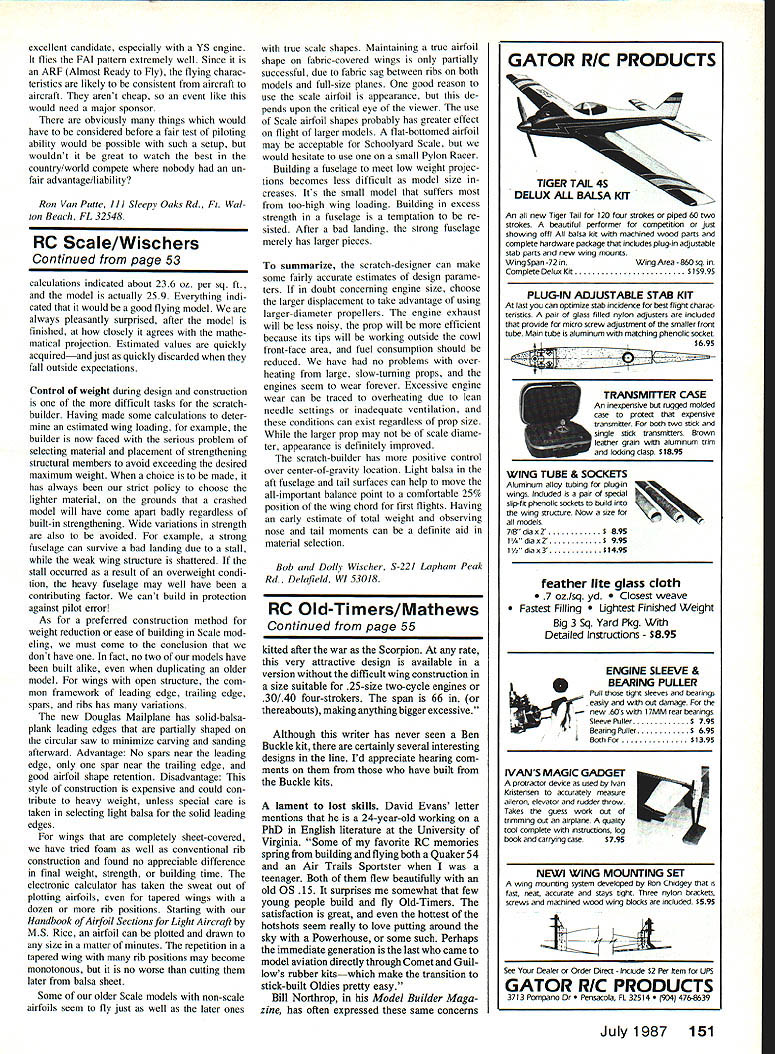
At a recent contest we discussed an idea for a top-level national or international RC Aerobatic Pattern competition in which every competitor flies the same airplane and judges do not know the identity of the fliers. The goal is to make flying ability the sole determinant of success.
Key elements discussed:
- Airplane selection: it must perform the FAI pattern well in competent hands. The Hobby Shack Supra-Fly was suggested as a good candidate because:
- It is easy to build.
- It has relatively large wing area for good low-speed handling.
- It has a high-mounted tail for good rudder authority in incipient snap rolls.
- The boxy fuselage accommodates a wide range of hardware installations.
- Power and prop: a modern, light, high-powered .35 to .40 engine was suggested (some recommended a 2-stroke .36) and a durable 3-blade prop.
- How airplanes would be supplied:
- Built-up ARF,
- Fully built and trimmed,
- Or as a kit requiring a few hours to complete.
- Entry fees would be used to buy the airplanes and cover shipping and handling.
- Ensuring parity and anonymity:
- A manufacturer representative would oversee maintenance so airplanes remain mechanically identical (no secret tuning).
- Judges would be kept unaware of pilots' identities by scoring from a tower with no view of the pilots, or by having pilots fly from an enclosed booth while kept in a separate holding area.
- Funding: sponsors and entry fees would provide the money for the contest.
Final note and call to action
Read the rules proposals in Model Aviation carefully. If you have an opinion on these proposals or other rule changes, take a few minutes to write your Contest Board member and make your views known.
Transcribed from original scans by AI. Minor OCR errors may remain.

