
Radio Control: Sport and Aerobatics
Ron Van Putte
Softening epoxy and risk
June's column contained a suggestion for softening Part A of a Dave Brown epoxy by putting it (with the top off the container) in a microwave oven for 20 to 30 seconds. The editor then inserted a comment and an example showing that I'd been fortunate to get away with doing that because some people are severely allergic to heated epoxy.
Actually, I don't think I was fortunate. Fortunate (lucky) is when you bet on something against 1,000-to-one odds and win. Since very few people are allergic as the person in the cited example, I'd say that the person who's allergic is unfortunate. Unfortunate is where the odds are 1,000-to-one in your favor and you lose.
Because I'm in the flight test business, I continually deal with safety engineers who must decide whether the testing I want to do is safe. They must weigh the odds of a failure occurring versus the implications of a failure. It's a difficult job because we're dealing with men's lives and millions of dollars' worth of equipment. Nevertheless, I am often given the go-ahead for a test though a single failure could cause the loss of an aircraft and the life of a pilot, because the probability of the failure is infinitesimal.
Similarly, we must weigh the odds when considering doing a lot of different things involved with RC. If we didn't do a particular thing because there was a remote possibility of a failure causing a catastrophic problem, we'd never show up at the flying field—much less attempt to fly our RC airplanes. Consequently, I will continue to soften Brown Part A epoxy in my microwave oven because I have determined that I am not allergic to its fumes. Prudent modelers who also determine they are not allergic to heated epoxy can do it, too.
The "pendulum effect" and dihedral
Before I climb off my soapbox, let me make a brief comment on the "AMA Commentary" printed with my June 1987 column.
For years we've heard columnists and some fellow fliers say that the reason high-wing airplanes are more stable laterally than their low-wing counterparts is because of the "pendulum effect." The last time I read it, something inside me snapped, and I'm forced to comment.
The "pendulum effect" is one of those convenient explanations, used to account for an observed phenomenon, which has no basis in fact. There's a simple way to resolve it—look at the forces and moments acting on a high-wing model and decide what really happens.
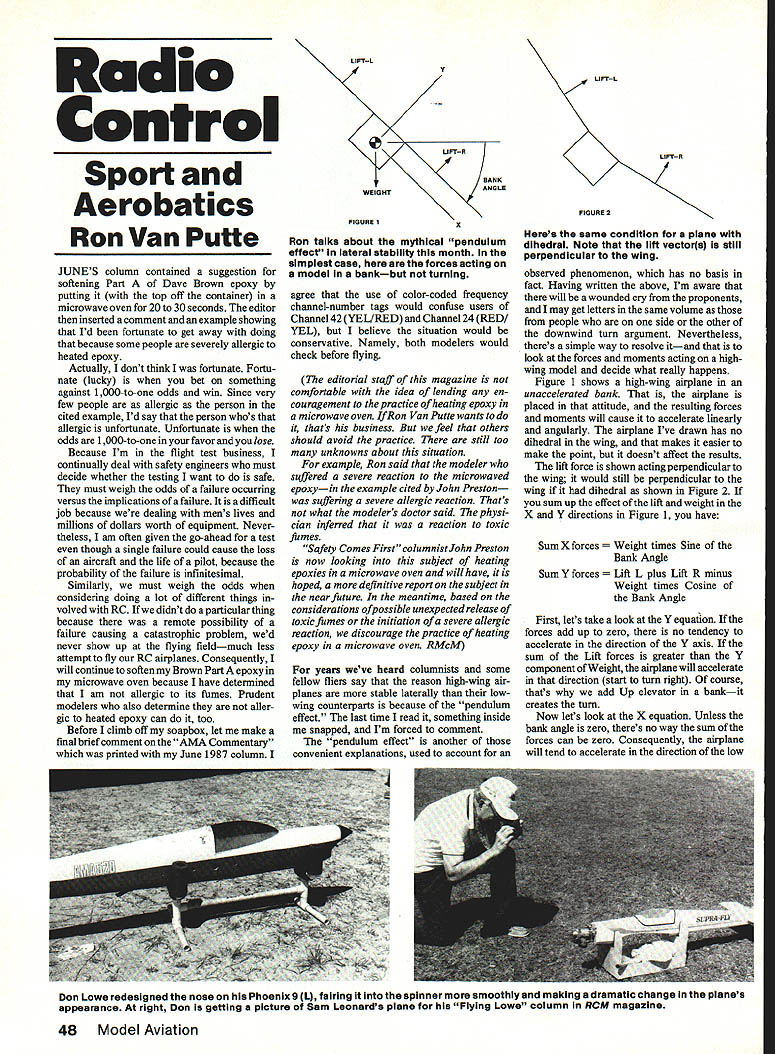
Figure 1 shows a high-wing airplane in an unaccelerated bank. That is, the airplane is placed in that attitude, and the resulting forces and moments will cause it to accelerate linearly and angularly. The airplane I've drawn has no dihedral in the wing, which makes the point easier, but that detail doesn't affect the results.
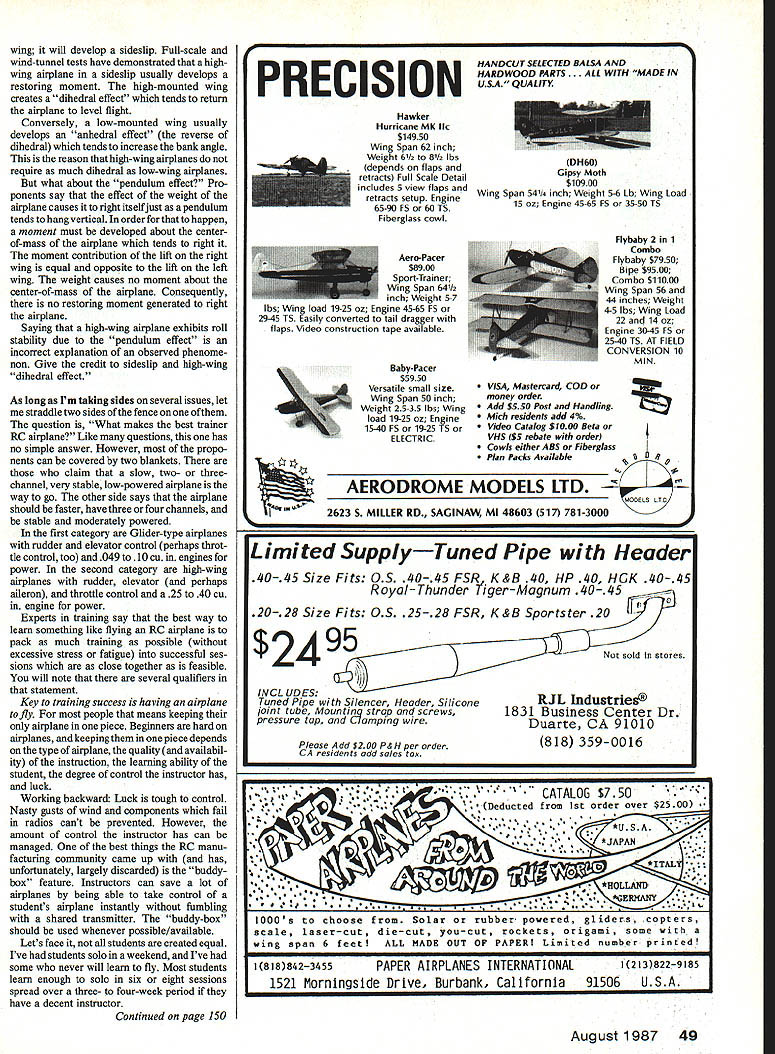
The lift force is shown acting perpendicular to the wing; it would still be perpendicular to the wing if it had dihedral as shown in Figure 2. If you sum up the effect of the lift and weight in the X and Y directions in Figure 1, you have:
- Sum X forces = Weight × Sine of the Bank Angle
- Sum Y forces = Lift L + Lift R − Weight × Cosine of the Bank Angle
First, look at the Y equation. If the forces add up to zero, there is no tendency to accelerate in the direction of the Y axis. If the sum of the lift forces is greater than the Y component of the weight, the airplane will accelerate in that direction (start to turn). Of course, that's why we add up-elevator in a bank—it creates the turn.
Now look at the X equation. Unless the bank angle is zero, there's no way the sum of the forces can be zero. Consequently, the airplane will tend to accelerate in the direction of the low wing; it will develop a sideslip. Full-scale and wind-tunnel tests have demonstrated that a high-wing airplane in a sideslip usually develops a restoring moment. The high-mounted wing creates a "dihedral effect" which tends to return the airplane to level flight.
Conversely, a low-mounted wing usually develops an "anhedral effect" (the reverse of dihedral) which tends to increase the bank angle. This is the reason that high-wing airplanes do not require as much dihedral as low-wing airplanes.
But what about the "pendulum effect?" Proponents say that the effect of the weight of the airplane causes it to right itself just as a pendulum tends to hang vertical. For that to happen, a moment must be developed about the center of mass of the airplane which tends to right it. The moment contribution of the lift on the right wing is equal and opposite to the lift on the left wing. The weight causes no moment about the center of mass of the airplane. Consequently, there is no restoring moment generated by the weight to right the airplane.
Saying that a high-wing airplane exhibits roll stability due to the "pendulum effect" is an incorrect explanation of an observed phenomenon. Give the credit to sideslip and the high-wing "dihedral effect."
RC Aerobatics/Van Putte
Continued from page 49
As long as I'm taking sides on several issues, let me straddle two sides of the fence on one of them. The question is, "What makes the best trainer RC airplane?" Like many questions, this one has no simple answer. However, most proponents can be covered by two blankets. There are those who claim that a slow, two- or three-channel, very stable, low-powered airplane is the way to go. The other side says that the airplane should be faster, have three or four channels, and be stable and moderately powered.
- Category 1: Glider-type airplanes with rudder and elevator control (perhaps throttle control), and .049 to .10 cu. in. engines for power.
- Category 2: High-wing airplanes with rudder, elevator (and perhaps aileron), and throttle control, with a .25 to .40 cu. in. engine for power.
Experts in training say that the best way to learn something like flying an RC airplane is to pack as much training as possible (without excessive stress or fatigue) into successful sessions which are as close together as feasible. You will note that there are several qualifiers in that statement.
Key to training success is having an airplane to fly. For most people that means keeping their only airplane in one piece. Beginners are hard on airplanes, and keeping them in one piece depends on the design, the tuneability, the quality (and availability) of the instruction, the learning ability of the student, the degree of control the instructor has, and luck.
- Luck is tough to control. Nasty gusts of wind and components that fail in radios can't be prevented.
- The amount of control that the instructor has can be managed. One of the best things the RC manufacturing community came up with (and has, unfortunately, largely discarded) is the "buddy-box" feature. Instructors can save a lot of airplanes by being able to take control of a student's airplane instantly without fumbling with a shared transmitter. The buddy-box should be used wherever possible/available.
Let's face it, not all students are created equal. I've had students solo in a weekend, and I've had some who never will learn to fly. Most students learn enough to solo in six or eight sessions spread over a three- to four-week period if they have a decent instructor.
It's also true that not all instructors are created equal. Some people can fly their own airplanes just fine but can't teach others how to do it. A really good instructor can dramatically shorten the training time for a student.
Now we get to the tough one—the trainer airplane. As mentioned earlier, the key to learning how to fly RC is keeping the airplane in one piece. A good student who has a good instructor and a buddy-box needs an entirely different airplane from a poor student with no instructor. The powered glider is a good choice of trainer airplane for students who are slow learners, have poor or no instruction and/or no buddy-box. This type of airplane is inherently stable and can often fly itself out of trouble. It is much easier to fly and land because it moves relatively slowly, and the novice pilot has a better chance to keep up with the aircraft's motion. It permits the student more time to evaluate the orientation of the airplane and figure out what to do. The wing loading is usually fairly low, which often allows it to survive crashes in good shape.
Why wouldn't everyone want to learn to fly using a powered glider? Well, depending on the abilities of the novice pilot and his instructor and the availability of a buddy-box, some students will learn a lot faster than others. Pilots seldom use a powered-glider type of trainer for much more than a radio-check airplane after they learn how to fly. So they move on to an advanced trainer much like the airplane the other proponents would have recommended they start with. This means an investment of more money in the long run, and it's wasted for a pilot who can learn to fly quickly.
Having said that, I'd straddle both sides of this issue; I must add that only the beginner can decide which airplane best satisfies the training situation in which he's found himself.
Ron Van Putte 111 Sleepy Oaks Rd. Ft. Walton Beach, FL 32548.
Transcribed from original scans by AI. Minor OCR errors may remain.

