
Radio Control: Sport and Aerobatics
Ron Van Putte
I didn't intend to submit my regular column this month. One reason I've written it is to tell you to look for my report on the Radio Control F3A team selection finals (otherwise known as the Masters' Tournament) in the "Competition Newsletter" section of the magazine. Two years ago I did only the Masters' Tournament coverage, and people told me that they missed my regular column and never noticed the Masters' Tournament coverage. So, here's my regular column—but be sure to check out the back of the magazine, too.
I almost had too much to do this month. Besides driving 950 miles to Chesapeake, VA for the Masters' Tournament, conducting external store separation flight tests on the new F-15E, and trying to get in some practice for the Nats, I also had to drive 750 miles to Middletown, OH for daughter Kathy's wedding. Next week I will drive 1,250 miles to the Nats in Lincoln, NE. I won't mind that at all.
In preparation for the Nats I've been trying out a couple of things. One nice feature of my Futaba PCM is that it has the flexibility to exercise a number of options. My Tipora has a couple of quirks that I've lived with, but recently I decided to try letting the radio do some of the work.
For some reason, when I had Up elevator applied for something like a Square Loop, the airplane yaws to the right. By using the transmitter's programmable mixer, I fed Up elevator signal to Left rudder so that whenever I gave full Up elevator, I got a tad of Left rudder. Hey — it works!
The next thing that bothered me is that Down elevator also causes the airplane to roll left. This quirk makes the backside of Double Immelmann maneuvers and Outside Loops look squirrely. So I tried mixing to get a little bit of Right aileron with Down elevator. Whoa! A little bit of aileron is very effective in outside maneuvers. That wasn't such a good idea. I'll use the stick to correct that problem.
If you have a radio with programmable mixing, you can try fixing up your airplane's idiosyncrasies with control mixing. It's fun to fool around with it when you've got the time. You might consider:
- Mixing rudder into elevator to cure airplane pitching during point rolls.
- Mixing rudder into aileron to reduce the roll effect of the rudder in point rolls on an airplane whose wing doesn't quite have the correct dihedral.
Control mixing is a wonderful fixer-upper for airplanes that aren't quite right.
In talking to Dave Brown at the Masters' Tournament about his Lite Flite wheels, I learned that he has changed the material in the tires to improve wearability. The first tires were fine for grass and some hard surfaces, but many surfaces were rough on the original tire material. The second material he tried wore much better than the original, but it was heavier. The third try resulted in a tire which wears about the same as the second material and weighs less than the original. Dave says that it's the same material that's used in expensive running shoes. I offered Dave a challenge to send me some new wheels to try on my club's runway. Our runway is asphalt with granite chips as the aggregate. It is rough on tires.
The matrix I include with reports of big contests like the Nats and Masters' Tournament has evolved over the years. For a long time it included a column on the kind of spinner that was used. For several reasons I eliminated it to cut down on the number of columns, partly because there was nothing particularly exciting about spinners and also because there wasn't much to be gained by using a particular kind of spinner.
After I returned from the Masters' Tournament, I was going over the top-ten information sheets when it struck me that spinners are news again, and I didn't have a column on who used what spinners. I thought about it for a while and realized that virtually all the Masters' Tournament competitors were using Tru-Turn spinners. That's quite a recommendation, especially when you realize that they just came on the market last year.
What's special about the Tru-Turn spinners? Four things:
- Light
- True
- Durable
- Attractive
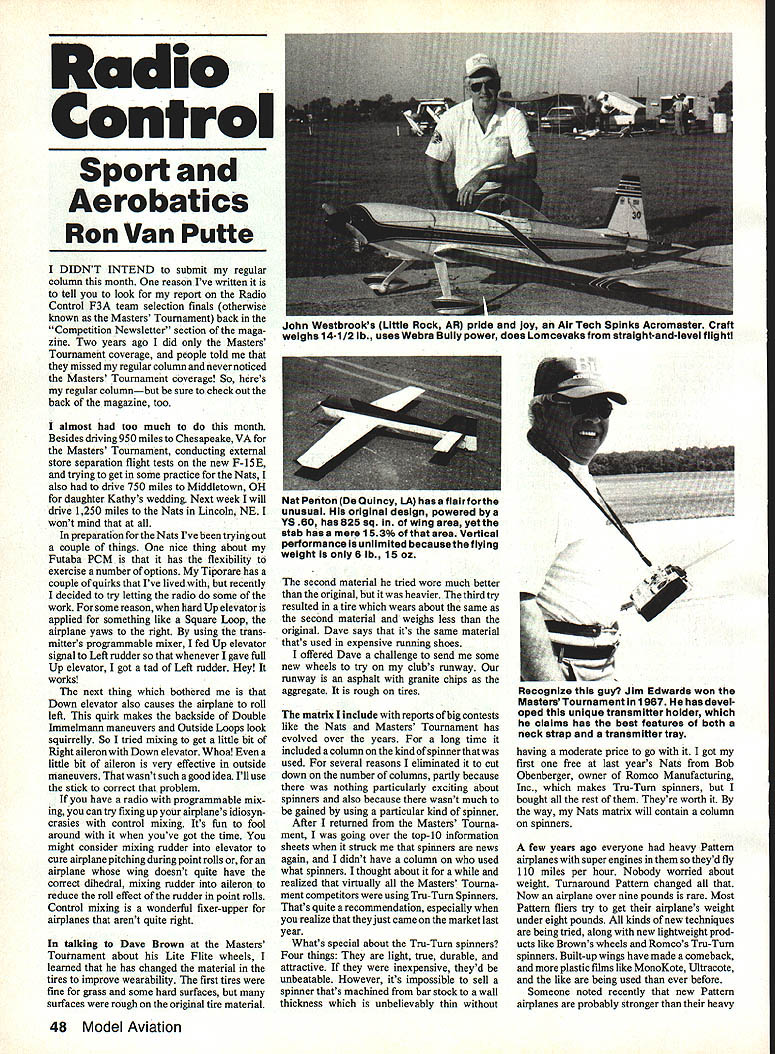
If they were inexpensive, they'd be unbeatable. However, it's impossible to sell a spinner that's machined from bar stock at a wall thickness which is unbelievably thin. Jim Edwards won the Masters' Tournament in 1987. He has developed a unique transmitter holder, which he claims has the best features of both a neck strap and a transmitter tray, all at a moderate price. I got my first one free at last year's Nats from Bob Obenberger, owner of Romco Manufacturing, Inc., which makes Tru-Turn spinners, but I bought the rest of them. They're worth it. By the way, my Nats matrix will contain a column on spinners.
A few years ago everyone had heavy Pattern airplanes with super engines in them so they'd fly 110 miles per hour. Nobody worried about weight. Turnaround Pattern changed all that. Now an airplane over nine pounds is rare. Most Pattern fliers try to get an airplane's weight under eight pounds. A lot of new techniques are being tried along with new lightweight products like Brown's wheels and Romco's Tru-Turn spinners. Built-up wings have made a comeback, and more plastic films like MonoKote, Ultracote, and the like are being used than ever before. Someone noted recently that new Pattern airplanes are probably stronger than their heavy predecessors. How can that be? The new techniques which permit lightweight structures — the use of carbon fiber tape and the sandwiching of balsa and thin plywood — result in structures that are stronger per unit of body weight.
Based on the fact that the advances in making airplanes strong and light have occurred in just the last couple of years, we will probably see a lot more innovations in the next few years. I'm looking forward to that.
When it was announced that next year's Nats will be at the site of this year's Masters' Tournament, my wife was delighted. Faith had accompanied me to Virginia but didn't get a chance to see and do all she wanted. So, I'll bet she will accompany me to Virginia again next year. In fact, she asked me to include the following note in my column.
A wife's eye-view
I am not the type of person to enjoy model airplane contests, but I thoroughly enjoyed going to the Masters' Tournament with Ron. Not because of the contest itself, but because of where it was held.
Fentress is very close to Norfolk, the Hampton Roads area of Virginia, and Virginia Beach. There is much to see and do for everyone, no matter what his/her interests.
Virginia Beach is crowded with bikini-clad girls, shops, etc. Also, there are some terrific restaurants offering everything from steak to seafood.
Norfolk has museums, art galleries, shopping malls, discount shops and walking and bus tours. Norfolk is also the home of the world's largest naval base. Just across the water from Norfolk is Fort Monroe, where Jefferson Davis was imprisoned after the Civil War.
Fentress is also close to Chincoteague and Assateague Islands, where the wild ponies are rounded up at the end of July each year. The Eastern Shore abounds with natural history. It is a terrific place to visit, and I encourage families to accompany their fliers to the Nats next year.
FVP
Ron Van Putte 111 Sleepy Oaks Rd. Ft. Walton Beach, FL 32548
Transcribed from original scans by AI. Minor OCR errors may remain.

