

Radio Control: Sport and Aerobatics
Ron Van Putte
Hot Epoxy
HOT EPOXY. The epoxy microwaving controversy heats up (pun intended). A couple of times in past columns I mentioned that I had softened Part A of Dave Brown's epoxy in my microwave oven when the epoxy became stiff. The editorial staff at Model Aviation took exception to this procedure, claiming that toxic fumes could be produced.
When I ran into David Falkenhagen from Sig Manufacturing Company at the Nats, we talked for quite a while about heating Part A of epoxy in a microwave oven to soften it. After the Nats, I got a letter from Dave. His somewhat edited letter follows:
After our conversation at the Nats, I thought it prudent to double check the epoxy situation with our supplier of raw resin. He informed me of a few things in addition to what we discussed that I thought you might like to know.
It turns out that the more pure the epoxy resin is, the more tendency it has to crystallize over the course of time. Purity in this sense means that the resin hasn't been diluted with other chemicals to reduce its viscosity or extend its pot life. He told me that the most common diluent was epichlorohydrin, which is a rather nasty compound. This would also be the chemical that could be released by secondary heating of the resin.
The good news is that our epoxy, and probably Dave Brown's as well, uses a very high-purity base resin that, when heated, will give off no toxic fumes. According to the supplier's chemist I talked to, most epoxy resins contain some of the epichlorohydrin in their resin makeup. Our epoxy contains less than 5 ppm (parts per million — ppm) and usually runs around 2 ppm on average.
It was also interesting that the supplier holds the finished base resins at a temperature of 150°F prior to their bottle-filling operation. As you know, this is more than an adequate temperature to restore any crystallized epoxy resin. Any higher than that and you will probably melt the polyethylene bottle!
On the basis of my conversation with the chemist, our supplier will continue to advise customers that if their Part A resin should become crystallized, for future use hot water or putting it in the microwave for 20–30 seconds will pose no health risk to the product. Other manufacturers' products may contain extenders or other diluents that might cause problems when heated — maybe — but I really can't say anything about other products.
One thing that got me thinking after the conversation: it probably would be a good idea to openly advertise the name of the base resin supplier. Model Aviation doesn't mind telling anyone on a one-to-one basis; competition would appreciate discretion in this manner. Please mention the supplier name in the column? I have a very good product and don't want it compromised. Just wanted to let you know Dave Brown isn't the only one who makes good epoxy. Good luck getting the column printed.
Side comments: Duke Fox and quieting engines
Duke Fox, Fox Manufacturing Co., has never avoided an unpopular stand and I thought he was right. Some recent Fox magazine ads about quieting engines apparently drew widespread support and Fox has apparently changed his mind and continued work on quieting engines. Duke's research resulted in a letter to AMA members via AMA-chartered club points-of-contact. Since I'm secretary of Eglin Aero Modelers, AMA Charter No. 221, I got letters and I'm going to quote a letter.
Project HUSH reports included: the greatest threat to continued enjoyment of the hobby is aggravation by nonmodelers who find the music of a sweetly running motor objectionable. We have determined it is possible to quiet present motors sufficiently that a person walking by a couple hundred feet away will not notice. To reduce noise level requires two alterations:
- Replacing the propeller with a quieter one.
- Installing an effective aftermuffler.
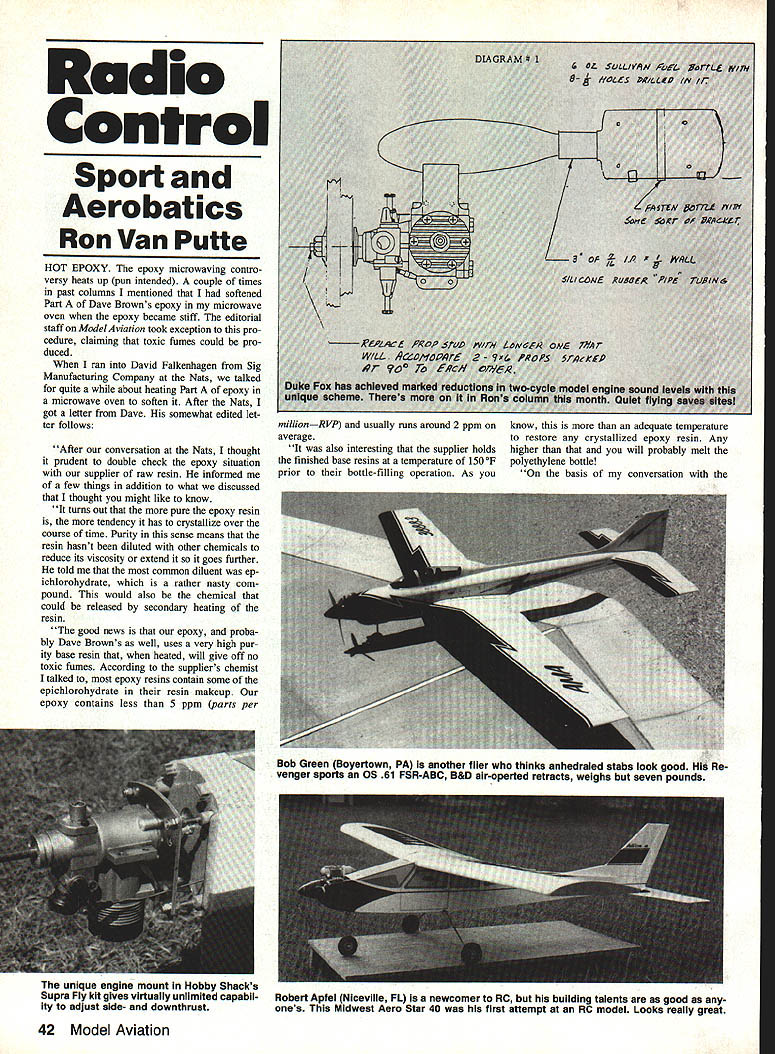
I am happy to report Joe Zingali, Zinger Props, and Chris Macbin, Rev-Up Props, are working on quiet props. Also Du-Bro and Sullivan Products have requested both working aftermuffler kits. Until new-generation aftermufflers and props appear on the market, you may want to try modifying models per Diagram No. 1. I believe the results will surprise you.
This article is the culmination of several months' experiments conducted with the object of producing a substantially quieter running two-cycle engine than is now available. The results hoped for are:
- To come up with a supereffective muffler that could be sold for a profit.
- To make it easy for customers to have quiet-running Fox motors.
We were able to get our Deluxe .40 running so quiet that at a distance of 100 ft there was only a four-decibel rise over a background of 64 decibels, and very little loss of performance. The effective ingredients were the use of two propellers, stacked one in front of the other on the crankshaft, and adding an aftermuffler made from a polycarbonate felt.
After doing the engine rework, the next test gave these results: same head, prop, fuel, and no spring starter; 16,000 rpm. This is with the Cox No. 325 (low-compression) head supplied with the engine and using one gasket washer. The high-compression head added another 450 rpm. The plane now flew quite well. I was able to loop, roll, stall turn, etc. (all positive-G maneuvers). The fuel tank's fuel pickup arrangement prevents inverted flying and negative‑G maneuvers.
After one flight, the engine wouldn't run any more. Some bits of grass had gotten themselves into the engine and were holding the reed valve open. I glued a piece of sponge to the firewall, covering the air inlet, to keep such junk out of the engine.
I should mention that the new Cox snap starter, catalog No. 333, works better than any of its predecessors and only cuts performance about 350 rpm. I used it on Caleb's airplane because it makes starting very simple.
Local flying, parade float, and rural R/C
Looking for some flying buddies, I turned to Mark Gilbert of Fairview, ID, a neighbor. Mark is the guiding member of the Franklin County Radio Controllers and has built up a small hobby shop, as a service to the members, in his father's business, Gilbert's Farm Equipment Sales & Service, on State Street, Fairview, ID. Mark was making up a flatbed trailer fitted out to look like a runway and dressed with all of the RC airplanes that the local RC fliers could assemble. It was quite an assembly.
The float was one of about two dozen in the rodeo parade for three nights and was sent out to show RC aircraft to the public. Caleb's "Upstart II" was added to the display. I think the quantity and variety of models displayed was impressive, considering the size of the village and the short time that the members have been in the hobby. In fact, the parade and the rodeo are pretty impressive, too.
I talked to some members of the PRCA (Professional Rodeo Cowboys Association), and their consensus was that the Famous Preston Night Rodeo is one of the best in the country (besides being the oldest night rodeo in America).
Based on a sample of one, I say that R/C is flourishing in rural America, in spite of the difficulties. But when I think back to the mid‑Thirties, when I believe that I was the only kid in rural Mattituck, NY who built model airplanes, I see that nothing has changed except that most model airplanes are now R/C instead of rubber‑powered free-flight models.
Prop stacking and muffler details
Stacking two propellers in this manner is a little strange in appearance, but it flies your airplane okay and really does make a substantial difference in sound. In an unmuffled or slightly muffled engine, the propeller noise is not noticeable until the muffler becomes reasonably effective. Then the propeller becomes the predominant sound. It is necessary to quiet both the propeller and the exhaust.
No metal muffler by itself that we have tested comes anywhere near the amount of sound reduction which was obtained by our standard muffler with a six-ounce Sullivan polyethylene bottle coupled to the tail. Again, this is a little strange in appearance, but it really does work. We had some tuned‑pipe silicone tubing, 7/16 in. I.D., 1/8 in. wall, by three inches long, that slipped over the exhaust port on the motor and into the six-ounce Sullivan bottle just like that. The fuel bottle that we used had holes drilled in the outside of it fairly evenly spaced. I do doubt that the positioning of these holes had any significance.
In addition, we discovered that the weight of the bottle and the arrangement of the tube apparently prevented the bottle from vibrating sympathetically with the engine — so no droning. The system will not be practical for a serious contest plane unless you can be sure the bottle won't pull out in flight.
Much of the improvement in decibel reduction came from replacing the propeller with two smaller props. You can hear the difference instantly on the ground.
Observations and endorsement
Duke Fox has stuck with the quieting work despite initial controversy and would appreciate increased sales and use of Fox motors. As he says, "The reward that I would most appreciate would be a rush of your club members to buy and fly Fox motors." It's obvious that more than a few serious competitors have already done just that. Almost everyone used Fox engines in Control Line Combat at this year's Nats.
Ron Van Putte 111 Sleepy Oaks Rd. Ft. Walton Beach, FL 32548
Transcribed from original scans by AI. Minor OCR errors may remain.

