
Radio Control: Sport and Aerobatics
Ron Van Putte 111 Sleepy Oaks Rd. Ft. Walton Beach, FL 32548
Do you like to trim out a new airplane? I don't. Rather than have the kind of airplane about which the designer reports, "It flew right off the drawing board," I mostly seem to have the other kind.
As I sat trying to puzzle out what to do to sort out all the idiosyncrasies of my newest airplane, I decided to make all the hassles partly pay for themselves by writing about them in this column. This will not be a complete "how to trim your new airplane" article, but rather an explanation of some things to try in order to get out of our miseries a bit easier.
Nose-heavy handling
The first thing I noticed about this airplane was that it was nose-heavy. I had to use enormous elevator deflections to loop it, so I was ready when I landed it. Sure enough, I ran out of up elevator just before touchdown. This is typical of a nose-heavy airplane. Fortunately the small amount of vertical sink didn't hurt anything.
If you find yourself with an airborne, nose-heavy airplane, try to keep the speed up a bit more than normal; don't drop the throttle all the way to idle until the airplane is a foot or so above the ground. This will reduce the amount of elevator required to flare it until it's close enough to the ground to be able to drop it in without damage.
After lots of tail weight was added (what a strange feeling it is to add tail weight), I was ready for the next flight. When you add tail weight, be careful of how much you add, because a tail-heavy airplane is much more exciting to fly than a nose-heavy one!
Adverse yaw and aileron differential
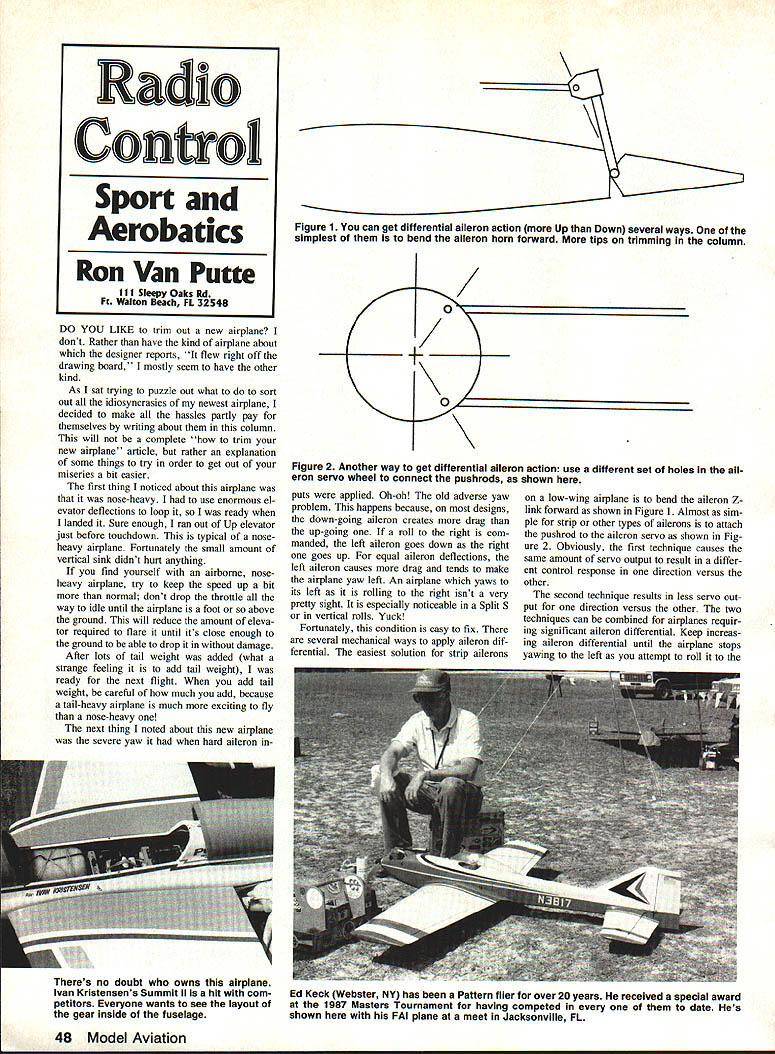
The next thing I noted about this new airplane was the severe yaw it had when hard aileron inputs were applied. The old adverse-yaw problem happens because, on most designs, the down-going aileron creates more drag than the up-going one. If a roll to the right is commanded, the left aileron goes down as the right one goes up. For equal aileron deflections, the left aileron causes more drag and tends to make the airplane yaw left. An airplane which yaws to its left as it is rolling to the right isn't a very pretty sight. It is especially noticeable in a Split S or in vertical rolls.
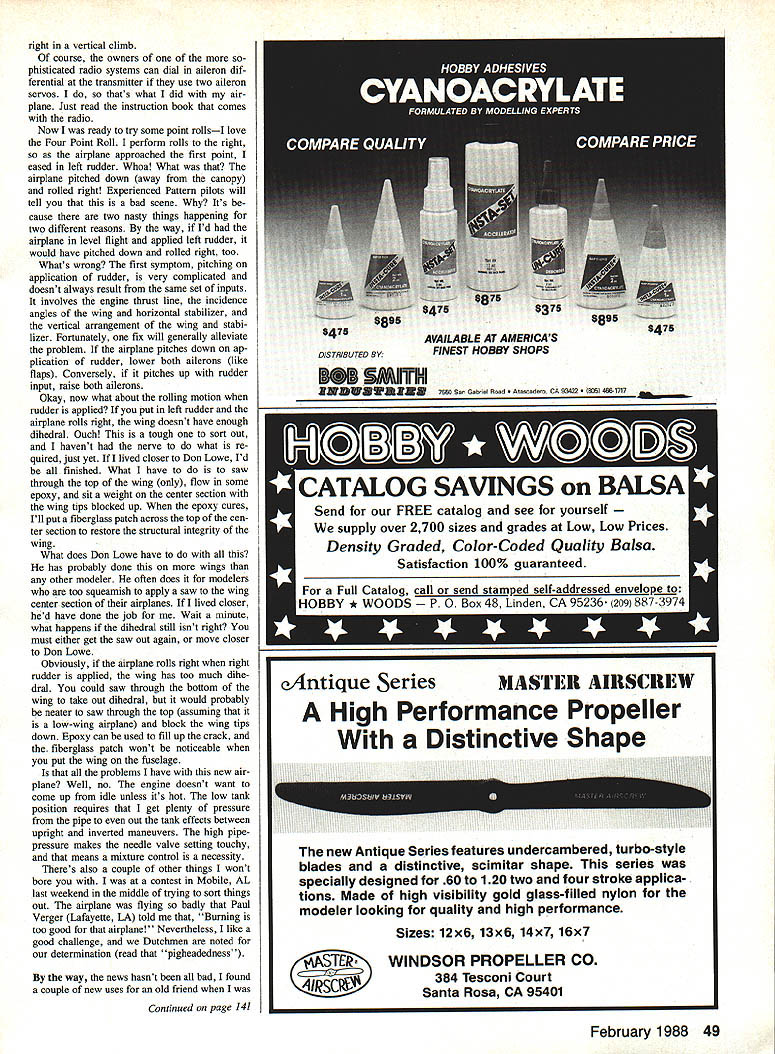
Fortunately, this condition is easy to fix. There are several mechanical ways to apply aileron differential. The easiest solution for strip ailerons on a low-wing airplane is to bend the aileron Z-link forward. Almost as simple for other types of ailerons is to attach the pushrod to the aileron servo off-center. Obviously, the first technique causes the same amount of servo output to result in a different control response in one direction versus the other. The second technique results in less servo output in one direction versus the other. The two techniques can be combined for airplanes requiring significant aileron differential. Keep increasing aileron differential until the airplane stops yawing to the left as you attempt to roll it to the right.
If your radio can dial in aileron differential in the transmitter, use two aileron servos and program the differential—it's an easy solution. Read the instruction book that comes with the radio.
Rudder-induced pitch and rolling on rudder
Now I was ready to try some point rolls. I love the Four-Point Roll. To perform the rolls right, as the airplane approached the first point I eased in left rudder. Whoa! The airplane pitched down (away from the canopy) and rolled right. Experienced Pattern pilots will tell you that's a bad scene. It's caused by two nasty things happening at the same time for two different reasons. By the way, if I'd had the airplane in level flight and applied left rudder, it would have pitched down and rolled right, too.
What's wrong? The first symptom—pitching on application of rudder—is complicated and doesn't always result from the same set of inputs. It involves engine thrust line, the incidence angles of the wing and horizontal stabilizer, and the vertical arrangement of the wing and stabilizer. Fortunately, one fix will generally alleviate the problem: if the airplane pitches down on application of rudder, lower both ailerons (like flaps). Conversely, if it pitches up with rudder input, raise both ailerons.
The rolling motion when rudder is applied is a dihedral issue. If you put in left rudder and the airplane rolls right, the wing doesn't have enough dihedral. This is a tough one to sort out. What I have to do is saw through the top of the wing (only), flow in some epoxy, and sit a weight on the center section with the wing tips blocked up. When the epoxy cures, I'll put a fiberglass patch across the top of the center section to restore the structural integrity of the wing.
What does Don Lowe have to do with all this? He has probably done this on more wings than any other modeler. He often does it for modelers who are too squeamish to apply a saw to the wing center section of their airplanes. If I lived closer, he'd have done the job for me. If the dihedral still isn't right you must either get the saw out again, or move closer to Don Lowe.
Obviously, if the airplane rolls right when right rudder is applied, the wing has too much dihedral. You could saw through the bottom of the wing to take out dihedral, but it would probably be neater to saw through the top (assuming it is a low-wing airplane) and block the wing tips down. Epoxy can be used to fill the crack, and the fiberglass patch won't be noticeable when you put the wing on the fuselage.
Engine and fuel issues
Is that all the problems I have with this new airplane? Well, no. The engine doesn't want to come up from idle unless it's hot. The low tank position requires that I get plenty of pressure from the pipe to overcome the effects between upright and inverted maneuvers. The high pipe pressure makes the needle valve setting too touchy, and that means a mixture control is a necessity.
There's also a couple of other things I won't bore you with. I was at a contest in Mobile, AL last weekend in the middle of trying to sort things out. The airplane was flying so badly that Paul Verger (Lafayette, LA) told me that "Burning is too good for that airplane!" Nevertheless, I like a good challenge, and we Dutchmen are noted for our determination (read that as "pigheadedness").
RC Aerobatics / Van Putte
New uses for R/C 56 glue
By the way, the news hasn't been all bad; I found a couple of new uses for an old friend when I was making this airplane. Years ago I discovered that one of the best ways to glue on a canopy was to use Wilhold R/C 56 glue. Back when everyone put canopies on their airplanes, everyone had extensive techniques to keep the canopy stuck down. When R/C 56 came along, the problem went away.
R/C 56 glue has several very nice features:
- It sticks to many materials.
- It dries clear and flexible.
- It cleans up with water.
I've always glued hinges into my airplanes with Wilhold or TiteBond carpenter's glue. I usually use a paper punch to make holes in the leading edge for the hinge, but some (like Sig) are now sold with holes through them. I fill the hinge slot with glue, "butter" the half of the hinge I'm inserting with more glue, and ease it into the slot, wiping off the excess.
This time I used R/C 56 instead of carpenter's glue because it appears to polymerize when it dries. I don't know what causes the chemical action, but after it dries, it doesn't seem to dissolve in water any longer. When I'd used carpenter's glue earlier, I worried about hinges pulling out when the airplane got wet, although none ever did. The R/C 56 glued the hinges in just fine, and now I don't worry about wet hinges pulling out.
The second new use of R/C 56 solved an old problem for me. I could never get a glue to work well with fiberglass fuselages. I used polyester resins with polyester fuselages and epoxy resins with epoxy fuselages, but nothing provided a secure joint. It seemed that fuselage facing would cure into the polyester/epoxy resins to pop loose from the fuselage. Cyanoacrylates (Jet, Hot Stuff, Zap, etc.) didn't do the job well, either. However, R/C 56 hangs in there like no other adhesive I've tried. I glued servo rails in with R/C 56 and tried to pull them out (short of damaging the fuselage), and they wouldn't budge. Nice stuff.
Transcribed from original scans by AI. Minor OCR errors may remain.

