
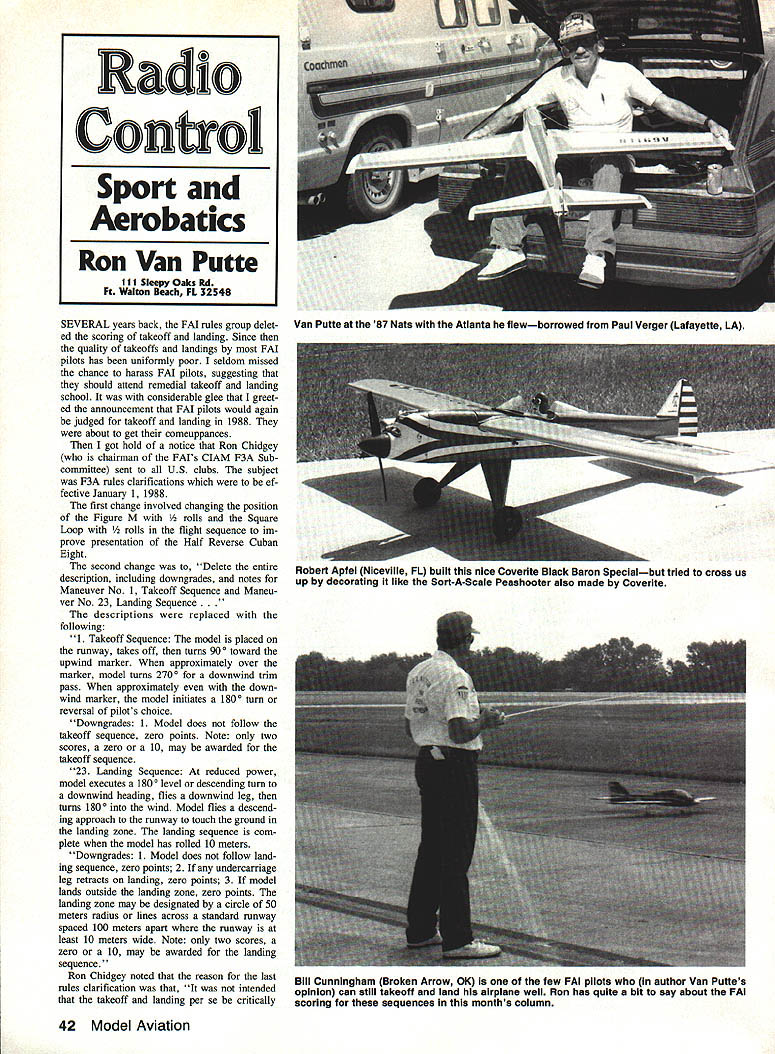

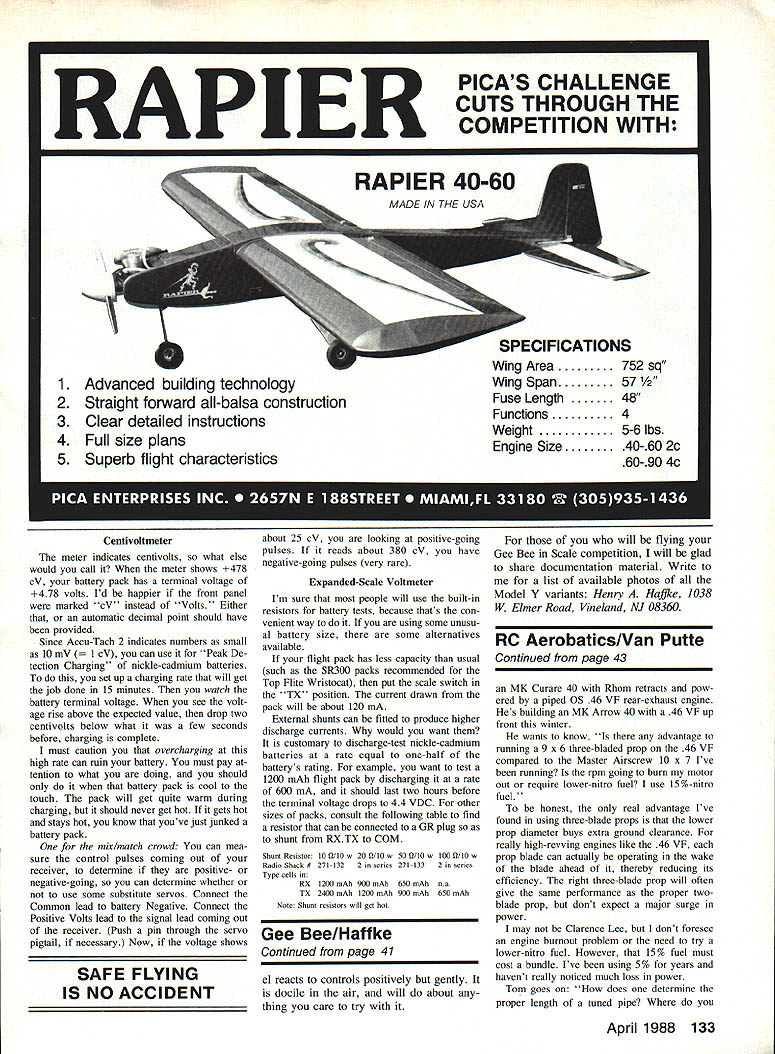
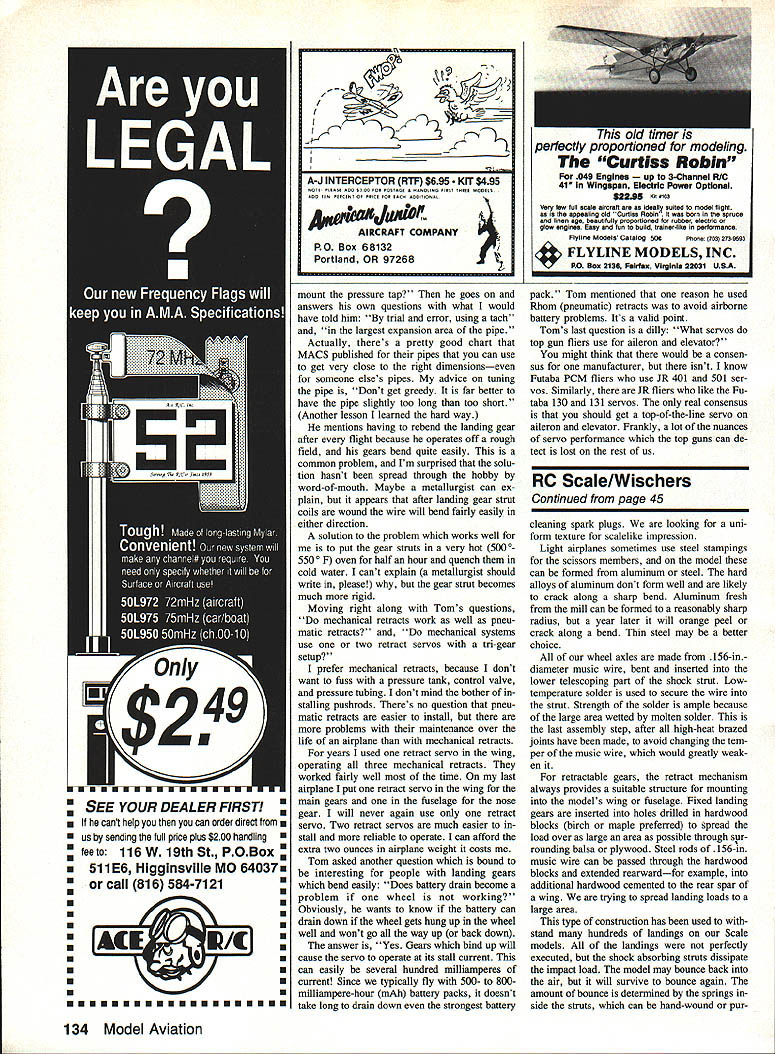
Radio Control: Sport and Aerobatics
Ron Van Putte 111 Sleepy Oaks Rd. Ft. Walton Beach, FL 32548
SEVERAL years back, the FAI rules group deleted scoring for takeoff and landing. Since then the quality of takeoffs and landings by most FAI pilots has been uniformly poor. I seldom missed the chance to harass FAI pilots, suggesting that they should attend remedial takeoff and landing school. It was with considerable glee that I greeted the announcement that FAI pilots would again be judged for takeoff and landing in 1988. They were about to get their comeuppances.
Then I got hold of a notice that Ron Chidgey (chairman of the FAI's CIAM F3A Subcommittee) sent to all U.S. clubs. The subject was F3A rules clarifications, to be effective January 1, 1988.
The first change involved changing the position of the Figure M with 1/2 rolls and the Square Loop with 1/2 rolls in the flight sequence to improve presentation of the Half Reverse Cuban Eight.
The second change deleted the entire description, including downgrades and notes, for Maneuver No. 1, Takeoff Sequence, and Maneuver No. 23, Landing Sequence. The descriptions were replaced with the following.
1. Takeoff Sequence (Maneuver No. 1)
- The model is placed on the runway, takes off, then turns 90° toward the upwind marker. When approximately over the marker, the model turns 270° for a downwind trim pass. When approximately over the downwind marker, the model initiates a 180° turn or reversal at the pilot's choice.
- Downgrades:
- Model does not follow takeoff sequence — zero points.
- Note: Only two scores, a zero or a 10, may be awarded for the takeoff sequence.
23. Landing Sequence (Maneuver No. 23)
- At reduced power, the model executes a 180° level or descending turn to a downwind heading, flies a downwind leg, then turns 180° into the wind. The model flies a descending approach to the runway to touch the ground in the landing zone. The landing sequence is complete when the model has rolled 10 meters.
- Downgrades:
- Model does not follow landing sequence — zero points.
- If an undercarriage leg retracts on landing — zero points.
- If the model lands outside the landing zone — zero points.
- The landing zone may be designated by:
- a circle of 50 meters radius, or
- lines across a standard runway spaced 100 meters apart, where the runway is at least 10 meters wide.
- Note: Only two scores, a zero or a 10, may be awarded for the landing sequence.
Ron Chidgey noted that the reason for this clarification was that "it was not intended that the takeoff and landing per se be critically judged. This new wording will continue to make two-gear undercarriages and grass contest sites viable alternatives."
My initial response to this is not publishable in a family-oriented magazine. The big boys are going to continue with their poor takeoffs and landings, because all they have to do is demonstrate something resembling the two sequences to earn a 10. Consequently, I can't think of a reason for either sequence to be in the book.
The only likely reason a pilot would get a zero for takeoff would be if the engine flamed out — in which case the flight would be over anyway. Similarly, the only likely reason a pilot would get a zero for landing would be if the engine flamed out and he couldn't make the landing zone, or if a gear leg failed. I thought that points were supposed to be awarded for pilot proficiency, not taken away for bad luck. Mysterious are the ways of the international rules gurus.
Mike Lauman's RC Pattern Scoring Software
In the mail came an announcement from Mike Lauman, who handled scoring for the F3A team selection finals (Master's Tournament) and the 1987 Nationals RC Pattern events. He is offering to distribute his RC Pattern scoring software. The package price is $25 and includes a program diskette and user's manual, with complete operating instructions. It supports the 1988–89 AMA and F3A Pattern events.
According to Mike, the partial list of program features includes:
- Up to 500 contestants, flying up to eight rounds, up to nine classes, and up to 24 judges per line.
- Runs on any IBM-compatible PC under PC-DOS or MS-DOS; requires a minimum of 256K RAM.
- Can run a small contest on one 360K floppy drive and a large one on two 360K drives. A hard disk is recommended for optimum performance.
- Completely menu-driven with self-explanatory, user-friendly screens — no need to be a computer person to operate the system.
- Streamlined data entry with full-screen editing capability. Each raw score is entered with only two keystrokes, including half-point scores. An optional audit trail can be printed for each flier.
- Handles "freeform" events such as Masters class easily; allows changing the maneuver schedule at any time during the contest.
- All data is stored on disk as it is entered, so power outages have minimal effect.
- Prints score sheets, registration forms, mailing labels, and contestant listings sorted by name, class, frequency, AMA number, or flight order.
- Prints current standings at any time showing each round score and combined total or average, ranked from highest to lowest final score.
Mike also describes scoring options including:
- dropping high and/or low judge scores (by maneuver or by flight),
- dropping high and/or low round scores,
- normalizing.
He will maintain a list of all purchasers and keep them informed of new releases, bug fixes, and other program activity.
If you're interested, send a $25 check or money order to:
- Mike Lauman
150 Plumb Tree Rd. Brandon, MS 39042
- Night phone: (601) 992-1900.
He invites anyone to call or write for more information.
Letter from Tom Young (Lakeville, MN) — "A Search of Many Answers"
Tom is back in RC after kids slowed his flying time to almost nothing. He signed his letter "A Search of Many Answers." Some excerpts from his letter and my answers follow.
Tuning the pipe / pressure tap question
Tom asked about mounting the pressure tap and tuning the exhaust (pipe). The practical answer is: tune by trial and error using a tach, and tune around the largest expansion area of the pipe. There is a good chart that MACS published for their pipes that will get you very close to the right dimensions — even for someone else's pipe. My main advice: don't get greedy. It is far better to have the pipe slightly too long than too short. (A lesson I learned the hard way.)
Landing gear that bends easily
Tom mentioned having to rebend the landing gear after every flight because he operates off a rough field and the gear bends easily. This is common. It appears that after landing gear strut coils are wound, the wire will bend fairly easily in either direction.
A solution that works well for us:
- Put the gear struts in a very hot oven (500°–550°F) for about half an hour, then quench them in cold water.
This heat treatment makes the gear strut much more rigid. I can't fully explain why (a metallurgist should write in), but it consistently improves stiffness.
Mechanical vs pneumatic retracts; number of retract servos
Tom asked, "Do mechanical retracts work as well as pneumatic retracts?" and "Do mechanical systems use one or two retract servos with a tri-gear setup?"
My preference is mechanical retracts — I don't want to fuss with a pressure tank, control valve, and pressure tubing. Mechanical retracts require pushrods and installation effort, but over the life of an airplane they tend to have fewer maintenance problems than pneumatics.
For years I used one retract servo in the wing operating all three mechanical retracts. They worked fairly well most of the time. On my last airplane I used one retract servo in the wing for the main gears and one in the fuselage for the nose gear. I will never again use only one retract servo. Two retract servos are much easier to install and more reliable to operate. I can afford the extra two ounces in airplane weight that they cost.
Battery drain when a wheel binds
Tom asked whether battery drain becomes a problem if a wheel gets hung up and the servo stalls in the wheel well. The answer is yes. Gears that bind will cause the servo to operate at its stall current, which can be several hundred milliamperes. Since typical flight battery packs are 500–800 mAh, it doesn't take long to significantly drain the pack. One reason some pilots use pneumatic retracts (e.g., Rhom) is to avoid airborne battery problems — a valid point.
What servos to use for aileron and elevator
Tom's last question: "What servos do you use for aileron and elevator?"
There is no universal consensus on a single manufacturer. I know Futaba PCM fliers who use JR 401 and 501 servos, and JR fliers who like the Futaba 130 and 131 servos. The only real consensus is this:
- Use top-of-the-line servos on aileron and elevator.
Many of the nuanced performance differences that top competitors detect are lost on the rest of us, but a high-quality servo on the primary control surfaces is essential.
Transcribed from original scans by AI. Minor OCR errors may remain.

