
Radio Control: Sport and Aerobatics
Ron Van Putte
Exponential Controls — Overview
While competing at the Nats, another contestant asked how I was able to perform such square corners on the Square Loop and the Top Hat without having jerky straight portions. I told him my secret: I use exponential on the elevator. The adjustment isn't difficult, but it takes a little time — usually about three to four flights. Getting a square corner isn't tough since it takes a lot of elevator throw. The trick is achieving a soft neutral so the vertical and horizontal pieces of the maneuver are straight and smooth.
After adjusting the total throw and the exponential to get sharp corners with straight, smooth sides, I tried it out on a complete flight. I was surprised: many maneuvers improved, most of the rest were unaffected, and only one maneuver caused a problem — Three Outside Loops. The exponential would "kick in" as the airplane passed the bottom of the loop, causing the airplane to pitch down and tighten the outside loop abruptly. I solved that by switching off the elevator exponential for Three Outside Loops. So now I use exponential elevator on everything except Three Outside Loops, and my flying has improved.
Aileron
Elevator wasn't the first place I tried exponential — aileron was. I'm a nervous flier and constantly move the stick a little bit. My loops looked ragged because my aileron corrections made them worse. A friend suggested trying low-rate aileron in loops; it worked. Then I thought about the Cuban Eight and Double Immelmann — both have loop segments that benefit from a soft neutral on aileron but also require high-rate rolls. Low-rate aileron made rolls too slow, so I tried exponential aileron. It worked: I now have a soft neutral around center but can still get high roll rates when needed.
To set up aileron exponential:
- Adjust maximum throw to give three rolls in five seconds.
- Adjust the dual-rate control to give the right amount of control authority around neutral.
I fly all Expert-class maneuvers using exponential aileron. I do use a slow-roll switch for Slow Roll.
Rudder
Yes, I use exponential rudder — but only for takeoff. Exponential on rudder gives soft steering commands on the ground without sacrificing good steering authority while taxiing. After takeoff I switch to high-rate rudder, because I found high-rate better than exponential for most maneuvers requiring rudder, especially point rolls.
Practical Notes on Transitioning Controls
- Transitioning to exponential controls is straightforward but may take several flights to fine-tune.
- Use exponential where a soft neutral helps precision and switch it out when abrupt or full-authority responses are required for specific maneuvers.
Competition Anecdotes
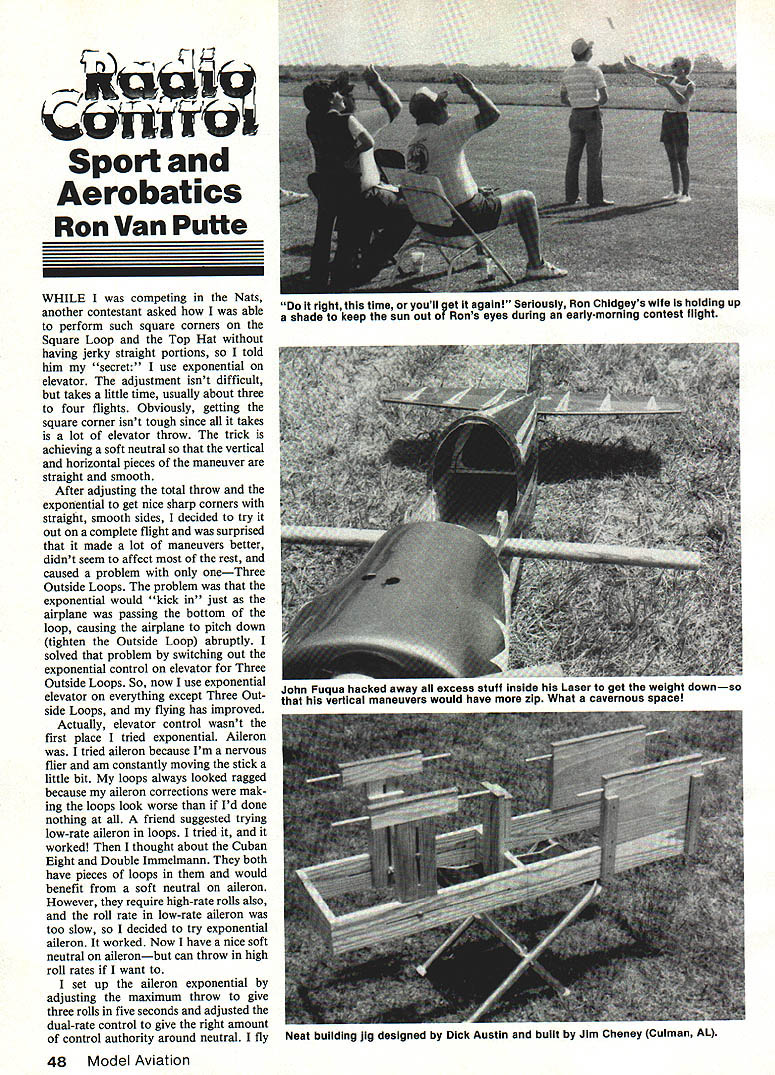
All the transition to exponential controls was done on a Tiporare I'd just acquired from fellow Eglin Aero Modeller John Fuqua. Up until then I'd been competing with airplanes I'd built. My flying improved dramatically and everyone credited the airplane. Ron Chidgey even told me, "All these years I thought you were a lousy flier, but you're not. You're a good flier — but a lousy builder!"
We'll see whether my building or the exponential controls were the real secret: the Tiporare was the one I "stuffed" at the Nats due to radio interference. I'm now building another Tiporare to take its place and plan to compete with it using exponential controls.
Repairing Fiberglass Fuselages
Most of you don't know it, but I acquired a reputation for repairing damaged airplanes after an article I wrote for a club newsletter was republished in R/C Modeler many years ago. The article described how to repair crash damage and pointed out that it is often faster to repair a crashed airplane than to build a new one from scratch. That article has become outdated because airplane construction, materials, and adhesives have advanced significantly. Foam wings, widespread use of fiberglass fuselages, cyanoacrylate (CyA) adhesives, and fast-cure epoxies have changed repair techniques. In some ways crash repair is easier now; in other ways it has become more difficult.
One real challenge is repairing fiberglass fuselages. I'm not talking about fuselages that are shattered into many small pieces. As long as the fuselage is reasonably intact or in two or three large pieces, there's a good chance it can be repaired.
Preparation and Cleaning
The first and most important part of the repair is thorough cleaning. The fuselage must be very clean or the repair will not be mechanically sound.
- I usually use K&B Superpoxy thinner because it cleans up almost everything.
- Alcohol and lacquer thinner do a reasonable job but are not as effective as the K&B thinner.
- A simple test for oil or contamination: see how well a piece of masking tape will stick. Masking tape won't adhere well if there's even a minute trace of oil.
Before starting the actual repair, stand back and examine the damage. Sometimes the repair is easier if done in a particular order. Practice fitting pieces together to determine the best sequence.
Fitting and Trimming
- Many break edges will have fuzzy or ragged material that won't mate cleanly. Trim these away until the remaining edges can be pushed together with little or no gap.
- Look for places to "key" the repair — for example, strips in the paint job or panel lines that will help align and index the pieces.
Tack-Glue and Alignment
- Tack-glue small sections with CyA to hold alignment.
- If there are small steps between two pieces, use your fingers on the inside and outside of the fuselage to align them before tack-gluing.
- Work your way around the repair, tack-gluing and reducing the distance between tack points until everything is glued back together.
- If pieces are missing, accept that at this stage; they will be filled in later.
Final Prep Before Patching
- Sand the inside of the fuselage on each side of the repaired area to give the patch something to bond to.
- Wipe the fuselage inside and out with solvent to remove dust and finger oils.
- Put masking tape on the outside of the fuselage across the repaired areas. I use pieces about five inches long. Stick down one end, pull it tight across the break, stick down the other end, and then thoroughly smooth the tape.
(End of available text.)
Transcribed from original scans by AI. Minor OCR errors may remain.

