
Radio Control: Sport and Aerobatics
Ron Van Putte 111 Sleepy Oaks Rd. Ft. Walton Beach, FL 32548
Introduction
Periodically I read aircraft-design articles about preventing control-surface flutter. Many of the suggested remedies are good ideas that delay the onset of the phenomenon, but few actually prevent it. Before discussing cures, a few points need to be clarified.
Flutter vs. control-surface buzz
- In the classical sense, what modelers usually call control-surface "flutter" is not classical flutter but control-surface buzz.
- Flutter engineers reserve "flutter" for oscillatory, self-sustaining motion that involves interaction of two or more modes of component motion (for example, bending and torsion interacting). Control-surface buzz involves only one mode of motion.
- The distinction matters to engineers because the mechanisms differ. Modelers seldom observe classical flutter, so the distinction is often ignored in practice.
Classical flutter is inherently destructive. At the flutter speed, components bend and/or twist in sustained oscillations whose amplitudes neither decrease nor increase. Once the flutter speed is exceeded, oscillations grow until something breaks or the structure changes. (Many modern fighters must be loaded with external stores very carefully because of this.)
I have observed only one case of true model flutter: an early Senior Falcon with a wing that was too flexible in bending and torsion. In a near-vertical dive the aircraft went into wing bending/torsion flutter and the right wing separated where the wing sheeting ended. The airplane did not fly well afterward.
What causes control-surface buzz (model "flutter")
Control-surface buzz involves oscillatory rotation of an aileron or elevator and is caused by how the surface is hinged and actuated:
- Hinges are usually at the front of the surface, so the surface center of mass lies behind the hinge line.
- Surfaces are often moved via a torque rod that enters the inboard end of the surface.
That combination—mass aft of the hinge and inboard torque input—creates a speed at which the surface will start to buzz. If that flutter speed is higher than the airplane can reach, you will never see the problem.
Common fixes and how they work
Two common prevention techniques work on opposite parts of the problem:
- Seal the gap between the control surface and the wing or horizontal stabilizer.
- This attacks the aerodynamic driver of the buzz and raises the speed at which it occurs.
- Stiffen the control-surface torque rod.
- This raises the natural frequency of the surface rotation and pushes the buzz-speed higher.
If those don't eliminate the problem, other corrective options include:
- Replace the control surface with one having a thicker leading edge (relative to the trailing edge) where it attaches to the wing or horizontal tail.
- Make the trailing edge of the control surface more blunt.
- Both changes tend to increase the speed at which buzz occurs.
Static balancing — the near cure-all
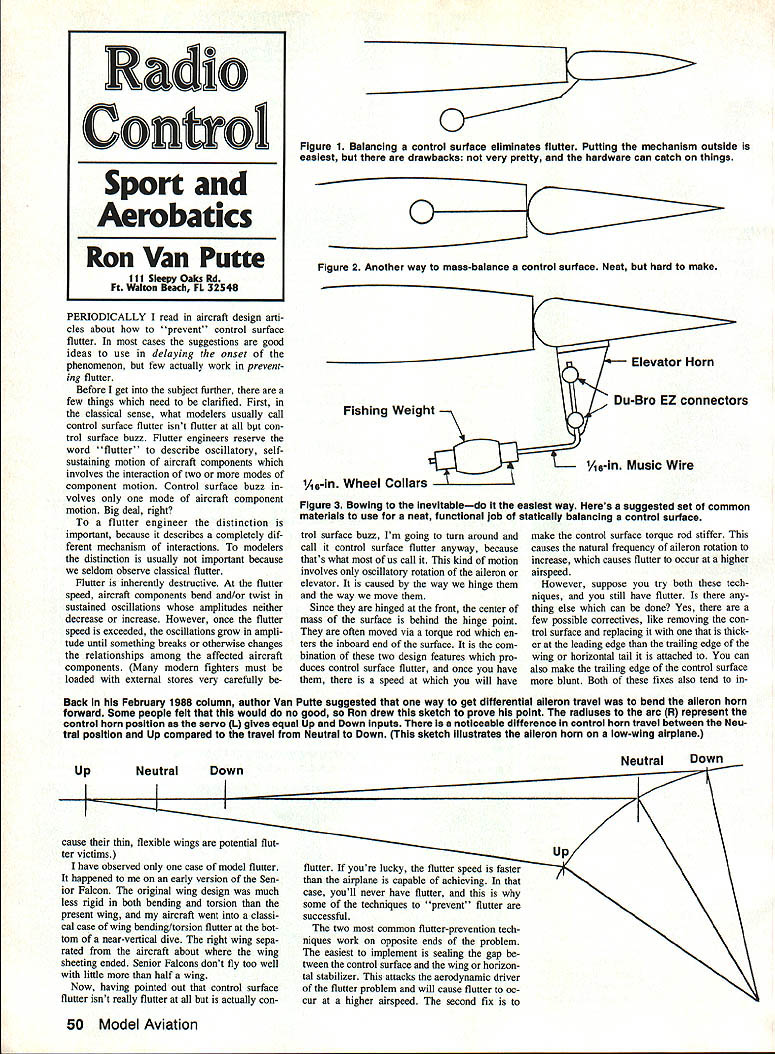
Static balancing usually works most of the time. The goal is to move the control-surface center of mass just forward of the hinge line. If successful, the tendency for the surface to oscillate about the hinge is greatly reduced.
Ways to achieve static balance:
- Internal weights near the leading edge (put mass forward on the surface).
- External mass balances extending ahead of the hinge line or adding mass to the control horn forward of the hinge.
Tradeoffs:
- External balances are easier to fit and adjust but can be unsightly and can catch on things.
- Internal balances are neater but harder to install.
Installation notes and cautions:
- Before adjusting, disconnect the servo linkage so the surface can move freely.
- Ensure hinges are free so the surface will flop down when released if no balance weights are used.
- Adjust the balance weight so the surface just barely moves up when released in the neutral position.
- Do not over-balance elevators: an overly balanced elevator can move up in positive-G maneuvers (like loops), which increases G, which moves the elevator up more, and can create an escalating problem.
I have seen neat static-balance installations hidden inside wings (see Figure 2). Figure 3 shows a straightforward way to balance a control surface using common materials; it is recommended for ease of installation, structural integrity, and the ability to change weights.
Aileron differential — high-wing vs low-wing
Following my February 1988 column on aileron differential, I received letters asking whether the techniques described were for high-wing or low-wing airplanes.
- For a low-wing airplane:
- Bend the aileron torque arms forward, or
- Attach the pushrods to the aileron servo wheel on the aileron side of the wheel.
- For a high-wing airplane, reverse both techniques:
- Bend the aileron torque arms back, and
- Attach the pushrods to the aileron servo wheel on the side opposite the ailerons.
Figure 4 illustrates what happens if servo output is equal in both directions for a low-wing airplane: there is more Up than Down. Using both techniques produces even more differential.
Anecdote — L.R. Taylor Power Pacer repair
I recently visited Hughes Aircraft in Canoga Park and took my L.R. Taylor Power Pacer in for repair. I had accidentally plugged a transmitter pack into the receiver leads while testing, which disabled the receiver. L.R. Taylor (20831 Roscoe Blvd., Canoga Park, CA 91306) repaired and recalibrated the Power Pacer quickly. The owner and I had a long chat while the repair was completed.
A note about availability: some dealers had Power Pacers on long back order because they had not actually placed orders with L.R. Taylor. L.R. Taylor is still in business—you just have to go to a source that actually orders from them.
Summary
- What modelers call control-surface "flutter" is usually control-surface buzz, a single-mode oscillation distinct from classical flutter.
- Gap sealing and stiffer torque rods are simple, effective first steps.
- Surface shape changes (thicker leading edge or blunt trailing edge) also help.
- Static balancing—moving the surface center of mass slightly ahead of the hinge line—is the most generally effective cure.
- Take care when balancing elevators to avoid over-balance and unintended flight-load amplification.
Transcribed from original scans by AI. Minor OCR errors may remain.

