
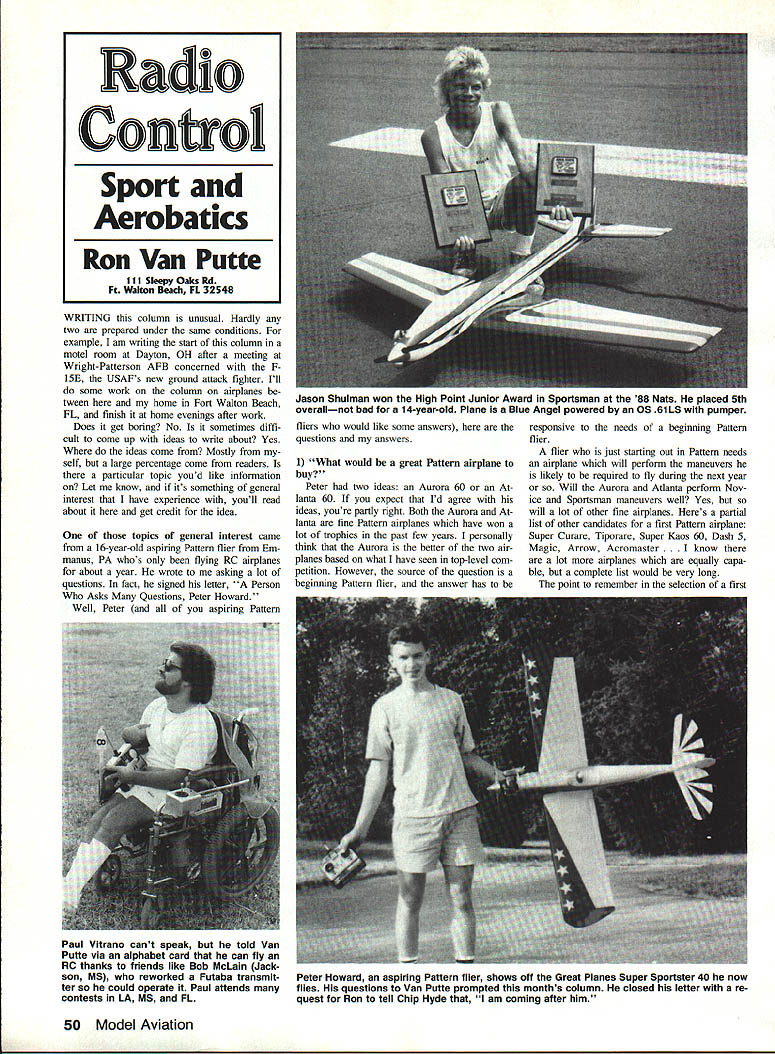
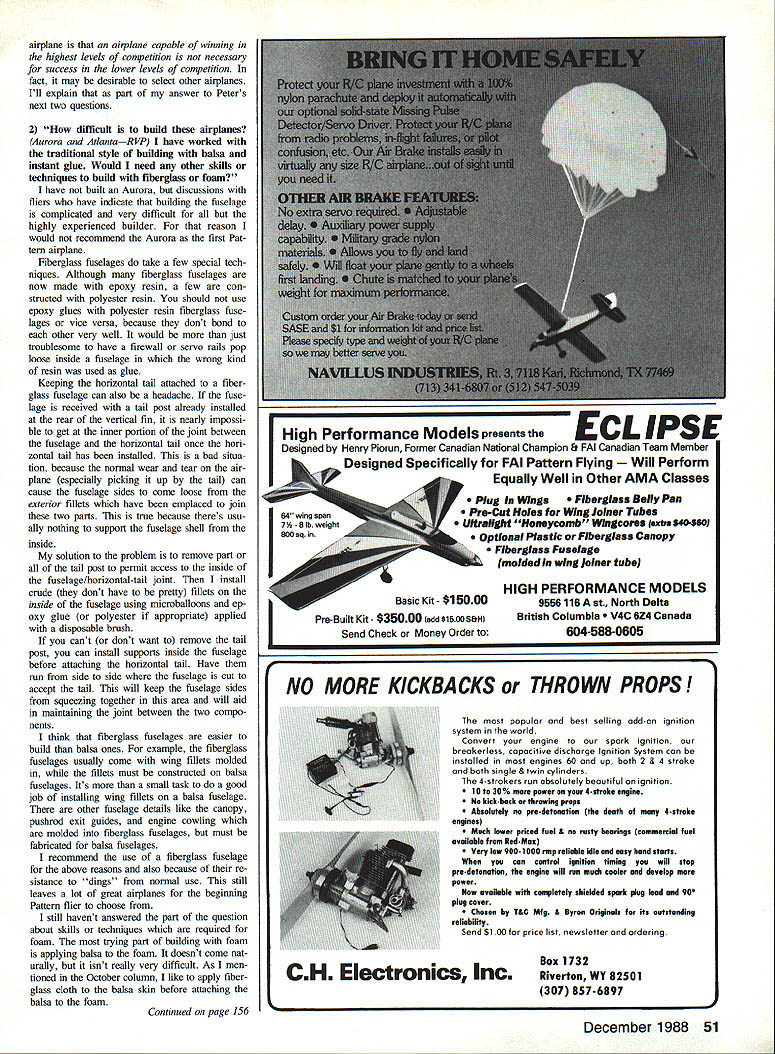
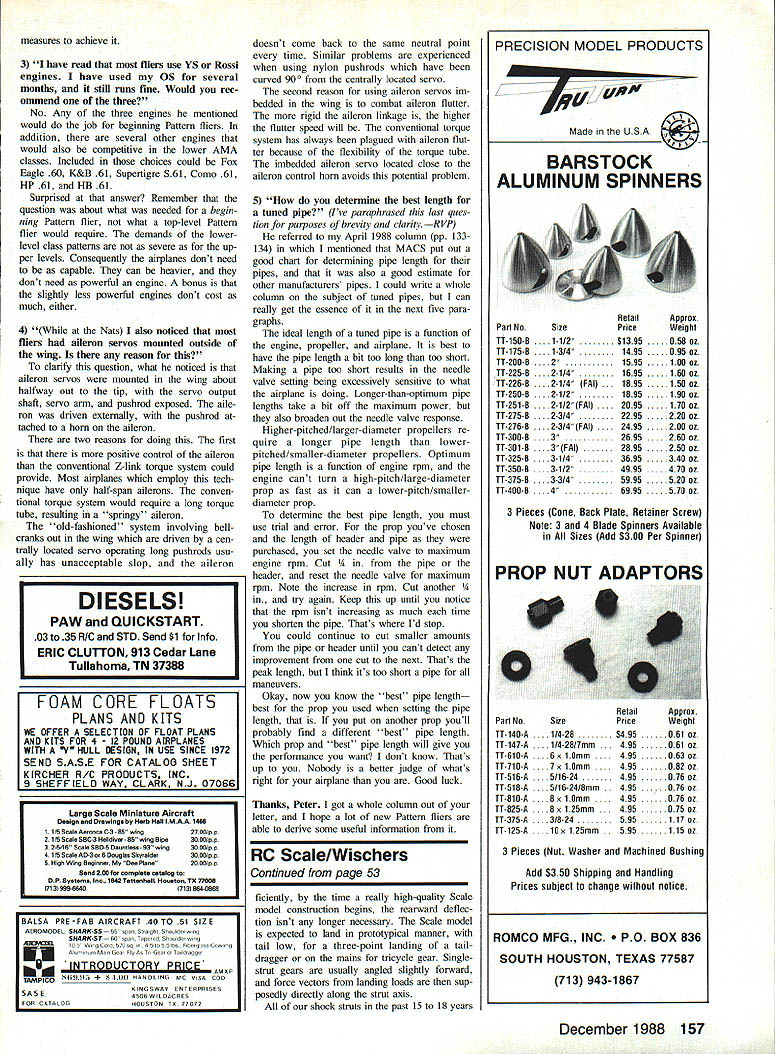
Radio Control: Sport and Aerobatics
Ron Van Putte 111 Sleepy Oaks Rd. Ft. Walton Beach, FL 32548
Writing this column is unusual. Hardly any two are prepared under the same conditions. For example, I am writing the start of this column in a motel room in Dayton, OH, after a meeting at Wright-Patterson AFB concerned with the F-15E, the USAF's new ground-attack fighter. I'll do some work on the column on airplanes between here and my home in Fort Walton Beach, FL, and finish it at home in the evenings after work. Does it get boring? No. Is it sometimes difficult to come up with ideas to write about? Yes. Where do the ideas come from? Mostly from myself, but a large percentage come from readers. Is there a particular topic you'd like information on? Let me know, and if it's something of general interest that I have experience with, you'll read about it here and get credit for the idea.
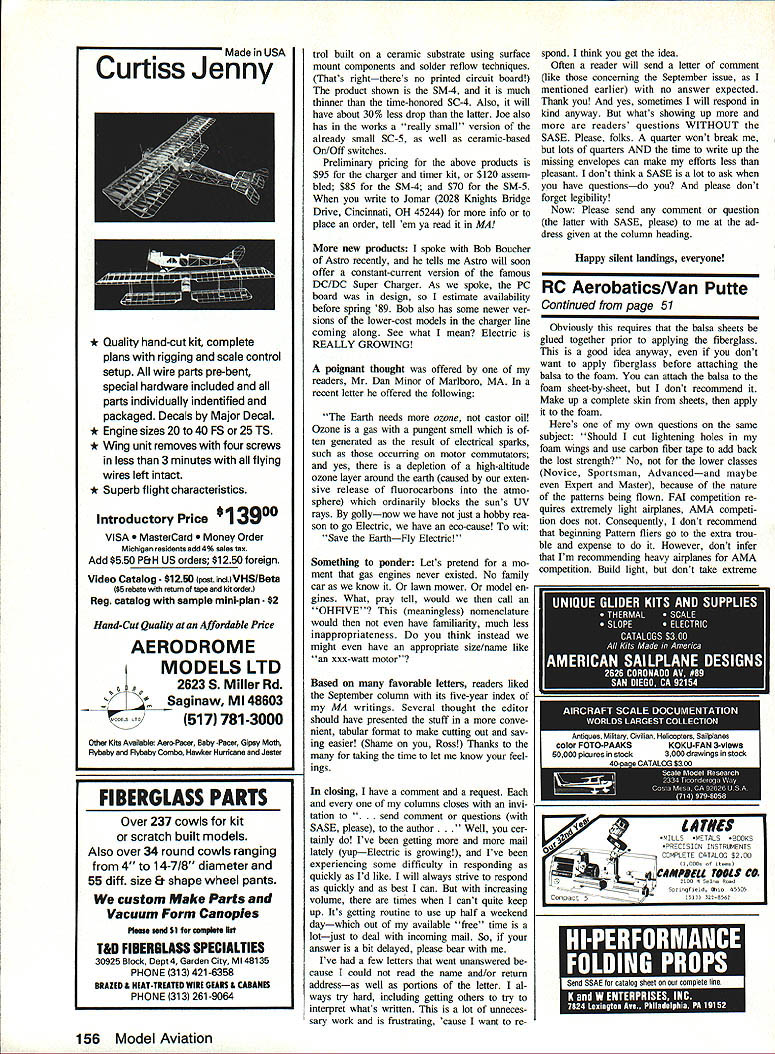
One of those topics of general interest came from a 16-year-old aspiring Pattern flier from Emmaus, PA, who's only been flying RC airplanes for about a year. He wrote to me asking a lot of questions. In fact, he signed his letter, "A Person Who Asks Many Questions, Peter Howard."
Well, Peter (and all of you aspiring Pattern fliers who would like some answers), here are the questions and my answers.
1. What would be a great Pattern airplane to buy?
Peter had two ideas: an Aurora 60 or an Atlanta 60. Both the Aurora and Atlanta are fine Pattern airplanes which have won a lot of trophies in the past few years. I personally think the Aurora is the better of the two airplanes based on what I have seen in top-level competition. However, the question comes from a beginning Pattern flier, and the answer must be responsive to a beginner's needs.
A flier who is just starting out in Pattern needs an airplane which will perform the maneuvers he is likely to be required to fly during the next year or so. Will the Aurora and Atlanta perform Novice and Sportsman maneuvers well? Yes, but so will many other fine airplanes. Here is a partial list of other candidates for a first Pattern airplane:
- Super Curare
- Tiporare
- Super Kaos 60
- Dash 5
- Magic Arrow
- Acromaster
I know there are many more equally capable airplanes, but a complete list would be very long. The point to remember in the selection of a first Pattern airplane is to choose one that suits your current skill level and will perform the required maneuvers reliably and predictably.
2. How difficult are airplanes like the Aurora and Atlanta to build?
I have worked in the traditional style of building with balsa and CA (instant) glues. Fiberglass and foam construction require other skills and techniques. I have built Auroras; discussions with fliers indicate the fuselage is complicated but not terribly difficult if you are a highly experienced builder. For that reason I would not recommend the Aurora as a first Pattern airplane.
Fiberglass fuselages are made with epoxy resin; a few are constructed with polyester resin. You should not use epoxy glues on polyester-resin fiberglass fuselages, or vice versa, because they don't bond very well and you'll have trouble with the firewall or servo rails popping loose inside the fuselage if the wrong kind of resin was used. Keeping the horizontal tail attached to a fiberglass fuselage can also be a headache. If the fuselage received the tail post already installed, the rear vertical fin makes it nearly impossible to get into the inner portion of the joint between fuselage and horizontal tail once the horizontal tail has been installed. This is a bad situation because normal wear and tear on an airplane, especially picking up the tail, can cause the fuselage sides to come loose from the exterior fillets that join the two parts. This is true because there is usually nothing to support the fuselage shell inside.
The solution is to remove the tail post to permit access inside the fuselage/horizontal-tail joint and install internal fillets using microballoons and epoxy. If you don't want to remove the tail post, you can install supports inside the fuselage before attaching the horizontal tail. I have cut the side of the fuselage to accept the tail which will keep fuselage sides from squeezing together in this area and will aid in maintaining the joint between the two components.
I think that fiberglass fuselages are easier to build than balsa ones. For example, fiberglass fuselages usually come with the wing fillets molded in, while the fillets must be constructed on balsa fuselages. It is more than a small task to do a good job of installing wing fillets on a balsa fuselage. There are other fuselage details—canopy, pushrod exit guides, and engine cowling—which are molded into fiberglass fuselages but must be fabricated for balsa fuselages.
I recommend the use of a fiberglass fuselage for the above reasons and also because of their resistance to dings from normal use. This still leaves a lot of great airplanes for the beginning Pattern flier to choose from.
Regarding foam construction, the most trying part is applying balsa to the foam. It doesn't come naturally, but it isn't really very difficult. As I mentioned in the October column, I like to apply fiberglass cloth to the balsa skin before attaching the balsa to the foam.
Obviously this requires that the balsa sheets be glued together prior to applying the fiberglass. This is a good idea anyway, even if you don't want to apply fiberglass before attaching the balsa to the foam. You can attach the balsa to the foam sheet-by-sheet, but I don't recommend it. Make up a complete skin from sheets, then apply it to the foam.
Here's one of my own questions on the same subject: "Should I cut lightening holes in my boom wings and use carbon fiber tape to add back the lost strength?" No, not for the lower classes (Novice, Sportsman, Advanced—and maybe even Expert and Master), because of the nature of the patterns being flown. FAI competition requires extremely light airplanes. AMA competition does not. Consequently, I don't recommend that beginning Pattern fliers go to the extreme and try to save weight so early. Do not use carbon fiber strips for AMA pattern models.
3. I have read that most fliers use YS or Rossi engines. I have used my OS for several months, and it still runs fine. Would you recommend one of the three?
No. Any of the three engines mentioned (YS, Rossi, OS) would do the job for beginning Pattern fliers. In addition, there are several other engines that would also be competitive in the lower AMA classes. Included in those choices could be:
- Fox Eagle .60
- K & B .61
- Super Tigre .61
- Como .61
- HR .61
- HB .61
Surprised at that answer? Remember that the question was about what was needed for a beginning Pattern flier, not what a top-level Pattern flier would require. The demands of the lower-level class patterns are not as severe as for the upper levels. Consequently, the airplanes don't need to be as capable, they can be heavier, and they don't need as powerful an engine. A bonus is that the slightly less powerful engines don't cost as much, either.
4. I noticed that most fliers had aileron servos mounted outside of the wing. Is there any reason for this?
To clarify, what he noticed was that aileron servos were mounted in the wing about halfway out to the tip, with the servo output shaft, servo arm, and pushrod exposed. The aileron was driven externally, with the pushrod attached to a horn on the aileron.
There are two reasons for doing this:
- More positive control. Most airplanes which employ this technique have only half-span ailerons. The conventional Z-link torque system would require a long torque tube, resulting in a "springy" aileron. The old-fashioned system involving bellcranks out in the wing driven by a centrally located servo operating long pushrods usually has unacceptable slop, and the aileron doesn't come back to the same neutral point every time. Similar problems are experienced when using nylon pushrods which have been curved 90° from a centrally located servo.
- To combat aileron flutter. The more rigid the aileron linkage, the higher the flutter speed will be. The conventional torque system has always been plagued with aileron flutter because of the flexibility of the torque tube. The embedded aileron servo located close to the aileron control horn avoids this potential problem.
5. How do you determine the best length for a tuned pipe?
(I've paraphrased this last question for purposes of brevity and clarity.)
I referred to my April 1988 column in which I mentioned that MACS put out a good chart for determining pipe length for their pipes, and that it was also a good estimate for other manufacturers' pipes. I could write a whole column on tuned pipes, but I can get the essence across in the next few paragraphs.
The ideal length of a tuned pipe is a function of the engine, propeller, and airplane. It is better to make the pipe a bit too long than too short. Making a pipe too short results in the needle-valve setting being excessively sensitive to what the airplane is doing. Longer-than-optimum pipes lengthen the rpm a bit off the maximum power, but they also broaden out the needle-valve response.
Higher-pitched/larger-diameter propellers generally require a longer pipe length than lower-pitched/smaller-diameter propellers. Optimum pipe length is related to engine rpm, and the engine can't turn a high-pitch/large-diameter prop as fast as it can a lower-pitch/smaller prop.
To determine the best pipe length, you must use trial and error:
- For the prop you've chosen, cut the header and pipe as they were purchased, and set the needle valve for maximum rpm.
- Cut 1/4" to 1/2" from the pipe or the header, and reset the needle for maximum rpm. Note the increase in rpm.
- Cut another 1/4" and try again. Keep this up until you notice that the rpm isn't increasing as much each time you shorten the pipe. That's where I'd stop.
You could continue to cut smaller amounts from the pipe or header until you can't detect any improvement from one cut to the next. That's the peak length, but I think it's too short a pipe for all maneuvers.
Now you know the "best" pipe length—best for the prop you used when setting the pipe length. If you put on another prop you'll probably find a different "best" pipe length. Which prop and "best" pipe length will give you the performance you want? I don't know. That's up to you. Nobody is a better judge of what's right for your airplane than you are. Good luck.
Thanks, Peter. I got a whole column out of your letter, and I hope a lot of new Pattern fliers are able to derive some useful information from it.
Transcribed from original scans by AI. Minor OCR errors may remain.

